



| HEADLINE |

|
Parliament passes Finance Bill
Published : Tuesday, 30 June, 2026 at 12:00 AM
Business Correspondent


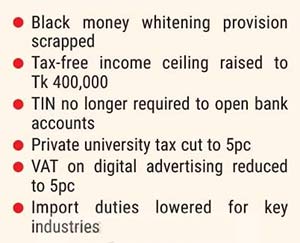 Parliament on Monday passed the Finance Bill 2026, introducing a series of major changes to the country's tax regime, including the abolition of the provision allowing undisclosed wealth (black money whitening) to be legalised, raising the tax-free income threshold to Tk 400,000 and removing the requirement for a Taxpayer Identification Number (TIN) to open bank accounts.
The bill was passed by voice vote during the afternoon sitting of the House after Finance Minister placed it for approval. He had originally tabled the bill during the budget session on June 11.
Before its passage, Prime Minister Tarique Rahman proposed several amendments, including increasing the tax-free income threshold from the proposed Tk 375,000 to Tk 400,000. Parliament approved the amendment, allowing individuals to earn up to Tk 400,000 annually tax-free in the 2026-27 fiscal year.
The amended bill also withdraws the requirement to submit a TIN for opening bank accounts as well as for land and apartment deed registration, transfer deeds and mutation within city corporations and municipalities.
Another significant amendment removes the advance tax on the sale of goods by retail traders, a move expected to provide relief to small businesses.
The bill also drops a proposed mechanism to narrow the gap between market prices and official mouza values for land registration following criticism that it could facilitate the legalisation of undisclosed wealth.
Among other changes, the income tax rate for private universities has been reduced from the proposed 10 per cent to 5 per cent, while VAT on advertisements placed through online video platforms, social media and search engines has been cut from 15 per cent to 5 per cent.
A revised VAT structure has been introduced for jewellery made of gold, silver, platinum and diamonds, alongside a 0.5 per cent withholding tax on purchases of such jewellery.
VAT exemptions have also been restored on fish supplies at the supplier level and on revenue-sharing payments made to the telecommunications regulator. In addition, customs duties and taxes have been reduced or waived on imported raw materials for sectors including shrimp processing, pharmaceuticals, electrical wires, PVC and PET resins, refined copper and fire safety equipment.
Loading...
Loading...
Also read



Editor : Iqbal Sobhan Chowdhury
Published by the Editor on behalf of the Observer Ltd. from Globe Printers, 24/A, New Eskaton Road, Ramna, Dhaka.
Editorial, News and Commercial Offices : Aziz Bhaban (2nd floor), 93, Motijheel C/A, Dhaka-1000.
Phone: PABX- 41053001-06; Advertisement: 41053012; 01793317829, 01550707291, E-mail: [email protected], [email protected] Online: email: [email protected] 41053014; 01550707297 Advertisement: 01550707296
Published by the Editor on behalf of the Observer Ltd. from Globe Printers, 24/A, New Eskaton Road, Ramna, Dhaka.
Editorial, News and Commercial Offices : Aziz Bhaban (2nd floor), 93, Motijheel C/A, Dhaka-1000.
Phone: PABX- 41053001-06; Advertisement: 41053012; 01793317829, 01550707291, E-mail: [email protected], [email protected] Online: email: [email protected] 41053014; 01550707297 Advertisement: 01550707296


