



| HEADLINE |

|
Women face persistent barriers to political leadership despite progress: Study
Published : Saturday, 4 July, 2026 at 12:00 AM
Women's Own Desk


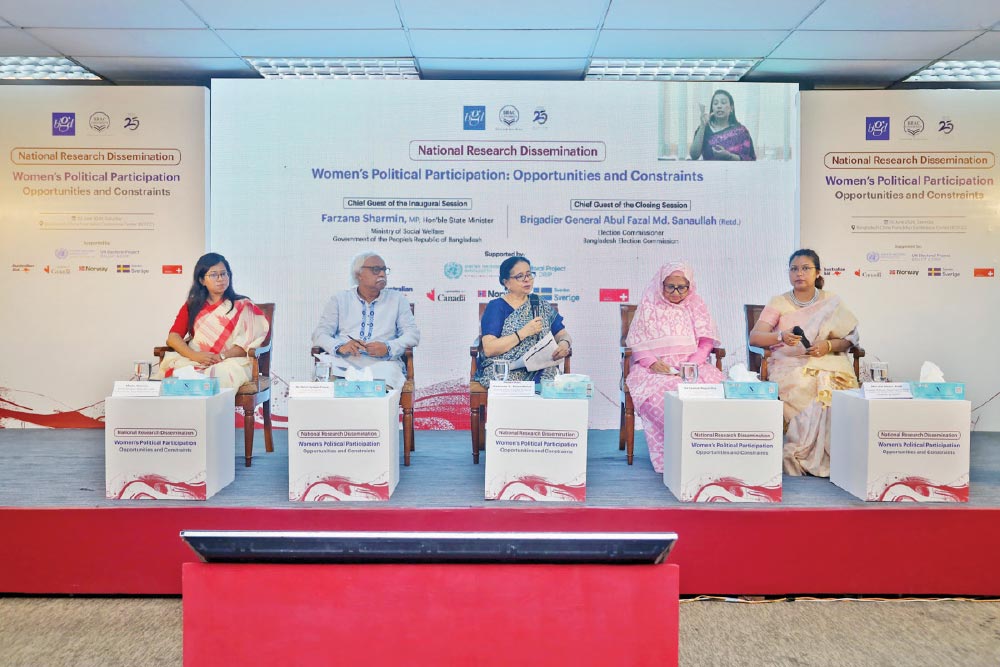 Violence against women in politics, entrenched patriarchal attitudes, financial limitations, and unequal social responsibilities continue to hinder women's meaningful participation and leadership in Bangladesh's political sphere, according to a new study unveiled recently.
The qualitative study, jointly launched by the BRAC Institute of Governance and Development (BIGD), BRAC University, and UN Women, examined the opportunities and challenges shaping women's political participation, representation, and leadership in Bangladesh.
Conducted under the United Nations Electoral Assistance Programme (DRIP/BALLOT), the research is based on 43 in-depth interviews with women parliamentarians, local government representatives, political party members, and public office holders, alongside a review of relevant legal and policy frameworks.
The findings were presented at a dialogue organized by BIGD, bringing together lawmakers, election officials, political party leaders, development partners, and researchers to discuss ways to strengthen women's role in democratic processes.
The study identifies violence against women in politics (VAWP), both online and offline, as one of the most significant deterrents preventing women from entering and advancing in political life. While Bangladesh's Constitution guarantees equal rights and legislative measures have increased women's representation at the local government level, the report notes that multiple structural barriers continue to limit their full participation.
Speaking at the inaugural session, BIGD Executive Director Dr. Imran Matin emphasized the importance of discussing women's political participation in Bangladesh's evolving political landscape.
"We cannot discuss women in isolation from their broader participation in public life, political activism, and leadership roles within political parties," he said, stressing that future policy discussions should be guided by evidence-based research.
UN Women Bangladesh Country Representative Gitanjali Singh highlighted the crucial role women play in strengthening democracy and governance.
She noted that women's participation in decision-making contributes to more inclusive policymaking in sectors such as health, education, childcare, infrastructure, and efforts to combat violence against women. Excluding women from public life and economic participation, she warned, weakens democratic institutions and societal progress.
Loading...
Loading...
Also read



Editor : Iqbal Sobhan Chowdhury
Published by the Editor on behalf of the Observer Ltd. from Globe Printers, 24/A, New Eskaton Road, Ramna, Dhaka.
Editorial, News and Commercial Offices : Aziz Bhaban (2nd floor), 93, Motijheel C/A, Dhaka-1000.
Phone: PABX- 41053001-06; Advertisement: 41053012; 01793317829, 01550707291, E-mail: [email protected], [email protected] Online: email: [email protected] 41053014; 01550707297 Advertisement: 01550707296
Published by the Editor on behalf of the Observer Ltd. from Globe Printers, 24/A, New Eskaton Road, Ramna, Dhaka.
Editorial, News and Commercial Offices : Aziz Bhaban (2nd floor), 93, Motijheel C/A, Dhaka-1000.
Phone: PABX- 41053001-06; Advertisement: 41053012; 01793317829, 01550707291, E-mail: [email protected], [email protected] Online: email: [email protected] 41053014; 01550707297 Advertisement: 01550707296


