



| HEADLINE |

|
Poor Economics: Redefining poverty
Published : Saturday, 4 July, 2026 at 12:00 AM
Abhijit V Banerjee and Esther Duflo


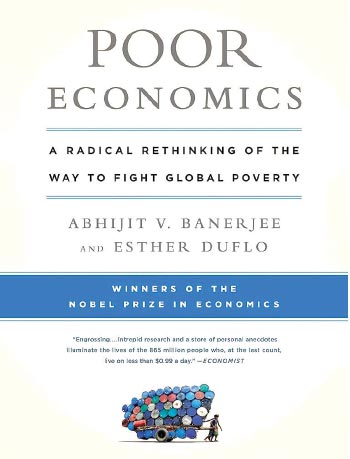 The book Poor Economics attempts to alter your perspective regarding the basic assumptions you have built up regarding the poor. Abhijit V Banerjee and Esther Duflo convey their beliefs through numerous statistics and meticulous trials carried out by the Abdul Jameel Poverty Action Lab ( J-PAL )
When it comes to the eradication of poverty, it could be said that economists are widely known to be in two ‘teams’, you could say. Those who place importance on foreign aid, believing that aid from other countries could be an effective way to reach out to those in the poorest parts of the countries and elevate their living standards, and those who believe that aid can be counterintuitive, it can indirectly prevent people from searching for their own solutions, and in the case of corruption, it could be mostly ineffective. This ‘debate’ is what makes the book Poor Economics more interesting than other standard books. The authors provide a deep dive into multiple instruments and policies that can precisely target those in need better than aid.
Reviewed by Lubabah Bint MahtabWhen I first opened this book, I hadn't expected it to be as meticulous and data-heavy as it was. Throughout the book, the authors present multiple statistics, figures, and a few graphs as well. The graphs, in particular, were a nice addition as it aids with visualisation of the context. Rather than just explaining the poverty trap with words alone, the graph helped me understand better how the issue progresses over time. It is made even more informative by using another graph that counters the initial one. This was very engaging as it gives you the space to contemplate which graph you believe is a more accurate representation of poverty as a whole. So unlike certain books where you read and once you're done, you simply close the book, Poor Economics actually makes you engage with the content.
Additionally, another compelling aspect of the book is how it is structured. Poor Economics is split into two segments. Part 1 focuses on “Private lives”, part 2 is concerned with “Institutions”. This means rather than a single point of focus, the readers can understand the issue of poverty at a small scale of individuals, to a much larger scale of how it is dealt with. With that being said, part 1 in particular is very data-rich, through the use of RCT, we get a deep dive into multiple different individuals' situations and their personal beliefs regarding why they are stuck in poverty, and so on. I believe this was a rather effective way to help the readers empathise with these people and gain a more thorough understanding of poverty as a whole, through smaller cases.
Although I do feel that the authors place excessive importance on smaller, more targeted aid, whilst overlooking the bigger picture. While they have placed importance on factors such as savings or daily calorie intake, it could be argued that a more national level assistance is important as well. This means that while they focus on how to treat poverty at an individual level, it could have certainly been worthwhile for them to look into how to prevent it in the first place. In that sense, it could be said that the book has a lack, though not a huge one i suppose.
Lastly, it seems that the authors have relied on the results of RCTS a little too much. These experiments test the impact of a small intervention in a controlled environment or area. Upon noticing this, I couldn't help but think that what might be true for a certain area may not be true for another area. The usefulness of smaller interventions may vary, so while the results or the RCTs are generally positive, I think it is worthwhile remembering that human behaviour is complex and tests will not always yield the same results everywhere, which makes the arguments for certain interventions a little less convincing.
Overall, I would still recommend Pook Economics to those who are truly concerned about poverty traps or interested in the nature of poverty as a whole. Rather than making poverty seem as though it is an intractable challenge that cannot be overcome, the book presents multiple solutions backed up with statistics and research findings that make it seem solvable, which would most likely make the readers feel a sense of contentment.
The reviewer is an A-level student
Loading...
Loading...



Editor : Iqbal Sobhan Chowdhury
Published by the Editor on behalf of the Observer Ltd. from Globe Printers, 24/A, New Eskaton Road, Ramna, Dhaka.
Editorial, News and Commercial Offices : Aziz Bhaban (2nd floor), 93, Motijheel C/A, Dhaka-1000.
Phone: PABX- 41053001-06; Advertisement: 41053012; 01793317829, 01550707291, E-mail: [email protected], [email protected] Online: email: [email protected] 41053014; 01550707297 Advertisement: 01550707296
Published by the Editor on behalf of the Observer Ltd. from Globe Printers, 24/A, New Eskaton Road, Ramna, Dhaka.
Editorial, News and Commercial Offices : Aziz Bhaban (2nd floor), 93, Motijheel C/A, Dhaka-1000.
Phone: PABX- 41053001-06; Advertisement: 41053012; 01793317829, 01550707291, E-mail: [email protected], [email protected] Online: email: [email protected] 41053014; 01550707297 Advertisement: 01550707296


