



| HEADLINE |

|

SERENDIPITY IN DIPLOMACY BETWEEN PROTOCOL & POLITICS
Published : Saturday, 11 July, 2026 at 12:00 AM
MAHMOOD HASAN


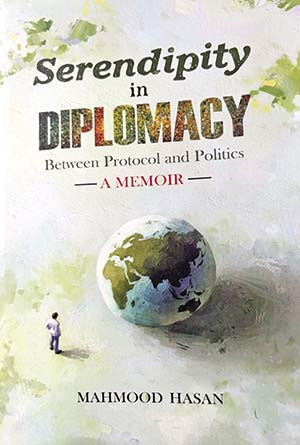 Surprises can be both pleasant and unpleasant. And when I was caught up with one a couple of weeks ago, it turned out to be a very pleasant one. The caretaker of our building called me on the intercom to say that there was a package for me. Now who would send me a package when I never receive one except for those I would order on my own. I had it sent up, and like a child opening Christmas gifts, tore off the wrapping. To my absolute delight I find it’s a book authored by my friend and colleague Ambassador (Retd) Mahmood Hasan. The climax of the surprise was that the book was not sent by the author but by the publisher for reasons best known to them and for free! My reaction was immediate: The author aside from being a colleague whom I have always held in high esteem and respect for his exceptional professional aplomb is no rookie when it comes to writing on international relations. He has been a regular columnist for the leading Dhaka English daily, The Daily Star. His writing skills and clarity of thought and expression in his columns left no doubt in me that his book would most definitely be a worthy read and it proved to be so upon finishing.
An essential element of a book is its title. It sets the tone of the contents and tells the reader what the book is all about. This proved true in the case of Mahmood’s book entitled “Serendipity in Diplomacy: Between Protocols and Politics” and suffixed by an explanation of it being his memoir. Having authored two memoirs myself, I would have considered the book as another monologue of anecdotes of a professional diplomat’s life. But the word “Serendipity“ in the title left me guessing on the motive and consideration of the author to choose a term that was originated by the 18th century English novelist Horace Walpole in his fairy tale “The Three Princes of Serendip”. In present day English the word is defined by Merriam Webster as “the ability to find valuable or agreeable things not sought for’, chances but happy discoveries. In simple English the title would be synonymous to “Blessings in Diplomacy” and this by itself should enthuse readers as it happened in my case.
When I authored my own two memoirs, I was more on discretion: guarded, circumspect and cautious. I deliberately skipped on many interesting incidents and anecdotes during my nearly four decade diplomatic career; the serious and the hilarious, and even mischievous that assuredly would be riveting and absorbing to the readers. But I refrained out of apprehension that relating to these could offend and embarrass individuals and potentates of influence and therefore best left unsaid and sparing myself ire of the powerful. Mahmood in contrast chose the opposite. In his memoir, he was candid throughout, both in agreement and expostulation calling a spade a spade irrespective of seniors, direct boss and on occasions, the Foreign Minister and political leaders by name.
Reviewed by Hemayet Uddin
The author at times went into the most mundane details of his personal and professional life which makes his memoir somewhat of a disquisition. But this takes a back step to his pithy and articulation on issues of substance that are aplenty in the book. What singles out Mahmood’s memoir from those of others is that he brings out into the open many complexities in diplomacy, the daunting professional demands in facing challenging situations and seeking resolution. His account bears similarity to Ambassador Abdulla Al Hasan’s Barir Golpo published in two volumes. Throughout his lengthy discourse, Ambassador Mahmood Hasan maintains a lucid and captivating style and a stratagem to keep readers entrenched in a state of suspended animation and in anticipation to keep on reading to the end.
The serendipity or blessings in diplomacy have been dexterously blended and intertwined in Mahmood’s diverse and heterogeneous episodes of his career when he was challenged to do the almost impossible, assume onerous responsibilities long before these were due. As you read the memoir, you will note that the author was probably destined to be the mythical “Atlas” in shouldering the heavy responsibility of “Head of Mission” as CDA way ahead of his time. As a junior diplomatic officer he had to address situations of the kind that many in senior positions would have probably balked. He was man enough to take the blame for diplomatic “faux pas” that were not on his account and showed his charisma to accept the indignities with dignity and honour. The episode of his being shanghaied out of the Foreign Ministry to the Establishment as “OSD“ to stay home at government expense to do nothing, and later brought back to the mainstream closest to power as his repute of being a talented officer following him, is nothing short of a thriller. The time honoured axiom that the “truth shall prevail” was vindicated when Mahmood was not only exonerated but rewarded.
Mahmood starts off with his first major exposure in diplomacy when he was the concerned desk officer at the Foreign Ministry and a member of President General Hussain Muhammad Ershad’s delegation to the 7th Summit Meeting of the Non Aligned Movement (NAM) held in New Delhi in 1983. Mahmood goes at length in elaborating the pressures put on him that would normally fall on the senior members of the delegation. Mahmood being involved with substantive aspects of the Summit agenda provides a detailed account of the proceedings, negotiations, deliberations, the Chair’s intervention in calming tensions between country specific delegations, the side line bilateral and closed door meetings and consultations among the core group of the Bangladesh delegation on sensitive and substantive issues. Incidentally as it happened, I was posted in New Delhi High Commission at the time of the Summit. President General Ershad’s delegation at the 7th NAM Summit in my memory was perhaps the largest ever, comprising Cabinet Ministers, serving heavyweight Generals, Ambassadors, Media Bosses, Foreign Ministry high ups and an army of support staff including his personal cook. As Second Secretary, I was tagged almost 24/7 as the High Commission’s “errand boy” for all arrangements and demands of the entourage including transportation, hotel room booking and settling bills, luggage collection, attending the advance security team headed by a General, delegates’ trips to Ajmer and a host of other endless chores. The irony however is inconceivable: being in centre point of the Summit venue, I was in the dark of the happenings and deliberations inside the plenary and committee rooms of Vighyan Bhavan as I had neither the time nor the access. Reading Mahmood’s verbatim was therefore a revelation. There is a bagful of interesting encounters from my side that I could share in my first book in which the NAM Summit featured. But I chickened out and Mahmood did not.
Mahmood moves on to his subsequent chapters that are all distinguished with witty and eye catching captions. Each are stand alone but some more weighty than the rest. For an young officer of not having crossed the rank of First Secretary ( Senior Assistant Secretary at the Headquarters), many of the author’s encounters that he shares in his memoir are symbolic of the hapless being thrown into the amphitheatres of ancient Rome to be fed to the lions. This comes to my mind when recounts his traumatic experiences in war torn Afghanistan during Soviet Occupation and Burma (Myanmar).
To say that a diplomatic assignment in war torn Afghanistan during the Soviet occupation and the Mujahedeen fighters resolve to end it is nightmarish would be no exaggeration. And this was probably true for the author as he was Charge D’ Affaires (CDA) to represent Bangladesh and protect the country’s interests. The absence of an Ambassador was deliberate to show Bangladesh‘s disapproval of the puppet regime of Najibullah. The author’s commentary on the formidable troubles waters that he had to negotiate as a young man in Kabul is exciting and engrossing for his readers.
The chapter on Burma can very well be a reference for those who follow developments in that country. Mahmood provides an eye witness account when the country was at its political worst, opting for isolation and sliding towards being a dystopian state and a ruthless military regime in perpetuity with the introduction of the “State Law and Order Restoration Committee (SLORC), determined to ensure it. Reading the chapter on Burma is an eye opener to the country’s history of full takeover by the Generals. The part on late Ambassador Enayetullah Khan and the author’s initiative to engage with the pro democracy leader Aung SUU Kyi and the latter’s coming to the Bangladesh Embassy Residence for dinner and spending more that hour to the annoyance of the Junta, is absolute drama. The author also writes on the beginning of persecution of Rohingyas. I am left with feelings of exasperation that given the author’s firsthand knowledge and perspicacity of Burmese politics and his personal relationship with Aung Suu Kyi would have contributed enormously in the handling of the present Rohingya crisis if the government of the day had taken him into confidence and sought his counsel. Why the Bangladesh Foreign Office pundits of the time did not consider this is anybody’s guess.
The author’s discourse on India both as a Ministry official and a mid level diplomat in the Bangladesh High Commission in New Delhi is most absorbing. He gives readers an insight of the dynamics and complexities in Bangladesh-India bilateral relations. Reading the chapter, one gets the impression that although a Counsellor with other senior colleagues in place, the High Commissioner reposed his full confidence on him as the “workhorse” and the principal interlocutor with the Indian Ministry of External Affairs. Mahmood shared some galvanic anecdotes to keep the reader engrossed. His trouble shooting role in redeeming the ignominy and diplomatic disaster initiated by the then Deputy High Commissioner in Calcutta in isolation and without informing the High Commission by inviting then Prime Minister Sheikh Hasina to open a Book Exhibition in Calcutta is absolutely fascinating. The author also highlighted inter alia, the Indian side’s ad nauseam allegations of alleged infiltration of “illegal migrants” and support to “IIG’s that were déjà vu for me.
The author’s entire saga is elaborate and each episode is provocative, stimulating and exhilarating. The incident of one humbug (not his word) Bangladesh Ambassador to Japan landing up at the wrong airport to receive the visiting Prime Minister of his country that led to his recall and subsequently fired is just one among the many. All these went on to make his career indeed “serpenditious“ as he moved up the ladder to do Ambassadorial assignments including his favourite Paris, and attainting the highest position in the bureaucracy as Secretary to the Government.
“Serendipity in Diplomacy” would serve as a primer to both trainees and in-service Bangladeshi diplomats. And for the rest, I will rate it as a must read book to be enlightened with the wealth of information and facts that remained in hiding until Ambassador Mahmood Hasan took up his pen. The book of 388 pages has been published by UPL, Dhaka.
Loading...
Loading...



Editor : Iqbal Sobhan Chowdhury
Published by the Editor on behalf of the Observer Ltd. from Globe Printers, 24/A, New Eskaton Road, Ramna, Dhaka.
Editorial, News and Commercial Offices : Aziz Bhaban (2nd floor), 93, Motijheel C/A, Dhaka-1000.
Phone: PABX- 41053001-06; Advertisement: 41053012; 01793317829, 01550707291, E-mail: [email protected], [email protected] Online: email: [email protected] 41053014; 01550707297 Advertisement: 01550707296
Published by the Editor on behalf of the Observer Ltd. from Globe Printers, 24/A, New Eskaton Road, Ramna, Dhaka.
Editorial, News and Commercial Offices : Aziz Bhaban (2nd floor), 93, Motijheel C/A, Dhaka-1000.
Phone: PABX- 41053001-06; Advertisement: 41053012; 01793317829, 01550707291, E-mail: [email protected], [email protected] Online: email: [email protected] 41053014; 01550707297 Advertisement: 01550707296


