



| HEADLINE |

|
CRUDE OIL MARKET SIZE AND FUTURE OUTLOOK
Published : Saturday, 4 July, 2026 at 12:00 AM


 The global oil market has regained its footing after weeks of geopolitical turbulence, with crude prices retreating from recent highs as fears of a major supply disruption through the Strait of Hormuz ease. Yet beneath the apparent calm, analysts warn that the market remains acutely sensitive to geopolitical developments, shifting production policies and an uncertain global economic outlook.
Brent crude, the international benchmark, has stabilised around US$71-73 a barrel, while US benchmark West Texas Intermediate (WTI) has traded near US$68-69, significantly below the levels briefly seen during the latest flare-up in Middle East tensions.
One of the most visible crude oil market trend is the increasing divergence between tightly managed OPEC+ supply and resilient non-OPEC growth from the U.S., Canada, Brazil, and Guyana. The market is no longer expanding through a uniform global production cycle. However, market balances are increasingly shaped by a combination of voluntary producer restraint in the Middle East and selective project-led growth in deepwater and unconventional basins. This has made the market more segmented by basin economics, project cycle time, and export flexibility.
At the same time, demand growth is becoming less transportation-centric than in earlier cycles. Jet fuel recovery, refinery runs, and petrochemical feedstocks remain supportive, but official outlooks increasingly highlight petrochemical demand, emerging-market industrialization, and evolving product mix as the main areas sustaining long-term oil use. As a result, the market is being influenced not only by headline production volumes, but also by crude quality compatibility, refinery configuration, trade-route diversification, and the strategic role of spare capacity.
The primary driver for crude oil market growth is the need for transportation fuels across road freight, aviation, marine bunkers, and mobility systems that remain difficult to replace at scale in the near term. Even where transport electrification is progressing, heavy-duty, aviation, and international logistics still require large hydrocarbon input streams. This preserves a substantial structural role for crude oil in refinery systems and in global trade balances.
An additional layer of support comes from petrochemical feedstocks, strategic stock policies, and energy-security considerations. Many importing countries continue to emphasize supply diversification and reserve buffers, while producer countries maintain long-cycle investment programs to protect export revenues and fiscal stability. This combination sustains crude production capacity even when price conditions fluctuate.
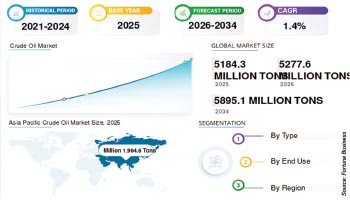
The crude oil market size was valued at 5,184.3 million tons in 2025. The market is projected to grow from 5,277.6 million tons in 2026 to 5,895.1 million tons by 2034, exhibiting a CAGR of 1.4% during the forecast period. Asia Pacific dominated the crude oil market with a market share of 37.9% in 2025.
Crude oil is a naturally occurring liquid mixture of hydrocarbons found in underground rock formations and extracted through drilling. It is unrefined petroleum in its raw form and may vary widely in color, density, sulfur content, and chemical composition depending on the source field. It contains a combination of paraffins, naphthenes, aromatics, sulfur compounds, nitrogen compounds, trace metals, and other impurities. After extraction, it is processed in refineries to produce fuels and petrochemical feedstocks, including gasoline, diesel, jet fuel, LPG, naphtha, lubricants, asphalt, and other industrial materials. Crude oil is commonly classified as light, medium, or heavy, and as sweet or sour, based on its density and sulfur level, as these characteristics influence refining complexity, product yield, and commercial value.
The market growth is driven by rising production levels, reserves, geopolitical developments, the Organization of the Petroleum Exporting Countries (OPEC+) policy decisions, refinery demand, inventory movements, and global economic activity. It is also influenced by benchmark crude streams such as Brent, WTI, and Dubai/Oman, which serve as pricing references for physical trade.
Furthermore, the competitive landscape is led by national oil companies and integrated international majors with strong reserve access, upstream scale, refining linkages, and trading capabilities. aramco, Exxon Mobil Corporation, Chevron Corporation, Shell, and bp p.l.c. remain among the most influential participants due to their resource positions, offshore and unconventional exposure, capital discipline, and ability to balance upstream production with downstream optionality.
Loading...
Loading...
Also read



Editor : Iqbal Sobhan Chowdhury
Published by the Editor on behalf of the Observer Ltd. from Globe Printers, 24/A, New Eskaton Road, Ramna, Dhaka.
Editorial, News and Commercial Offices : Aziz Bhaban (2nd floor), 93, Motijheel C/A, Dhaka-1000.
Phone: PABX- 41053001-06; Advertisement: 41053012; 01793317829, 01550707291, E-mail: [email protected], [email protected] Online: email: [email protected] 41053014; 01550707297 Advertisement: 01550707296
Published by the Editor on behalf of the Observer Ltd. from Globe Printers, 24/A, New Eskaton Road, Ramna, Dhaka.
Editorial, News and Commercial Offices : Aziz Bhaban (2nd floor), 93, Motijheel C/A, Dhaka-1000.
Phone: PABX- 41053001-06; Advertisement: 41053012; 01793317829, 01550707291, E-mail: [email protected], [email protected] Online: email: [email protected] 41053014; 01550707297 Advertisement: 01550707296


