



| HEADLINE |

|
How Tiny Shocks Are Quietly Rewriting Bangladesh's Economic Future
Published : Saturday, 18 July, 2026 at 12:00 AM
Faruk Ahmed


 Imagine a butterfly gently flapping its wings in one corner of the world. Days later, a garment factory in Gazipur misses a shipment deadline. Wheat becomes dearer in Dhaka. A power plant is completed months behind schedule. Foreign investors postpone decisions. Inflation tightens its grip on household budgets. Economic growth loses momentum.
It sounds like fiction, but this is precisely how today's global economy works.
Scientists call it the Butterfly Effect�"a principle of chaos theory introduced by American meteorologist Edward Lorenz, explaining how tiny changes in one part of a complex system can produce enormous consequences elsewhere. In the twenty-first century, Bangladesh has become a living demonstration of this phenomenon. The country's economy is no longer shaped solely by domestic policies or local events. It is increasingly influenced by a web of interconnected forces stretching from Wall Street to the Strait of Hormuz, from European battlefields to climate-induced heatwaves at home.
The greatest threat to Bangladesh's economy today may not be a single catastrophic crisis. It is the accumulation of countless seemingly insignificant shocks whose combined impact quietly erodes growth, productivity and investor confidence.
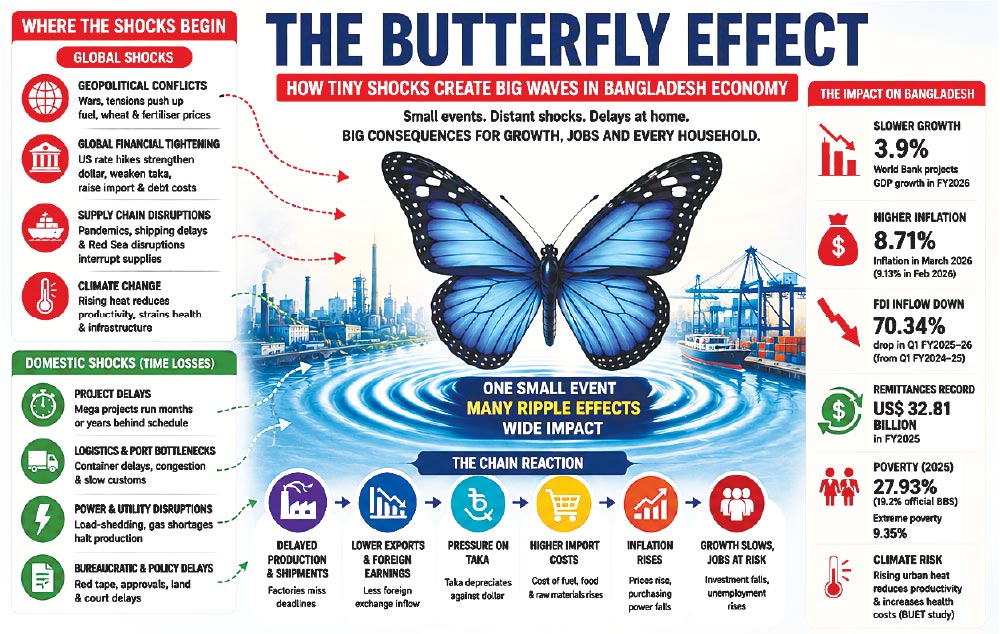 Recent history offers striking evidence
A virus first detected in Wuhan paralysed global supply chains, forcing factories across Bangladesh to suspend production and triggering billions of dollars in cancelled garment orders. Russia's invasion of Ukraine sent international prices of wheat, fertiliser and fuel soaring, fuelling domestic inflation and increasing production costs. Renewed tensions in the Middle East pushed crude oil prices upwards and revived fears over disruptions in the Strait of Hormuz, through which a substantial share of the world's oil passes. At the same time, higher interest rates imposed by the US Federal Reserve strengthened the dollar, weakened the taka and inflated Bangladesh's import bill as well as the cost of servicing foreign debt.
None of these events originated in Bangladesh. Yet every one altered its economic trajectory.
The Butterfly Effect has therefore ceased to be a scientific metaphor. It has become Bangladesh's economic reality.
An economy vulnerable to distant tremors
Bangladesh's impressive rise over the past three decades has been built on global integration. Ready-made garments account for the overwhelming share of merchandise exports. Millions of migrant workers sustain domestic consumption through remittances. Industries depend heavily on imported fuel, machinery and raw materials. Such openness has powered economic expansion, but it has also increased vulnerability.
In a tightly connected global economy, every external disturbance creates domestic ripple effects.
The World Bank's latest Bangladesh Development Update warns that the country is entering a period where multiple vulnerabilities�"persistent inflation, subdued private investment, banking sector weaknesses and geopolitical uncertainty�"are increasingly reinforcing one another. The Bank projects GDP growth of around 3.9 per cent in FY2026, significantly below the pace required to generate adequate employment for Bangladesh's expanding labour force.
The International Monetary Fund delivers a similar warning. While recognising Bangladesh's long-term economic potential, the IMF argues that delayed structural reforms, weak governance, fragile financial institutions and insufficient export diversification are preventing the economy from reaching its full potential. Unless reforms accelerate, future global shocks will continue to produce disproportionately large domestic consequences.
Climate: the silent butterfly
Not every butterfly originates abroad.
Research by the Bangladesh University of Engineering and Technology (BUET) has identified rising urban temperatures as an emerging economic threat capable of generating cascading impacts across multiple sectors. What appears to be a modest increase in temperature reduces labour productivity, raises healthcare costs, disrupts infrastructure performance and weakens industrial output.
A few additional degrees of heat translate into exhausted construction workers, reduced factory efficiency, increased electricity demand, higher medical expenditure and lower economic productivity. Climate change is no longer simply an environmental concern; it has become an economic variable capable of slowing long-term growth.
Time�"the most expensive invisible tax
Perhaps the most damaging Butterfly Effect in Bangladesh is neither war, nor climate, nor financial markets.
It is time.
A single day lost in approving an investment proposal. A shipment delayed at Chattogram Port. Weeks spent clearing imported machinery through customs. A court case delaying land acquisition. A power outage halting factory production. A mega project slipping months�"or years�"behind schedule.
Each delay appears manageable in isolation.Collectively, they cost the economy billions.
The World Bank has consistently identified logistics bottlenecks, inefficient customs procedures, transport congestion and infrastructure weaknesses as major barriers to productivity and investment. Manufacturing firms lose valuable production hours waiting for imported raw materials. Exporters fail to meet delivery deadlines. Foreign investors reconsider expansion plans. Small administrative delays quietly multiply into significant macroeconomic losses.
Time overruns in mega infrastructure projects are particularly expensive. Every additional month increases construction costs through higher prices of imported machinery, steel and cement, while mounting interest payments inflate the burden on public finances. More importantly, delayed completion postpones the very economic returns these projects are designed to generate.
A highway completed two years late delays trade.A railway delayed postpones industrial expansion.A port expansion deferred keeps logistics costs unnecessarily high.A power plant delivered behind schedule limits industrial production.
The opportunity cost is enormous
How one delay becomes a national problem
The manufacturing sector illustrates the Butterfly Effect with remarkable clarity.
Global buyers increasingly operate on just-in-time supply chains, demanding speed, precision and reliability. When imported raw materials arrive late or utility services become unreliable, production schedules collapse.
A missed deadline means delayed exports.Delayed exports reduce foreign exchange earnings.Lower foreign exchange weakens the taka.A weaker taka makes imports more expensive.Higher import costs fuel inflation.Inflation erodes household purchasing power.Consumer demand weakens.Economic growth slows.
What began as a delayed shipping container ultimately reaches every kitchen table in the country.
The same pattern is visible in investment
Bangladesh has recently experienced a sharp decline in foreign direct investment. Investor confidence can deteriorate quickly when regulatory uncertainty, governance weaknesses or policy inconsistency become evident. Lower investment today translates into fewer factories tomorrow, slower job creation, reduced productivity and weaker long-term growth.
The banking sector produces another chain reaction.
Rising non-performing loans restrict banks' lending capacity. Businesses postpone expansion. Entrepreneurs delay investment. Industrial activity weakens. Employment growth slows. Consumer spending declines. Economic momentum gradually fades.
Again, the Butterfly
Effect is at work
Every reform matters.
Yet the Butterfly Effect is not exclusively a story of crisis.Small positive reforms can create equally powerful waves of prosperity.A transparent tax administration strengthens investor confidence.Faster customs clearance improves export competitiveness.Reliable electricity enhances factory productivity.
Digital public services reduce transaction costs.Efficient project management saves billions in public expenditure.Judicial reforms improve contract enforcement.Better governance attracts foreign investment.Each reform may appear modest.Together, they possess the power to transform Bangladesh's economic future.
A Defining Moment
As Bangladesh prepares for post-LDC graduation and aspires to become an upper-middle-income economy, resilience has become as important as growth itself.
The challenge is no longer merely to respond to crises after they occur. It is to anticipate risks, strengthen institutions and ensure that minor disruptions do not evolve into national economic setbacks. Equally important is creating conditions where small improvements generate lasting gains across the economy.
The country's next chapter will depend not only on billion-dollar infrastructure projects or ambitious national strategies but also on the efficiency of everyday decisions�"how quickly files move, how efficiently ports operate, how reliably electricity is supplied, how consistently policies are implemented and how effectively institutions perform.
The lesson of the Butterfly Effect is both profound and urgent.
In today's interconnected world, no delay is too small, no reform too modest and no shock too distant to matter.
A butterfly's wings may never literally create a storm.But in Bangladesh's economy, a delayed file, a missed shipment, a bureaucratic bottleneck, a heatwave or a distant geopolitical conflict certainly can.
The future of Bangladesh may therefore depend not on avoiding every crisis, but on recognising a simple truth: in a complex economy, every decision, every hour and every day counts. The smallest ripple today can become tomorrow's economic tide�"either carrying the nation towards sustained prosperity or pulling it into a cycle of missed opportunities.
Loading...
Loading...
Also read



Editor : Iqbal Sobhan Chowdhury
Published by the Editor on behalf of the Observer Ltd. from Globe Printers, 24/A, New Eskaton Road, Ramna, Dhaka.
Editorial, News and Commercial Offices : Aziz Bhaban (2nd floor), 93, Motijheel C/A, Dhaka-1000.
Phone: PABX- 41053001-06; Advertisement: 41053012; 01793317829, 01550707291, E-mail: [email protected], [email protected] Online: email: [email protected] 41053014; 01550707297 Advertisement: 01550707296
Published by the Editor on behalf of the Observer Ltd. from Globe Printers, 24/A, New Eskaton Road, Ramna, Dhaka.
Editorial, News and Commercial Offices : Aziz Bhaban (2nd floor), 93, Motijheel C/A, Dhaka-1000.
Phone: PABX- 41053001-06; Advertisement: 41053012; 01793317829, 01550707291, E-mail: [email protected], [email protected] Online: email: [email protected] 41053014; 01550707297 Advertisement: 01550707296


