





| HEADLINE |

|
Record foodgrain stock raises food security, storage questions


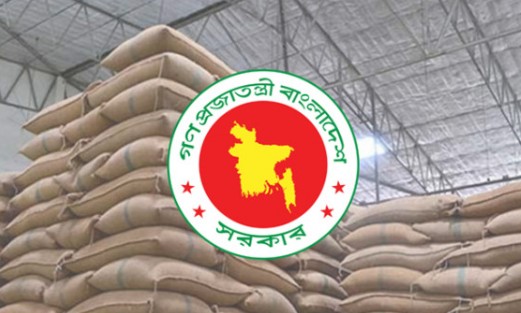
Bangladesh has reached a milestone in government foodgrain reserves, with official warehouses holding the highest stock in the country's history.
The record reserve is expected to strengthen food security and provide greater protection against supply shocks, but it has also exposed new challenges, including a shortage of storage space and questions over why consumers have yet to see a significant decline in rice prices.
According to the Ministry of Food, government warehouses currently hold 22.62 lakh tonnes of foodgrains, comprising 1.805 million tonnes of rice, 195,161 tonnes of paddy and 330,205 tonnes of wheat. According to the Ministry of Food and the Food Directorate, the current reserve is the highest government foodgrain stock on record.
The Food Directorate says the stock has become so large that storage capacity has come under pressure even as the ongoing Boro procurement drive continues until August 31.
"We have broken all previous stock records. The reserve is expected to increase further once the Boro procurement programme ends," said food directorate Director (Procurement) Moniruzzaman.
What drove the record foodgrain stock?
The growing reserve has also created an unexpected logistical challenge.
Officials attribute the increase to a combination of strong domestic procurement, higher imports and comparatively lower public distribution in recent months.
Government data show the Boro procurement campaign has progressed steadily. So far, authorities have collected more than 818,000 tonnes of parboiled rice, 58,700 tonnes of non-parboiled rice and over 304,000 tonnes of paddy. The government aims to procure 1.2 million tonnes of parboiled rice, 100,000 tonnes of non-parboiled rice and 500,000 tonnes of paddy before the campaign concludes.
Food ministry officials also say imports have contributed significantly to the growing reserve. According to Food Ministry data, during FY2025-26, Bangladesh imported more than 8.5 million tonnes of foodgrains through government and private channels, while additional imports are planned later this year to strengthen strategic reserves.
Another factor has been relatively lower foodgrain distribution through government safety-net programmes compared with procurement, allowing stocks to accumulate inside public warehouses.

Stronger buffer against emergencies
Food policy experts say maintaining a healthy public reserve is essential for responding to floods, cyclones and unexpected disruptions in domestic or international supply chains.
Agricultural economist Dr Jahangir Alam Khan said Bangladesh generally needs to maintain around 13.5 lakh tonnes of emergency foodgrain reserves.
"Large reserves provide security during floods, cyclones or global supply disruptions, but the government must ensure proper storage, timely distribution and quality preservation. Otherwise, carrying costs and storage losses could offset some of the benefits," he said.
"Earlier, the government often struggled to maintain even that level. Now the reserve exceeds 2.2 million tonnes, giving the country a much stronger emergency buffer."
The current reserve is around 9 lakh tonnes above the estimated emergency requirement of 13.5 lakh tonnes, giving the government greater flexibility during floods, cyclones and market disruptions.
The larger reserve is also expected to reduce reliance on emergency imports during natural disasters or periods of market instability.
Yet Consumers Are Still Paying More
Despite the government's record foodgrain stockpile, retail rice prices remain relatively high across many parts of the country, leaving consumers yet to benefit from the unprecedented reserve.
Analysts say government procurement has reduced the volume of rice available in the open market, while limited Open Market Sale (OMS) operations have had little impact on retail prices.
Consumer Association of Bangladesh (CAB) Vice-President SM Nazer Hossain said adequate government reserves generally help stabilise the market by discouraging hoarding and speculative trading, as traders know the government can release grain if prices rise excessively.
"The government has enough stock to intervene whenever necessary. However, unless OMS and other distribution programmes are expanded, consumers may not immediately benefit from the record reserve," he said.
He also stressed that stronger market monitoring would help prevent artificial price increases. Market analysts agree that expanded public distribution, timely government intervention and continued enforcement against hoarding will be essential if the record stock is to translate into lower food prices.
Is a Record Stock Enough?
Food policy experts say the record reserve is encouraging, but maintaining high stock levels alone will not guarantee lower food prices or long-term food security.
Agricultural economist Dr Jahangir Alam Khan said Bangladesh has exceeded its minimum emergency reserve requirement, which is estimated at around 13.5 lakh tonnes. However, he noted that efficient stock management is just as important as increasing reserves.
"Large reserves provide security during floods, cyclones or global supply disruptions, but the government must ensure proper storage, timely distribution and quality preservation. Otherwise, carrying costs and storage losses could offset some of the benefits," he said.
Former officials of the Food Directorate also emphasised that adequate reserves should be complemented by stronger market intervention to stabilise prices whenever necessary.
Record Stock at a Glance
Government Foodgrain Stock (as of July 2026)
• Total foodgrain stock: 22.62 lakh tonnes
• Rice: 18.05 lakh tonnes
• Paddy: 1.95 lakh tonnes
• Wheat: 3.30 lakh tonnes
• Emergency reserve requirement: Around 13.5 lakh tonnes
• Boro procurement target: 18.29 lakh tonnes
• Boro collected so far: More than 11 lakh tonnes
• Procurement campaign ends: August 31
• Government warehouses: Near full capacity
Government rice stock alone is also at a record level, according to the Ministry of Food.
Warehouses Running Out of Space
The record stock has created an unexpected logistical challenge. Officials at the Food Directorate say government warehouses are approaching full capacity while the Boro procurement campaign is still underway.
According to officials, much of the existing storage space has already been occupied by rice, paddy and wheat collected over recent months. With procurement continuing until the end of August, authorities may need to speed up grain distribution or make temporary storage arrangements if stocks continue to increase.
Food experts say the situation also underscores the need to expand modern storage facilities, including steel silos and climate-controlled warehouses, to minimise spoilage and improve stock management. They warn that prolonged storage without proper conditions could increase the risk of quality deterioration and financial losses.
According to information previously provided by the Ministry of Food, Bangladesh's government foodgrain storage capacity stood at 2.118 million tonnes, comprising 2,722 warehouses and seven silos. The ministry is also implementing projects to expand storage capacity through new warehouses and modern steel silos.
Production and demand
Bangladesh produced around 46 million tonnes of rice and 1.04 million tonnes of wheat during FY2024-25, according to official estimates.
The UN Food and Agriculture Organization (FAO), however, estimates annual domestic demand at approximately 41.1 million tonnes of rice and 7.4 million tonnes of wheat, highlighting the country's continued dependence on wheat imports despite self-sufficiency in rice.
With Boro procurement continuing until the end of August and additional imports planned later this year, government foodgrain reserves may increase further.
The immediate challenge for policymakers will be balancing procurement, storage and market distribution while ensuring that record public stocks ultimately translate into stable prices for consumers and stronger national food security.
Why imports continued despite record stocks
One question raised by economists is why Bangladesh continued importing foodgrains despite holding record government reserves.
Officials say wheat imports remain necessary because domestic production meets only a fraction of annual demand. While Bangladesh produces more rice than it consumes in most years, the country still depends heavily on imported wheat for flour mills and the food processing industry.
According to FAO estimates, annual wheat demand stands at around 7.4 million tonnes, compared with domestic production of only about 1.04 million tonnes.
Loading...
Loading...
Also read









Editor : Iqbal Sobhan Chowdhury
Published by the Editor on behalf of the Observer Ltd. from Globe Printers, 24/A, New Eskaton Road, Ramna, Dhaka.
Editorial, News and Commercial Offices : Aziz Bhaban (2nd floor), 93, Motijheel C/A, Dhaka-1000.
Phone: PABX- 41053001-06; Online: 41053014; 01550707296 Advertisement: 41053012; 01550707291
E-mail: [email protected] [email protected]
Published by the Editor on behalf of the Observer Ltd. from Globe Printers, 24/A, New Eskaton Road, Ramna, Dhaka.
Editorial, News and Commercial Offices : Aziz Bhaban (2nd floor), 93, Motijheel C/A, Dhaka-1000.
Phone: PABX- 41053001-06; Online: 41053014; 01550707296 Advertisement: 41053012; 01550707291
E-mail: [email protected] [email protected]


