



| HEADLINE |

|
Football or Business?
Published : Wednesday, 22 July, 2026 at 7:00 PM
Hasibul Islam


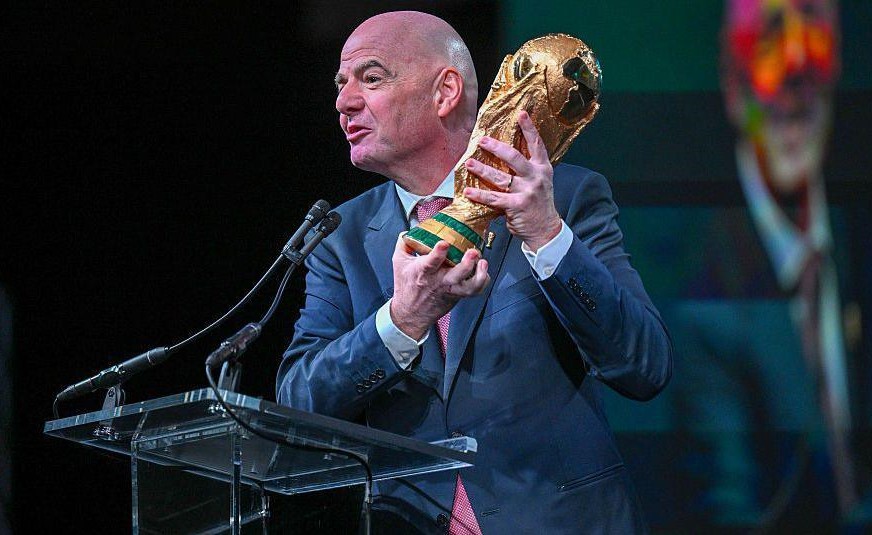
Collected Photo
Football is no longer just a 90-minute contest on the pitch. It has become one of the world’s biggest entertainment industries, where passion and emotion are intertwined with billions of dollars in business, diplomacy, state interests and global influence. Under FIFA president Gianni Infantino, the World Cup has entered a new era of expansion and commercialization but his leadership has also faced growing criticism over political influence and controversial decisions.
Infantino’s World Cup Legacy: More teams, more money, more controversy
The conclusion of the 2026 FIFA World Cup marked Gianni Infantino’s third World Cup as FIFA president. While his tenure has brought significant changes to the world’s biggest football tournament, it has also intensified debates over whether football is moving closer to business and politics than the spirit of the game.
Since taking charge after the downfall of former FIFA president Sepp Blatter amid corruption allegations, Infantino has transformed the structure of the World Cup. Elected in 2016, and re-elected in 2019 and 2022, the Swiss football administrator has strengthened FIFA’s commercial model while pushing for a larger global footprint.
From 32 teams to 48: Infantino’s expansion vision
One of Infantino’s biggest reforms has been expanding the World Cup from 32 teams to 48, beginning with the 2026 edition hosted jointly by the United States, Canada and Mexico.
Infantino argues that a bigger tournament gives smaller nations a chance to compete on the global stage and accelerates football development in emerging countries.
The 2026 World Cup provided examples supporting that argument, with debutants such as Cape Verde attracting worldwide attention. Their participation added new stories and fresh excitement to the tournament.
However, critics argue that expansion is driven more by financial motives than sporting necessity. More teams mean more matches, larger broadcasting deals, increased sponsorship opportunities and greater commercial revenue.
The dream of a 64 team World Cup
Infantino has already expressed interest in taking expansion further, with a possible 64-team World Cup being discussed for 2030.
Supporters believe the larger format would provide opportunities for more countries and eliminate complicated qualification scenarios. Critics, however, fear that increasing the number of teams could reduce the overall quality of competition and turn the World Cup into an oversized commercial event.
Football or Business?
Infantino’s supporters believe he has made the World Cup more inclusive and truly global. Under his leadership, FIFA has expanded not only the World Cup but also other competitions, including the Club World Cup.
His philosophy is often summarized as: more teams, more matches, more fans and more revenue.
But traditional football supporters worry that commercial interests are increasingly influencing decisions that should be based on sporting values.
Political shadows around the 2026 World Cup
Beyond business concerns, the 2026 World Cup also faced political controversy.
One of the biggest debates involved United States forward Folarin Balogun’s red-card suspension being overturned. FIFA rules traditionally do not allow appeals against red-card bans during the tournament, but the decision was later changed.
Although FIFA said its disciplinary committee acted independently, the controversy intensified after US President Donald Trump claimed he had influenced the decision. Trump has also repeatedly described Infantino as a personal friend.
Infantino rejected claims of political interference, but questions remained over whether FIFA maintained full independence from the host nation.
Was FIFA too weak against host country policies?
Another major issue was related to immigration restrictions in the United States.
Several football officials and supporters reportedly faced visa difficulties. Somali referee Omar Artan was unable to enter the US, while Iran’s delegation faced visa delays before eventually receiving approval. Some Iranian officials reportedly missed the tournament, forcing the team to base itself in Mexico before traveling for matches.
Reports also emerged of delays involving Iraqi and Swiss delegations at borders, while some supporters from countries including Haiti and Iran were unable to attend matches due to visa problems.
The incidents raised questions about whether FIFA could effectively enforce its own principles when dealing with host-country policies.
Infantino’s biggest test ahead
The 2030 World Cup, marking the tournament’s centenary, will be another major challenge for FIFA. The event is scheduled to involve six countries - Spain, Portugal, Morocco, Argentina, Uruguay and Paraguay.
At the same time, Infantino’s ambition for a 64-team World Cup remains under discussion.
However, his future leadership could determine whether those plans become reality. Growing criticism over political influence, commercial expansion and dissatisfaction among sections of European football could make his next FIFA election a difficult challenge.
With FIFA’s 211 member associations holding voting power, Infantino needs at least 106 votes to remain president.
The biggest question now is not only what shape the next World Cup will take, but whether Infantino will still be the man leading it.
-HIS
Loading...
Loading...
Also read








Editor : Iqbal Sobhan Chowdhury
Published by the Editor on behalf of the Observer Ltd. from Globe Printers, 24/A, New Eskaton Road, Ramna, Dhaka.
Editorial, News and Commercial Offices : Aziz Bhaban (2nd floor), 93, Motijheel C/A, Dhaka-1000.
Phone: PABX- 41053001-06; Advertisement: 41053012; 01793317829, 01550707291, E-mail: [email protected], [email protected] Online: email: [email protected] 41053014; 01550707297 Advertisement: 01550707296
Published by the Editor on behalf of the Observer Ltd. from Globe Printers, 24/A, New Eskaton Road, Ramna, Dhaka.
Editorial, News and Commercial Offices : Aziz Bhaban (2nd floor), 93, Motijheel C/A, Dhaka-1000.
Phone: PABX- 41053001-06; Advertisement: 41053012; 01793317829, 01550707291, E-mail: [email protected], [email protected] Online: email: [email protected] 41053014; 01550707297 Advertisement: 01550707296


