



| HEADLINE |

|

Bangladesh’s cotton output tops 100,000 tonnes for first time
Published : Thursday, 23 July, 2026 at 12:00 AM
Mizanur Rahman


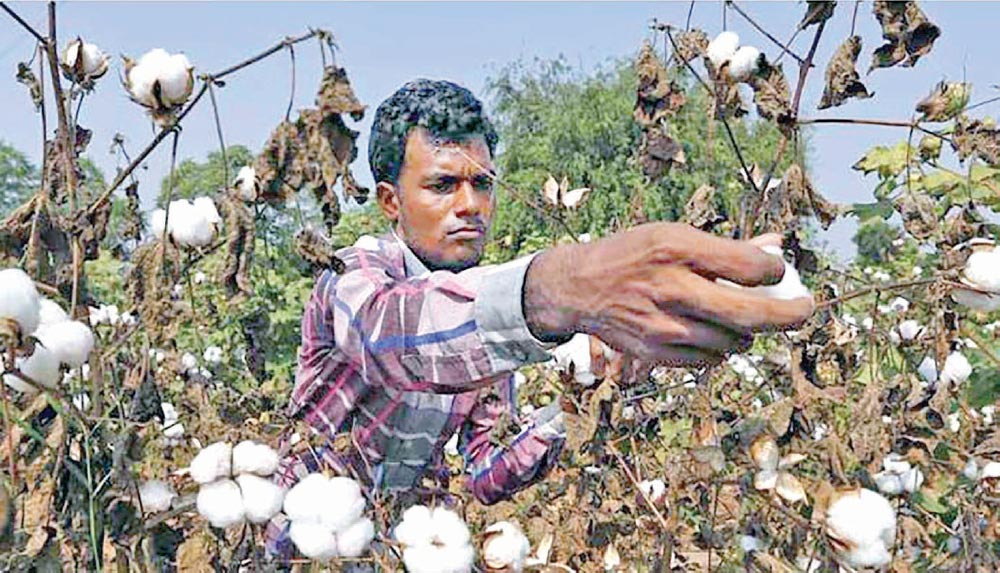 Bangladesh has achieved a landmark milestone in its cotton sector, with domestic lint cotton production surpassing 100,000 tonnes for the first time, reflecting sustained gains in productivity despite little expansion in cultivated land.
The achievement marks a significant step towards strengthening the country's raw material base for its export-oriented textile and readymade garment (RMG) industry, which remains heavily dependent on imported cotton.
According to the Cotton Development Board (CDB), lint cotton production reached a record 102,362 tonnes in the 2025-26 season, up from nearly 99,798 tonnes a year earlier. The decade-long rise has been driven by improved seed varieties, modern cultivation methods, stronger extension services and higher farm productivity.
Production has grown steadily over the past decade, rising from 68,663 tonnes in 2014-15 to more than 102,000 tonnes in 2025-26�"an increase of almost 50 per cent.
The CDB's data also show continuous growth in seed cotton output, which increased from 152,534 bales in 2014-15 to 224,971 bales in 2025-26, underlining the sector's improving performance despite persistent constraints on cultivable land.
Officials said the sector's success has been achieved largely through higher yields rather than expansion of acreage. The adoption of high-yielding cotton varieties, improved crop management, farmer training and wider use of modern farming practices has enabled growers to harvest substantially more cotton from almost the same land base.
Upland cotton continued to dominate domestic production, accounting for the overwhelming majority of output, while hill cotton also registered gradual gains, although its contribution remains comparatively modest.
The CDB has intensified efforts to expand cotton cultivation through research, demonstration plots, technology transfer and extensive extension support in cotton-growing regions. These initiatives have helped improve productivity and encouraged greater adoption of modern farming techniques.
The milestone comes at a time when Bangladesh's textile and apparel industry�"one of the world's largest cotton consumers�"continues to rely overwhelmingly on imported raw cotton to meet industrial demand.
Industry experts say the steady increase in domestic production demonstrates Bangladesh's growing capacity to strengthen its cotton sector, although local output still meets only a small fraction of the industry's overall requirement.
They believe that expanding cultivation into suitable new areas, accelerating the adoption of climate-resilient, high-yielding varieties and increasing investment in agricultural research and technology could substantially reduce dependence on imported cotton over the coming years.
Higher domestic production would help conserve valuable foreign exchange, reinforce the agricultural economy, strengthen supply chain resilience and create additional income opportunities for thousands of farming households.
Executive Director of the Cotton Development Board, Dr Md Rezaul Amin, said the board has been pursuing a long-term strategy to increase domestic cotton production while improving farmers' incomes through research, innovation and modern agricultural practices.
He said the introduction of improved cotton varieties, wider dissemination of advanced cultivation techniques and expanded extension services have significantly enhanced productivity despite challenges such as limited cultivable land and the growing impact of climate change.
"The CDB will continue developing climate-resilient, high-yielding cotton varieties, expanding cultivation into suitable new areas and promoting technology-driven farming to further increase domestic production," Dr Amin said.
He expressed confidence that these initiatives would strengthen Bangladesh's cotton sector, enhance its contribution to meeting the textile industry's raw material needs and gradually reduce the country's dependence on imported cotton.
Loading...
Loading...
Also read



Editor : Iqbal Sobhan Chowdhury
Published by the Editor on behalf of the Observer Ltd. from Globe Printers, 24/A, New Eskaton Road, Ramna, Dhaka.
Editorial, News and Commercial Offices : Aziz Bhaban (2nd floor), 93, Motijheel C/A, Dhaka-1000.
Phone: PABX- 41053001-06; Advertisement: 41053012; 01793317829, 01550707291, E-mail: [email protected], [email protected] Online: email: [email protected] 41053014; 01550707297 Advertisement: 01550707296
Published by the Editor on behalf of the Observer Ltd. from Globe Printers, 24/A, New Eskaton Road, Ramna, Dhaka.
Editorial, News and Commercial Offices : Aziz Bhaban (2nd floor), 93, Motijheel C/A, Dhaka-1000.
Phone: PABX- 41053001-06; Advertisement: 41053012; 01793317829, 01550707291, E-mail: [email protected], [email protected] Online: email: [email protected] 41053014; 01550707297 Advertisement: 01550707296


