



| HEADLINE |

|

Existing Investors Stay, New Global Capital Walks Away
Published : Saturday, 25 July, 2026 at 12:00 AM


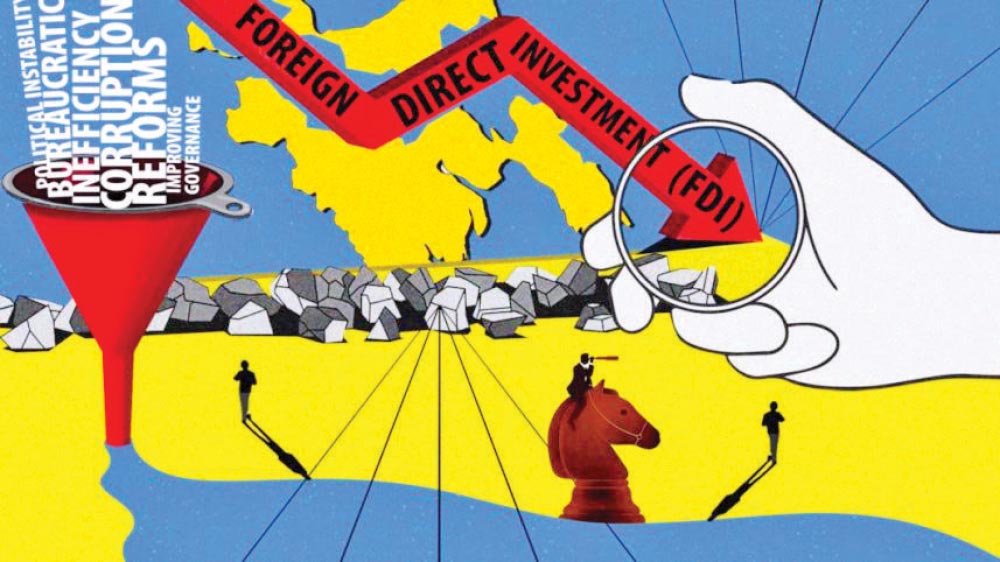 Bangladesh's foreign investment story has entered its most decisive chapter in years�"and the latest figures send a stark warning.
At a time when the country is preparing for life after Least Developed Country (LDC) graduation and desperately needs fresh capital to reignite growth, foreign direct investment (FDI) is flashing red. The latest Bangladesh Bank data reveal that fresh equity FDI�"the clearest indicator of new overseas investors�"collapsed by a staggering 70.34 per cent year-on-year in the first quarter of 2026 to just US$78.26 million, the weakest quarterly performance in a year. Overall FDI inflows also tumbled 43.81 per cent to US$447.31 million.
These are not merely disappointing statistics. They are a referendum on Bangladesh's investment climate.
For a nation with an economy approaching half a trillion US dollars, a population of nearly 170 million and ambitions to become an upper-middle-income manufacturing powerhouse, the collapse raises a far more profound question: why are multinational companies choosing to expand elsewhere while keeping Bangladesh on hold?
The answer lies in a widening confidence gap.
Existing Investors believe. New investors hesitate
Bangladesh's investment landscape presents a striking paradox.
Foreign companies already operating in the country continue to deepen their commitments. Reinvested earnings have surged dramatically, while intra-company loans from overseas parent firms have also increased significantly. These are powerful signals that businesses familiar with Bangladesh's market still see long-term commercial opportunities.
Yet fresh entrants are conspicuous by their absence.
The dramatic plunge in new equity investment shows that multinational corporations considering Bangladesh for the first time remain unconvinced. Existing investors are expanding because they understand the market. New investors, however, are waiting for stronger assurances before committing billions of dollars.
This divergence has become Bangladesh's biggest investment challenge.
Retaining investors is encouraging. Failing to attract new ones is alarming.
Without fresh multinational corporations bringing new technologies, export markets, management expertise and high-value manufacturing, Bangladesh risks slowing its industrial transformation just when global supply chains are being reshaped.
Confidence�"not incentives�"is now the real currency
Investment decisions are no longer driven primarily by tax holidays or low wages.
Global corporations increasingly evaluate countries based on policy predictability, institutional quality, regulatory transparency, legal certainty and the ease of doing business.
Here Bangladesh continues to face stubborn structural weaknesses.
Frequent policy changes, prolonged approval procedures, bureaucratic complexity, foreign exchange uncertainty, energy shortages, congested logistics, customs delays, limited industrial land, shortages of skilled workers and governance concerns collectively create an environment where investors prefer caution over commitment.
Political uncertainty surrounding the transition to a fully elected government has further reinforced that hesitation.
Foreign investors rarely abandon promising markets because of a single event. They withdraw�"or postpone investment�"when uncertainty begins to outweigh opportunity.
That appears to be precisely where Bangladesh stands today.
The global investment race is accelerating
The timing could hardly be worse.
Competition for international investment has intensified dramatically.
Countries such as Vietnam, India and Indonesia are aggressively strengthening their investment ecosystems through digital government services, faster approvals, world-class infrastructure, integrated industrial zones and greater policy consistency.
India alone attracted around US$39 billion in FDI and has emerged among the world's leading investment destinations, benefiting from sustained reforms and manufacturing incentives.
Bangladesh, by contrast, attracted only US$1.48 billion in FDI in 2024�"far below several smaller developing economies despite possessing one of South Asia's largest consumer markets.
The comparison underlines a harsh reality. Investors increasingly reward predictability rather than potential. Bangladesh still possesses enormous potential. What it lacks is sufficient confidence.
FDI means far more than foreign currency
The implications extend well beyond the balance of payments. Every productive dollar of FDI brings advanced technology, management expertise, research and development, skilled employment, stronger exports and integration into global value chains.
Lower investment today inevitably translates into slower industrial expansion tomorrow.
It delays diversification beyond garments, weakens manufacturing competitiveness, slows renewable energy projects, constrains digital transformation and limits the emergence of high-value industries capable of generating quality employment.
It also affects domestic capital markets. Reduced foreign investment typically dampens business confidence, weakens corporate earnings expectations and discourages private-sector expansion�"ultimately slowing overall economic growth.
One bright spot offers a blueprint
Not every part of Bangladesh tells the same story.
The Bangladesh Export Processing Zones Authority (BEPZA) continues to outperform the broader economy.
While national exports have weakened, exports from BEPZA-managed zones have continued to grow, supported by stronger governance, efficient services and investor-friendly administration.
More importantly, BEPZA secured a record volume of new investment commitments from companies based in China, South Korea, Singapore and the United Arab Emirates.
Its growing concentration of non-garment manufacturers exporting to more than 120 countries demonstrates that investors respond positively when institutions function efficiently.
The lesson is unmistakable. Bangladesh's problem is not a shortage of opportunities. It is the uneven quality of the investment environment.
Reform window must not be wasted
The government's proposed Invest Bangladesh Act 2026, which seeks to merge key investment agencies into a single institution offering genuine one-stop services, could mark the most significant reform of Bangladesh's investment architecture in decades.
Combined with trade facilitation measures, customs modernisation and renewable energy initiatives, the reform agenda signals that policymakers recognise the urgency of restoring investor confidence.
Yet announcements alone will not persuade multinational corporations.
Investors judge governments by implementation rather than intention.
The real test will be whether bureaucratic barriers are dismantled, approvals become genuinely digital, regulations remain stable and institutions become more predictable.
Only visible improvements on the ground will convince global boardrooms that Bangladesh has entered a new era.
A defining economic moment
Bangladesh's economic fundamentals remain compelling.
A vast domestic market, a young workforce, strategic geographic location and an expanding middle class continue to make the country one of Asia's most promising long-term investment destinations.
But potential alone has never attracted capital. Confidence does.
The latest FDI figures deliver a sobering verdict. Bangladesh has largely succeeded in retaining existing foreign investors, but it is losing the battle for new global capital. That distinction may determine the country's economic future.
Winning back investor confidence is no longer simply an investment objective�"it has become an economic imperative.
Unless Bangladesh transforms its reform agenda into measurable action, the nation risks watching the next wave of global investment bypass its shores, leaving one of Asia's most promising economies trailing behind its regional competitors just when the race for capital is becoming fiercest.
Loading...
Loading...
Also read



Editor : Iqbal Sobhan Chowdhury
Published by the Editor on behalf of the Observer Ltd. from Globe Printers, 24/A, New Eskaton Road, Ramna, Dhaka.
Editorial, News and Commercial Offices : Aziz Bhaban (2nd floor), 93, Motijheel C/A, Dhaka-1000.
Phone: PABX- 41053001-06; Advertisement: 41053012; 01793317829, 01550707291, E-mail: [email protected], [email protected] Online: email: [email protected] 41053014; 01550707297 Advertisement: 01550707296
Published by the Editor on behalf of the Observer Ltd. from Globe Printers, 24/A, New Eskaton Road, Ramna, Dhaka.
Editorial, News and Commercial Offices : Aziz Bhaban (2nd floor), 93, Motijheel C/A, Dhaka-1000.
Phone: PABX- 41053001-06; Advertisement: 41053012; 01793317829, 01550707291, E-mail: [email protected], [email protected] Online: email: [email protected] 41053014; 01550707297 Advertisement: 01550707296


