



| HEADLINE |

|
The silent NHRC and unheard cry for justice
Published : Saturday, 25 July, 2026 at 12:00 AM
Simanta Bardhan


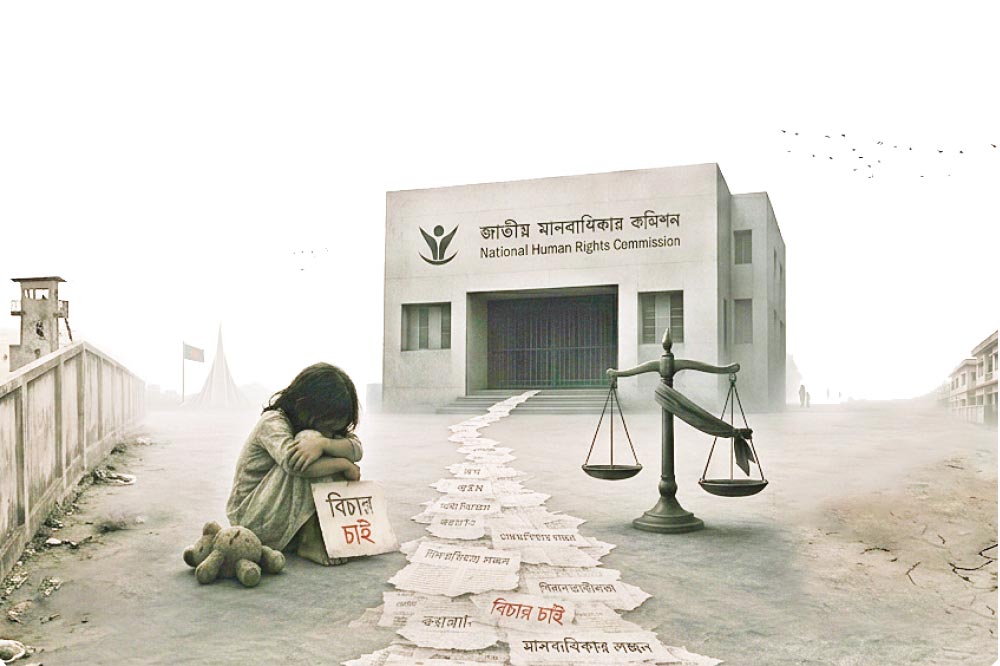
A nation is often judged not by the strength of its government but by the strength of the institutions that stand between power and the powerless. In Bangladesh, that safeguard has steadily faded since the July Movement of 2024.
The election of the BNP-led government revived hopes that the rule of law would once again be anchored in functioning public institutions. The new administration has introduced positive reforms in several sectors but it has yet to restore the country's foremost human rights body. The numerous ordinances promulgated during the interim administration placed an enormous legislative burden on the newly elected Parliament, which was expected to convert them into Acts during its first session. Many failed to survive that process, including the ordinances concerning the Anti-Corruption Commission (ACC) and the NHRC.
Nonetheless, the government has already constituted a search committee to recommend candidates for the leadership of the ACC under the Anti-Corruption Commission Act, 2004. Yet no comparable initiative has been undertaken to revive the NHRC, despite repeated appeals from human rights defenders and the growing number of people seeking institutional protection.
The origins of this vacuum can be traced to the political transition that followed the July uprising. After collapse of Sheikh Hasina led government, several constitutional and statutory institutions including NHRC were thrown into uncertainty. On November 7, 2024, NHRC became effectively defunct after its chairman Kamal Uddin Ahmed and all the commissioners stepping down. Several commission officials later told the media that the members had been "forced to resign."
For the next 18 months, promises replaced action. Advisers to the interim government repeatedly pledged to overhaul the commission and establish a model rights institution. Those assurances echoed through official briefings but produced little beyond expectation. As the administration approached the end of its tenure, it finally promulgated the National Human Rights Commission Ordinance, 2025, through a gazette notification issued on November 9, 2025. By then, however, the commission had already spent a year without effective leadership while allegations of human rights violations continued to mount.
The interim administration eventually reconstituted the commission on February 5, 2026. Former High Court judge Moyeenul Islam Chowdhury was appointed chairperson, while Mohammad Nur Khan, Nabila Idris, Dhaka University teacher Mohammad Sharif Ul Islam and human rights activist Ilira Dewan became members.
The appointments, however, arrived against the backdrop of a worsening human rights record. Reports published by rights organisations documented an alarming rise in mob violence during the institutional vacuum. Between September 2024 and January 2026, at least 259 people were killed in 413 lynching incidents.
The statistics tell only part of the story. Across towns and villages, rumours increasingly replaced evidence, and suspicion became a substitute for justice. Men accused of theft or blasphemy were beaten to death before any investigation could begin.
The Moyeenul Islam Commission functioned for 62 days only and disposed of just 54 complaints before resigning on April 9 this year, after Parliament passed the National Human Rights Commission (Repeal and Re-enactment) Bill. With that resignation, the institution slipped once more into uncertainty, leaving Bangladesh without a functioning statutory human rights watchdog.
Without a functioning NHRC, allegations of abuse have accumulated while the country's principal human rights body has remained unable to receive complaints, conduct inquiries or speak with the authority entrusted to it by law.
Monitoring reports published in June 2026 suggest that the human rights climate deteriorated further after the general election. Injuries arising from political violence reportedly rose by 77 per cent, while deaths linked to mob attacks remained persistently high.
The number of mass arrests also increased more than sevenfold, climbing from 65 in May to 473 in June. Together, these figures have fuelled renewed concern over due process, judicial impartiality and the risk of politically motivated repression. Yet amid this increasingly fragile landscape, the NHRC has remained a silent spectator, unable to investigate fresh allegations or intervene where public confidence demands an independent voice.
The consequences reach far beyond statistics. Every unresolved complaint represents a citizen denied recognition; every unattended allegation weakens confidence in the rule of law. For families searching for justice after a lynching, for women subjected to sexual violence, for members of minority communities living in fear or for relatives seeking answers after a custodial death, the commission was intended to be more than another state institution.
The government has already prepared the draft National Human Rights Commission Act, 2026, which is expected to be placed before Parliament in due course. The proposed legislation offers an opportunity not merely to replace an ordinance but to rebuild public confidence in one of the country's most important statutory institutions.
Until the new law is enacted and comes into force, there is a compelling case for establishing an interim commission, much as the government has already done in the case of the ACC. Silence, however unintended, risks being interpreted as indifference.
Loading...
Loading...
Also read



Editor : Iqbal Sobhan Chowdhury
Published by the Editor on behalf of the Observer Ltd. from Globe Printers, 24/A, New Eskaton Road, Ramna, Dhaka.
Editorial, News and Commercial Offices : Aziz Bhaban (2nd floor), 93, Motijheel C/A, Dhaka-1000.
Phone: PABX- 41053001-06; Advertisement: 41053012; 01793317829, 01550707291, E-mail: [email protected], [email protected] Online: email: [email protected] 41053014; 01550707297 Advertisement: 01550707296
Published by the Editor on behalf of the Observer Ltd. from Globe Printers, 24/A, New Eskaton Road, Ramna, Dhaka.
Editorial, News and Commercial Offices : Aziz Bhaban (2nd floor), 93, Motijheel C/A, Dhaka-1000.
Phone: PABX- 41053001-06; Advertisement: 41053012; 01793317829, 01550707291, E-mail: [email protected], [email protected] Online: email: [email protected] 41053014; 01550707297 Advertisement: 01550707296


