



| HEADLINE |

|

Bangla edition of sphere handbook launched to strengthen humanitarian standards in Bangladesh
Published : Sunday, 26 July, 2026 at 6:01 PM
Observer Online Desk


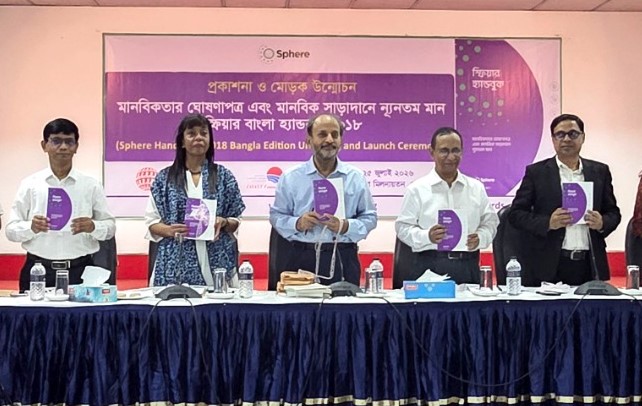
Humanitarian actors must ensure disaster-affected people receive assistance with dignity while upholding globally recognised standards of quality, accountability and inclusion, speakers said at the launch of the Bangla edition of the Sphere Handbook in Dhaka on Saturday.
The Bangla edition of the Sphere Handbook was officially launched in Dhaka on Saturday, with government officials, UN representatives and humanitarian leaders describing it as a significant step towards improving the quality and accountability of humanitarian response in Bangladesh.
The event was organised by Sphere Community Bangladesh (SCB), COAST Foundation and Disaster Forum. SCB serves as a platform to promote Sphere standards and strengthen quality and accountability in humanitarian action across the country.
The Sphere Handbook contains the Humanitarian Charter, Protection Principles, the Core Humanitarian Standard (CHS), and minimum standards for health, water, sanitation and hygiene (WASH), food security, nutrition, shelter and settlement. Speakers said the Bangla version would enable frontline responders and humanitarian practitioners to better understand and implement these internationally recognised standards during emergencies.
Director General of the Department of Disaster Management under the Ministry of Disaster Management and Relief, Razwanur Rahman, attended the event as the chief guest. United Nations Resident Coordinator in Bangladesh Carol Flore-Smereczniak, UNHCR Deputy Representative Juliette Murekeyisoni, and Director (MIM) of the Directorate of Disaster Management Netai Chandra Dey Sarkar were present as special guests.
The session was chaired by Disaster Forum Member Secretary Gawher Nayeem Wahra and moderated by Md Iqbal Uddin.
Addressing the event, Razwanur Rahman described the Bangla translation of the Sphere Handbook as an important milestone in institutionalising humanitarian standards within government systems.
“Applying humanitarian standards and translating the Sphere Handbook are key steps towards embedding these standards into government Standard Operating Procedures,” he said.
UN Resident Coordinator Carol Flore-Smereczniak underscored the need to translate policy commitments into practical action.
“We need to move from ‘paper to practice’ to provide timely and dignified aid,” she said.
UNHCR Deputy Representative Juliette Murekeyisoni said the localisation of the handbook would strengthen accountability, inclusivity and the overall effectiveness of humanitarian operations.
COAST Foundation Executive Director Rezaul Karim Chowdhury said the organisation would use the handbook to ensure its humanitarian response aligns with globally accepted standards.
Sphere Secretariat representative Zunaira Shams highlighted the importance of disability inclusion in humanitarian standards, while Sphere Regional Focal for Asia Tooba Siddiqi stressed the need for stronger advocacy to promote localisation.
Takeshi Komino of the Asian Disaster Reduction and Response Network said disaster-affected communities should be aware of their rights and entitlements so they can hold humanitarian actors accountable.
Kobita Bose of Plan International Bangladesh called for a coordinated humanitarian action plan, while Tahmina Haque of the NGO Platform Cox’s Bazar emphasised broader application of Sphere standards in the Rohingya response.
Representatives from UN agencies, international and national NGOs, and other humanitarian organisations also attended the programme.
-HIS

Loading...
Loading...
Also read








Editor : Iqbal Sobhan Chowdhury
Published by the Editor on behalf of the Observer Ltd. from Globe Printers, 24/A, New Eskaton Road, Ramna, Dhaka.
Editorial, News and Commercial Offices : Aziz Bhaban (2nd floor), 93, Motijheel C/A, Dhaka-1000.
Phone: PABX- 41053001-06; Advertisement: 41053012; 01793317829, 01550707291, E-mail: [email protected], [email protected] Online: email: [email protected] 41053014; 01550707297 Advertisement: 01550707296
Published by the Editor on behalf of the Observer Ltd. from Globe Printers, 24/A, New Eskaton Road, Ramna, Dhaka.
Editorial, News and Commercial Offices : Aziz Bhaban (2nd floor), 93, Motijheel C/A, Dhaka-1000.
Phone: PABX- 41053001-06; Advertisement: 41053012; 01793317829, 01550707291, E-mail: [email protected], [email protected] Online: email: [email protected] 41053014; 01550707297 Advertisement: 01550707296


