



| HEADLINE |

|

Billions Tk Dhaka-Gazipur BRT project now facing uncertainty
Published : Monday, 27 July, 2026 at 12:00 AM
Tanvir Raihan


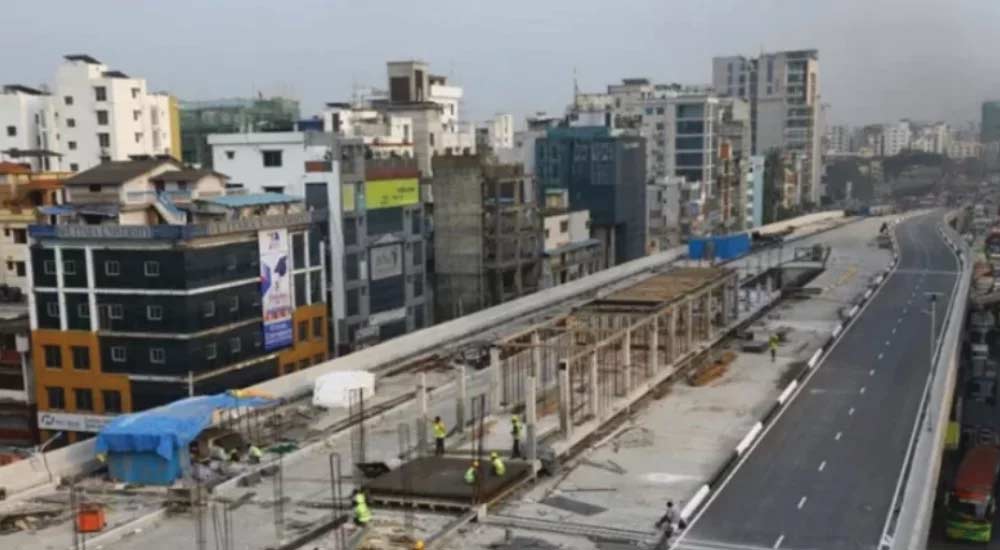 Conceived as a flagship public transport initiative to transform commuting between Hazrat Shahjalal International Airport and Gazipur, the Bus Rapid Transit (BRT) project was launched in 2012 with the promise of providing fast, uninterrupted travel through dedicated bus lanes.
The project was originally scheduled for completion within four years, with operations expected to begin in 2017. However, 14 years later, the service has yet to commence. Construction remains incomplete, costs have escalated significantly, and parts of the infrastructure have already begun to deteriorate before being put into use. The government is now considering whether to abandon the project altogether or inject billions of taka more to make it operational.
An investigation found that the project's initial estimated cost was Tk 20.40 billion. Following three revisions, the cost increased to Tk 42.68 billion. A fourth revision later proposed raising the budget to Tk 65.98 billion, although it has yet to receive approval. So far, Tk 28.11 billion has been spent without a single BRT bus entering service.
A panel of experts from the Bangladesh University of Engineering and Technology (BUET), appointed by the Ministry of Road Transport and Bridges to review the project, described it as an example of a "systemic failure" in Bangladesh's infrastructure planning and implementation.
According to the experts, the project suffered from fundamental weaknesses from the outset, including an inadequate feasibility study, serious design deficiencies, poor coordination among implementing agencies, and a lack of effective accountability throughout the implementation process.
A visit to several BRT stations between the airport and Gazipur revealed that many of the facilities remain unusable. Escalators are out of service, lifts are deteriorating, and portions of the infrastructure have begun to decay after remaining unused for years, raising concerns over the effective use of public funds.
Transport experts argue that successful BRT systems around the world are generally built on roads with 12 to 14 lanes. In contrast, much of the Dhaka-Gazipur highway consists of only four lanes. Allocating two of those lanes permanently for BRT has significantly reduced road capacity for general traffic, contributing to congestion rather than easing it.
The BUET review further noted that the Airport-Gazipur corridor was not among the priority routes identified in the original Strategic Transport Plan (STP). According to the experts, the corridor was selected for the BRT project at a later stage despite concerns over its suitability.
The project has involved several government agencies, including the Roads and Highways Department (RHD), the Bridges Division, the Local Government Engineering Department (LGED), Dhaka Bus Rapid Transit Company Limited (DBRTCL), and the Dhaka Transport Coordination Authority (DTCA), alongside several local and international consultants.
Experts believe the absence of effective coordination among these institutions became one of the project's most significant weaknesses, delaying implementation and complicating decision-making.
The expert review suggests that abandoning the project would not necessarily reduce financial losses. Removing concrete barriers, demolishing stations, dismantling escalators and lifts, and compensating contractors would require substantial additional expenditure.
Conversely, making the system operational would require more than Tk 35 billion to procure specialised BRT buses and complete the remaining works.
Although the BUET panel did not single out any individual for responsibility, it recommended examining the roles of the feasibility study consultants, foreign design firms, implementing agencies, government officials, the Planning Commission, the Implementation Monitoring and Evaluation Division (IMED), and the project's development partners.
The experts stressed that accountability should be established to determine why such a large public investment failed to deliver its intended outcome.
Road, Rail and Water Transport Minister Sheikh Robiul Alam said opinions remain divided over the project's future.
"There are strong arguments both for cancelling the project and for completing it with additional investment. The government will take a final decision after consulting all stakeholders," he said.Professor Shamsul Haque, who led the BUET expert panel, described the BRT as a project that had been "imposed from the outset."
"The feasibility study and engineering design contained fundamental flaws. Neither the Planning Commission nor the implementing agencies identified these shortcomings in time. Future infrastructure projects must undergo rigorous technical scrutiny and independent evaluation before implementation," he said.
The Bangladesh Institute of Planners (BIP) believes that scrapping the project after most of the physical infrastructure has already been built could result in even greater financial losses. Instead, planners have suggested exploring options to repurpose or redesign the existing infrastructure before taking a final decision.
The government now faces three broad options: abandon the project and convert the infrastructure for general road use, invest additional funds to make the BRT operational, or redesign the project by integrating it with other public transport systems.
Whatever decision is ultimately taken, the Dhaka-Gazipur BRT project is likely to remain a significant case study in Bangladesh's infrastructure governance, highlighting the importance of sound planning, technical due diligence, institutional coordination and accountability in implementing large-scale public investment projects.

Loading...
Loading...
Also read



Editor : Iqbal Sobhan Chowdhury
Published by the Editor on behalf of the Observer Ltd. from Globe Printers, 24/A, New Eskaton Road, Ramna, Dhaka.
Editorial, News and Commercial Offices : Aziz Bhaban (2nd floor), 93, Motijheel C/A, Dhaka-1000.
Phone: PABX- 41053001-06; Advertisement: 41053012; 01793317829, 01550707291, E-mail: [email protected], [email protected] Online: email: [email protected] 41053014; 01550707297 Advertisement: 01550707296
Published by the Editor on behalf of the Observer Ltd. from Globe Printers, 24/A, New Eskaton Road, Ramna, Dhaka.
Editorial, News and Commercial Offices : Aziz Bhaban (2nd floor), 93, Motijheel C/A, Dhaka-1000.
Phone: PABX- 41053001-06; Advertisement: 41053012; 01793317829, 01550707291, E-mail: [email protected], [email protected] Online: email: [email protected] 41053014; 01550707297 Advertisement: 01550707296


