



| HEADLINE |

|

Key challenges facing Bangladesh tourism industry
Published : Tuesday, 28 July, 2026 at 12:00 AM
Mohosinul Karim


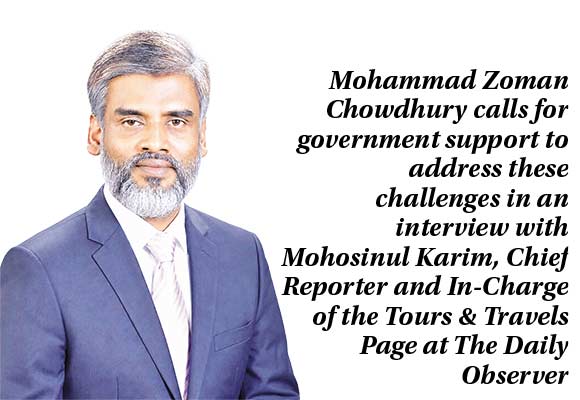 Former President of the Aviation Club and former Vice Chairman of the Association of Travel Agents of Bangladesh (ATAB), Dhaka Region, Mohammad Zoman Chowdhury, says Bangladesh's tourism industry has enormous potential but continues to face major obstacles, including inadequate infrastructure, limited air connectivity, accommodation shortages and insufficient government support.
In an exclusive interview at his Nayapaltan office, the proprietor of Elham Travel Corporation and veteran travel operator shared his assessment of the sector's current challenges and outlined the measures needed to unlock its full potential.
Asked about the industry's biggest challenges, Zoman Chowdhury said the shortage of quality accommodation remains one of the most critical issues. Many tourist destinations still lack sufficient standard hotels, motels, guest houses and rest houses capable of meeting the expectations of domestic and international visitors.
Security is another major concern, he said, stressing that tourists must feel safe throughout their journey-from transportation and accommodation to visits at tourist attractions. Although the situation has improved in some areas, comprehensive security arrangements are still needed across both established and emerging destinations.
He also highlighted inadequate infrastructure, noting that better roads, highways, transport services and supporting facilities are essential to ensure comfortable travel nationwide.
According to him, visa-related complications continue to create barriers for both foreign visitors and outbound Bangladeshi travellers. At the same time, Bangladesh's aviation sector is facing serious challenges, as several international airlines have suspended or reduced operations, creating an acute shortage of airline seats.
"Despite growing demand for international travel, travel agencies are often unable to arrange sufficient tickets for their clients," he said, adding that operators are losing business opportunities while struggling with high operating costs, including office maintenance, staff salaries and administrative expenses. Evaluating the government's role, Zoman Chowdhury said visible initiatives remain limited. While some improvements have been made in security and infrastructure, including road development and accommodation facilities in selected destinations, these represent only the initial stages of progress.
He credited private entrepreneurs for driving the industry's growth, saying investors have established hotels, resorts, travel agencies, transport services and other tourism-related businesses despite limited policy support. "The private sector deserves much of the credit for sustaining and expanding Bangladesh's tourism industry. With stronger public-private collaboration, the sector could achieve significantly greater success," he said.
On government priorities, he urged authorities to improve air connectivity by increasing airline seat availability and encouraging more international carriers to operate flights to and from Bangladesh. He also called for expanding quality hotels, resorts and guest houses, simplifying visa procedures, improving road, transport and digital connectivity, and strengthening tourist police, emergency response systems and destination management.
He recommended greater financial support for tourism businesses through tax incentives, easier access to financing and lower travel-related taxes to help travel agencies, tour operators and hospitality businesses recover and invest in future growth.
"Bangladesh's tourism sector has tremendous potential to contribute to economic development, employment generation and foreign exchange earnings. With coordinated efforts between the government and private sector, the country can emerge as a competitive tourism destination in South Asia," he concluded.

Loading...
Loading...
Also read



Editor : Iqbal Sobhan Chowdhury
Published by the Editor on behalf of the Observer Ltd. from Globe Printers, 24/A, New Eskaton Road, Ramna, Dhaka.
Editorial, News and Commercial Offices : Aziz Bhaban (2nd floor), 93, Motijheel C/A, Dhaka-1000.
Phone: PABX- 41053001-06; Advertisement: 41053012; 01793317829, 01550707291, E-mail: [email protected], [email protected] Online: email: [email protected] 41053014; 01550707297 Advertisement: 01550707296
Published by the Editor on behalf of the Observer Ltd. from Globe Printers, 24/A, New Eskaton Road, Ramna, Dhaka.
Editorial, News and Commercial Offices : Aziz Bhaban (2nd floor), 93, Motijheel C/A, Dhaka-1000.
Phone: PABX- 41053001-06; Advertisement: 41053012; 01793317829, 01550707291, E-mail: [email protected], [email protected] Online: email: [email protected] 41053014; 01550707297 Advertisement: 01550707296


