



| HEADLINE |

|

Speculations, allegations, realities haunting ex-president Shahabuddin



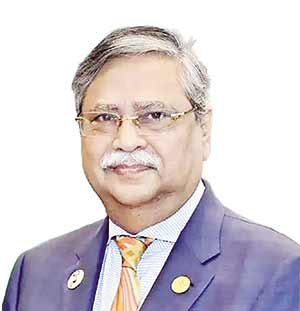 On Friday, 24 July, a chapter of Bangladesh's constitutional history quietly closed when Md. Sahabuddin submitted his resignation to Speaker Hafiz Uddin Ahmed. It was an unceremonious departure, but its repercussions have been far from quiet. He left Bangabhaban one day after his resignation and staying at his Gulshan flat.
Citing a succession of illnesses, the outgoing President stepped down one year and nine months before his term was due to expire, saying he could no longer shoulder the constitutional burdens of office. Yet his exit has deepened, rather than settled, the debate. Calls for his arrest and trial have thrust Article 51 into the spotlight, reigniting a legal and political contest over presidential immunity, the divide between official and private acts, and the constitutional limits of accountability.
Adding fuel to this already smouldering fire, Bangladesh Azad Party has filed a complaint with the International Crimes Tribunal (ICT), seeking an investigation into Sahabuddin and his predecessor, Abdul Hamid, over alleged crimes against humanity during the July uprising. How the ICT reacts to such complaint will be watched by legal experts.
Arrest demands and controversy
Since his departure, a chorus of political voices including the Jamaat-e-Islam, National Citizen Party (NCP), Bangladesh Khelafat Majlis and Inqilab Manch have called for Sahabuddin's arrest and prosecution. Yet not all quarters share this appetite. The Prime Minister's political assistant, Md. Rashed Khan, took to Facebook with a pointed rebuttal, "If Nahid Islam of NCP had formed a revolutionary government without taking the oath of office from the President in accordance with the constitution, there would have been no question of impunity." He continued, with no small measure of irony, "You cannot forgive someone and evaluate him in a new way and demand his trial again... Why was this trial not done during their interim government?"
Government's position and Shahabuddin's future
Home Minister and influential BNP Standing Committee member Salahuddin Ahmed struck a more measured, almost elegiac note. "We see the presidency as an institution," he said. "He discharged his duties as per constitution with dignity and cooperated with our government." Acknowledging criticism of Sahabuddin's role during the final days of the previous regime, he maintained that "the role he played from August 5 to 8, before the formation of the interim government, was very important. His role in keeping the state on the constitutional path during the crisis deserves praise." He added: "According to the Constitution, he enjoys immunity and cannot be prosecuted for criminal offences."
Acting President Hafiz Uddin Ahmed also praised the role of Shahabuddin.
Law Minister Md. Asaduzzaman adopted a more cautious tone, saying any case against the former President "will be scrutinised," including the motives behind the allegations. "The President is protected by law," he said, stopping short of ruling out legal proceedings.
Sahabuddin, however, met the controversy with quiet defiance. "I do not pay any attention to these," he said. "I am not a criminal. I served as President with my head held high. I handled the crisis that arose after August 5, 2024."
Is his political career at the root of the controversy?
To understand the suspicion surrounding Sahabuddin, one must trace a career that mirrors the shifting currents of Bangladesh's public life. He founded the Chhatra League in Pabna, fought in the Liberation War, and was imprisoned after Bangabandhu's assassination in 1975. He later joined the judiciary, retiring as a district and sessions judge, before chairing the Awami League government's inquiry into the 2001 post-election violence. In 2011, he became an Anti-Corruption Commission Commissioner and, after completing that term, joined the Awami League's Advisory Council. In 2023, the party nominated him unopposed for the presidency. Sworn in as Bangladesh's 22nd President on April 24, 2023, he went on to administer the oath to three successive governments-the Awami League, the interim government and finally the BNP.
Political motives and controversies
His presidency was never destined for a quiet retirement. Questions over his political pedigree gave way to legal entanglements, the wrath of July Movement participants, controversy over Prime Minister Sheikh Hasina's resignation letter, and mounting friction with the interim government. Parliament, too, became a stage for his discomfort: the Jamaat-NCP alliance turned his first address to the 13th National Assembly into a trial by fire, which he weathered, famously, with a smile. A little over five months into the BNP government, the decision to step down was finally taken. Even after the BNP's victory in the 2026 elections, his continued tenure had seemed, for a while, assured - until, analysts suggest, a certain distance opened between him and his erstwhile patrons, and word filtered down from the party's upper echelons that resignation was now the preferred course.
When past history becomes a tool of politics
Sahabuddin's post-judicial career carries its own shadows. He served as Vice Chairman of Islami Bank Bangladesh Limited from 2017 to 2023, after serving as an ACC commissioner from 2011 to 2016-a post that, under the ACC Act, bars its holders from later accepting profitable positions in the Republic. Whether the presidency itself constitutes such a "profitable position" was contested in the High Court, which in March 2023 dismissed his writ petitions challenging his own election. More seriously, the Bangladesh Financial Intelligence Unit informed the High Court that Sahabuddin and his firm, JMC Builders, were among 24 companies implicated in Islami Bank's alleged Tk 80,000 crore share scandal involving unpaid loans taken while he was the bank's vice chairman.
Constitutional protection
Sahabuddin has answered every allegation with the same terse refrain. "What will you judge?" he asked reporters last Friday. "Let them read Article 51 of the Constitution." He has described his years in Bangabhaban as confinement and his resignation as "liberation"-a word he uses, tellingly, without irony.
Article 51 provides two layers of protection. Under Article 51(1), the President cannot be held accountable in court for acts performed in the discharge of official duties, though this does not prevent him from suing the state. Article 51(2) goes further, barring criminal proceedings or arrest warrants against a sitting President-but only during the term of office.
Constitutional expert Dr Shahdeen Malik argues that Article 51(2) offers no blanket immunity, saying corruption, criminal offences or acts predating the presidency remain subject to prosecution after a President leaves office. Senior Supreme Court advocate ZI Khan Panna disagrees, questioning why such allegations were not pursued earlier and maintaining that Sahabuddin may still find protection under Article 51.
Justice in the mould of Ershad?
Comparisons to Hussain Muhammad Ershad are inevitable, if imperfect. Ershad, toppled by the 1990 mass uprising, spent nearly five years in Dhaka Central Jail on charges of corruption and abuse of power. Twenty-seven cases were filed against him upon his fall on 6 December 1990; the tally eventually swelled to forty-three. He was released on bail on 9 January 1997, after six years behind bars.
Yet the analogy has its limits. Ershad, as chief executive of a Presidential System, bore direct responsibility for the machinery of the state and could not entirely hide behind Section 51 for his personal crimes. Sahabuddin, by contrast, presided over a Parliamentary System in which executive power rests chiefly with the Prime Minister; under Article 48(3), the President acts largely on the Cabinet's advice. The foundation for prosecuting him, several analysts caution, is accordingly far less certain.
Waiting for time
Whether a case is ultimately filed will hinge on the nature of the allegations, the evidence unearthed, and the diligence of investigators. The Constitution grants no permanent sanctuary, but neither does political clamour alone suffice to summon a prosecutor or a warrant; in the end, statute and the courts will have the final word.
Sahabuddin's resignation has ended one constitutional chapter but opened another. His future now rests not on political rhetoric but on investigations, constitutional interpretation and judicial determination. At the heart of the debate lies Article 51: whether presidential immunity shields only official acts or extends beyond the office itself. The answer may shape not only Sahabuddin's fate but also a defining constitutional precedent for the Republic.

Loading...
Loading...
Also read



Editor : Iqbal Sobhan Chowdhury
Published by the Editor on behalf of the Observer Ltd. from Globe Printers, 24/A, New Eskaton Road, Ramna, Dhaka.
Editorial, News and Commercial Offices : Aziz Bhaban (2nd floor), 93, Motijheel C/A, Dhaka-1000.
Phone: PABX- 41053001-06; Advertisement: 41053012; 01793317829, 01550707291, E-mail: [email protected], [email protected] Online: email: [email protected] 41053014; 01550707297 Advertisement: 01550707296
Published by the Editor on behalf of the Observer Ltd. from Globe Printers, 24/A, New Eskaton Road, Ramna, Dhaka.
Editorial, News and Commercial Offices : Aziz Bhaban (2nd floor), 93, Motijheel C/A, Dhaka-1000.
Phone: PABX- 41053001-06; Advertisement: 41053012; 01793317829, 01550707291, E-mail: [email protected], [email protected] Online: email: [email protected] 41053014; 01550707297 Advertisement: 01550707296


