



| HEADLINE |

|

Delay In Metro Rail Construction
Thousands of crores at risk
Published : Sunday, 4 October, 2026 at 12:00 AM
Staff Correspondent


 Prolonged delays in two major metro rail projects in Dhaka have pushed their combined estimated cost to more than Tk 2.04 lakh crore, raising concerns over the growing financial burden on the state.
MRT Line-1 and MRT Line-5 Northern Route were originally approved at a combined cost of about Tk 93,800 crore. Following revisions approved by the Executive Committee of the National Economic Council (ECNEC) in September 2026, their combined cost increased to Tk 2,04,243 crore - an additional Tk 1,10,443 crore, or around 118 per cent.
The projects, financed largely by the Japan International Cooperation Agency (JICA), have faced prolonged procurement difficulties, design changes, inflation, taka depreciation and rising financing costs.
MRT Line-1, Bangladesh's first underground metro rail project, was approved in 2019 at Tk 52,561.43 crore. Its revised cost now stands at Tk 1,14,394.89 crore, an increase of Tk 61,833.46 crore, or 117.64 percent.
The 31.24-kilometre route will connect Hazrat Shahjalal International Airport with Kamalapur, with an elevated extension from Natun Bazar towards Purbachal. The revised financing includes a JICA loan of Tk 83,842.63 crore.
The project has also been hit by procurement problems. According to reporting based on project documents, the Dhaka Mass Transit Company Limited (DMTCL) halted procurement after bids for major packages came in around 90-100 percent above the costs set in the original Development Project Proforma.
Limited bidder participation and concerns over tender structures also emerged, prompting plans for fresh international competitive tenders.
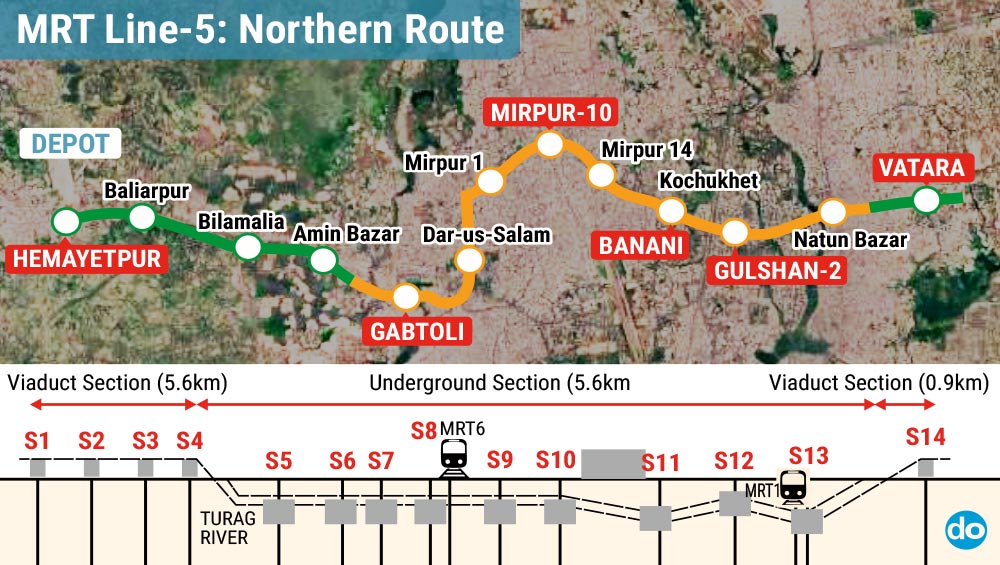
MRT Line-5 Northern Route has seen a similar escalation. The 20-kilometre route from Hemayetpur to Vatara was originally estimated at Tk 41,238.54 crore. Its revised cost has risen to Tk 89,848.36 crore, an increase of Tk 48,609.82 crore, or 117.87 per cent.
The route will comprise 13.50 kilometres underground and 6.50 kilometres elevated, with 14 stations.
Project authorities and government officials have cited inflation, taka depreciation, higher construction and material prices, changes in detailed engineering designs, additional traffic-management arrangements and increased costs of imported equipment as reasons for the escalation.
For MRT Line-1, design changes resulted in larger stations, relocated entrances and exits, additional ventilation requirements and other engineering modifications. Extensive diversion roads and utility relocation are also required during construction.
The exchange rate is another major factor, as a large portion of metro rail equipment and construction inputs must be imported.
Financing costs have also risen. Bangladesh initially secured JICA financing in 2019 at concessional interest rates of 0.6-0.9 percent. Terms for subsequent financing were not fully locked in at that time, while recent reports indicate that new JICA financing could carry rates of around 3.5 percent or more.
Delays can therefore increase both construction costs and the long-term cost of borrowing.
Procurement delays can further compound the problem. When tenders remain unresolved for a long period, contractors face higher labour, material and financing costs. Prices submitted under earlier market conditions may no longer remain viable, potentially forcing re-tendering and causing further delays.
The government has now begun moving ahead with major procurement packages after ECNEC approved the revised project proposals.
However, the revised approvals leave an important question over how the additional Tk 1.1 lakh crore accumulated.
Inflation, exchange-rate depreciation, supply-chain disruptions, engineering changes and higher financing costs are measurable factors that can raise infrastructure costs. But they may not explain every increase.
A transparent review of the decision-making and procurement timelines is therefore necessary to establish when key decisions were taken, where they remained pending, why tender prices differed so sharply from the original estimates and why procurement had to be halted.
The distinction is important. Additional costs arising from unavoidable external factors should be identified, while any costs linked to avoidable delays or administrative decisions should also be documented. Metro rail is a major part of Dhaka's future transport system, but the scale of investment makes financial accountability equally important.
The two projects now carry more than Tk 1.1 lakh crore in additional estimated costs compared with their original combined budget. The government's approval of the revised costs should therefore be followed by close scrutiny of the delays, procurement process and financing arrangements that have placed thousands of crores of additional public money at stake.
Loading...
Loading...
Also read



Editor : Iqbal Sobhan Chowdhury
Published by the Editor on behalf of the Observer Ltd. from Globe Printers, 24/A, New Eskaton Road, Ramna, Dhaka.
Editorial, News and Commercial Offices : Aziz Bhaban (2nd floor), 93, Motijheel C/A, Dhaka-1000.
Phone: PABX- 41053001-06; Advertisement: 41053012; 01793317829, 01550707291, E-mail: [email protected], [email protected] Online: email: [email protected] 41053014; 01550707297 Advertisement: 01550707296
Published by the Editor on behalf of the Observer Ltd. from Globe Printers, 24/A, New Eskaton Road, Ramna, Dhaka.
Editorial, News and Commercial Offices : Aziz Bhaban (2nd floor), 93, Motijheel C/A, Dhaka-1000.
Phone: PABX- 41053001-06; Advertisement: 41053012; 01793317829, 01550707291, E-mail: [email protected], [email protected] Online: email: [email protected] 41053014; 01550707297 Advertisement: 01550707296


