



| HEADLINE |

|
"Let my baby live"- A mother’s prayer in Gaza
Published : Saturday, 1 August, 2026 at 8:52 PM
Hasibul Islam


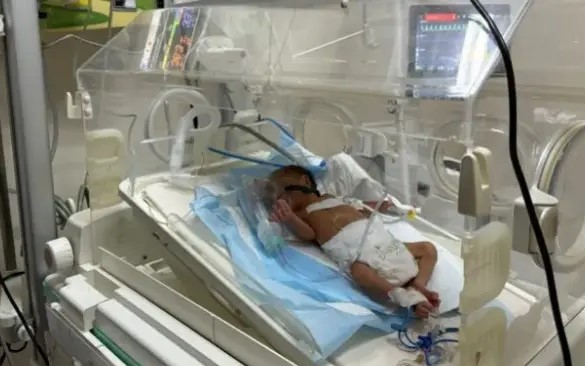
A newborn’s first cry is usually the sound of joy that fills a hospital room. But when baby Yazan Al-Khalidi entered the world, there was only silence. He did not cry, he could not be placed in his mother’s arms, and within moments he was rushed to a neonatal intensive care unit. Behind the glass wall of the incubator, his mother Noor Salem could only watch and pray, fearing she might lose another child in war-torn Gaza.
Instead of his mother’s embrace, Yazan’s first days of life have been spent inside the glass walls of an incubator. Every day, Noor Salem stands outside the neonatal intensive care unit, watching her baby’s chest rise and fall. The sight that her child is still breathing has become her greatest source of hope.
For 30-year-old Noor, motherhood has been marked more by pain than celebration. During Gaza’s famine in 2025, she lost her first child shortly after birth. Before the wounds of that loss could heal, she became pregnant again, this time carrying her baby through months of war, hunger and uncertainty.
Her worst fears returned when Yazan was born prematurely in the eighth month of pregnancy. Moments after birth, his body turned bluish. He was not crying and struggled to breathe. Doctors immediately transferred him to the neonatal intensive care unit at Al-Aqsa Martyrs Hospital in Deir al-Balah, central Gaza.
“When I saw that my son was not moving like other babies and was not crying, I felt I might lose him again,” Noor said. “I only want my child to survive.”
A war that begins at birth
The war in Gaza has not only destroyed homes and infrastructure, it has severely damaged the healthcare system. Among the most vulnerable victims are newborn babies fighting for survival from their first moments of life.
According to UNICEF, one in every five newborns in Gaza requires intensive medical care or special temperature support.
Doctors say cases of premature births, low birth-weight babies, stillbirths and birth complications have increased due to malnutrition, repeated displacement, extreme stress and the collapse of prenatal healthcare services.
Shortage of incubators, medicine and hope
Dr Afnan Abu Hasaballah, an obstetrician and gynecologist working at the Nuseirat refugee camp, said hospitals are receiving increasing numbers of pregnant women showing clear signs of malnutrition.
Some have gone days without adequate food. Others have fallen ill due to a lack of clean water. Many have endured pregnancy while living under the constant fear of airstrikes.
“These conditions have greatly increased the risk of premature births,” Dr Afnan said.
Hospitals are also struggling with severe shortages. There are not enough incubators, ventilators, medicines, electricity or fuel. Doctors say some newborns are being lost despite having a chance of survival if basic treatment had been available.
The struggle continues beyond the hospital
Even after leaving the incubator, the struggle does not end for many babies. Families often return home to find there is no baby formula, no diapers, no clean water and no warm blankets.
In the Nuseirat refugee camp, the Kutuf Al-Khair Foundation is trying to provide support to pregnant women and newborns.
The organisation’s head, Akram Abu Ziab, said the need for assistance in Gaza continues to grow, but available support remains far below what is required.
“Behind every child born in Gaza is a mother fighting to keep her baby alive under unimaginable circumstances,” he said.
For mothers like Noor Salem, every breath their newborn takes is a victory. In Gaza, even the first moments of life have become a struggle for survival.
-HIS
Loading...
Loading...
Also read



Editor : Iqbal Sobhan Chowdhury
Published by the Editor on behalf of the Observer Ltd. from Globe Printers, 24/A, New Eskaton Road, Ramna, Dhaka.
Editorial, News and Commercial Offices : Aziz Bhaban (2nd floor), 93, Motijheel C/A, Dhaka-1000.
Phone: PABX- 41053001-06; Advertisement: 41053012; 01793317829, 01550707291, E-mail: [email protected], [email protected] Online: email: [email protected] 41053014; 01550707297 Advertisement: 01550707296
Published by the Editor on behalf of the Observer Ltd. from Globe Printers, 24/A, New Eskaton Road, Ramna, Dhaka.
Editorial, News and Commercial Offices : Aziz Bhaban (2nd floor), 93, Motijheel C/A, Dhaka-1000.
Phone: PABX- 41053001-06; Advertisement: 41053012; 01793317829, 01550707291, E-mail: [email protected], [email protected] Online: email: [email protected] 41053014; 01550707297 Advertisement: 01550707296


