



| HEADLINE |

|

Mosabber raises the bar for environmental journalism in Bangladesh
Published : Monday, 10 August, 2026 at 11:13 PM
Md Abdur Razzak Sarker


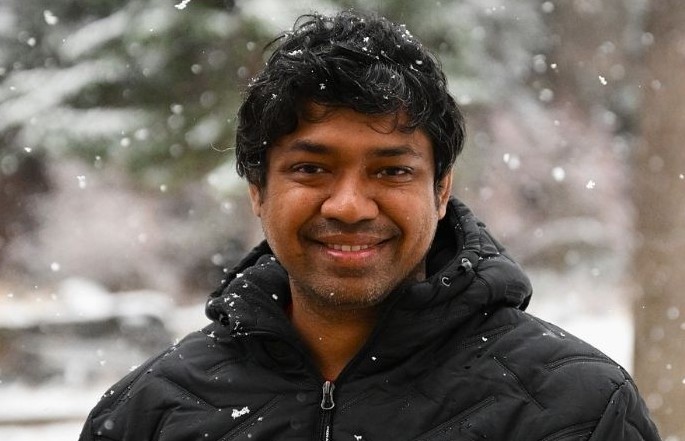
Collected Photo
Growing up near Bangladesh's Teesta River, Mosabber Hossain witnessed a cycle that repeated itself almost every year. During the monsoon, powerful currents swallowed farmland, homes and entire communities. Families who had spent generations along the river suddenly found themselves displaced, forced to rebuild their lives elsewhere.
Long before he understood the scientific language of climate change, Hossain understood its human cost.
Watching families lose everything to river erosion shaped his worldview and ultimately his career. He wanted to tell the stories of people whose voices rarely reached policymakers or national audiences. That ambition would eventually carry him far beyond Bangladesh, establishing him as an internationally recognized climate and investigative journalist. Now he is become an idol for the young reporter in Bangladesh on environment reporting.
Finding His Voice in Bangladesh's Newsrooms
Hossain began his journalism career covering local communities before joining Prothom Alo, Bangladesh's largest and most influential Bengali-language newspaper. Over the following years, he built a reputation for investigative reporting and public-interest journalism, covering climate change, environmental degradation, corruption, business, telecommunications, governance and social issues.
Rather than relying solely on official statements, he developed a reporting style grounded in field investigations, public records, scientific research and extensive interviews with affected communities.
His consistent performance and commitment to high-quality reporting earned him recognition as Prothom Alo's Best Employee in 2021 on 23rd anniversary of the most populer daily, reflecting years of distinguished work in one of Bangladesh's most competitive newsrooms.
Giving Climate-Vulnerable Communities a Global Voice
Climate reporting became the defining focus of Hossain's career. He travelled repeatedly to Bangladesh's coastal districts, where rising sea levels, cyclones, salinity intrusion and increasingly severe weather were transforming everyday life. Many of these assignments required days of travel to remote communities where people were living on the front lines of climate change.
His reporting sought to explain climate change not simply through scientific data, but through the lives of farmers losing cropland, fishermen struggling to survive, families displaced by erosion and children growing up in increasingly fragile communities.
One Reuters feature documenting the lives of climate-vulnerable coastal communities gained international attention. The story was republished by news organizations around the world, bringing the experiences of ordinary Bangladeshis to a global audience. The reporting later became part of discussions featured by the World Economic Forum, demonstrating how local journalism could influence international conversations about climate adaptation and resilience.
Recognition Beyond Bangladesh
As his reporting gained visibility, Hossain's work began attracting international recognition.
In 2014, he received the South Asian Inquirer Award from the Thomson Foundation in the United Kingdom for investigative journalism. According to his professional record, he remains the only Bangladeshi journalist to have received this South Asia-wide recognition from the Thomson Foundation.
Years later, the Thomson Foundation again highlighted his career by featuring him among eight influential journalists during its 60th anniversary celebration.
His environmental reporting also earned the Bangladesh Housing and Building Research Institute (HBRI) Climate Journalism Award. The award recognized a Reuters report examining climate-resilient and environmentally sustainable housing models from around the world, highlighting practical solutions that could help vulnerable countries such as Bangladesh adapt to climate change.
Last year Mosabber got the ‘National Tobacco Control Award 2025’ in the print media journalist category was presented on World No Tobacco Day.
Few years back including Mossabber four journalists have won the PROGGA Tobacco Control Journalism Award 2022 for their contribution in creating anti-tobacco awareness among the people. Mosabber Hossain, as a senior correspondent of Prothom Alo, won the award under the online media category. Additionally, he contributed to a climate project with Nextblue, a global news platform focused on climate issues, which won the 2022 Covering Climate Now Journalism Awards.
In 2015, I had the privilege of speaking at the GIJN conference in Norway, where he shared the behind-the-scenes story of one of my investigative reports. His investigative story plan published by GIJN’s website.
His work extended beyond published reporting. Singapore's CNA and Germany's taz conducted feature interviews with Hossain, discussing his reporting methods, environmental journalism and the challenges of covering climate change from the perspective of the Global South.
Building Influence Beyond Reporting
As Hossain's experience grew, so did his contributions to journalism beyond the newsroom.
He served as a judge for environmental journalism and environmental award programs, evaluating reporting and recognizing excellence in the field. He also taught environmental journalism, investigative reporting and media practice at several academic institutions, including the Bangladesh University of Professionals (BUP) and the National Institute of Mass Communication.
His commitment to visual storytelling became another hallmark of his work. Environmental photographs he captured during field reporting were published by The Daily Star and featured by the United Nations Development Programme (UNDP) across its digital platforms, helping communicate the human dimensions of climate change through compelling imagery.
From Bangladesh to International Climate Journalism
Seeking to strengthen his understanding of environmental science, Hossain pursued graduate study in Environmental Science and Natural Resource Journalism at the University of Montana. The interdisciplinary program brought together environmental science, public policy and journalism, enabling him to combine scientific understanding with investigative reporting. He got the Bertha Morton scholarships for his academic excellence. This year in the University of Montana this award subsequently becomes most prestigious awards for graduate students. The Graduate School awards up to 3 fellowship and approximately 20 scholarships annually.
His academic work expanded opportunities to collaborate with scientists, environmental researchers and international news organizations while continuing to report on climate-related issues.
That experience became a bridge between his reporting in Bangladesh and his work in the United States.
Reporting America's Environmental Challenges
In 2026, Hossain joined the Pulitzer Prize-winning nonprofit newsroom Inside Climate News as a Summer Fellow.
Reporting across Montana and the American West, he examined issues including mining, drought, wildfire risk, water resources and climate resilience.
Among his recent investigations was "New Gold Exploration Revives Old Fears for Montana's Blackfoot River." The investigation explored how a proposed gold exploration project revived concerns among local communities over historic mining pollution, examining the balance between economic development and long-term environmental protection.
The investigation reflected the same reporting philosophy that had guided his work in Bangladesh: combining scientific evidence, public records and the experiences of affected communities to explain complex environmental issues.
The same year, he was selected for the NYU Stern School of Business Climate Economics Journalism Fellowship, joining 36 journalists chosen from more than 1,000 applicants worldwide to study climate economics with leading scholars, economists and journalists at New York University.
A Career Built on Public Service
Over the course of his career, Hossain has received international awards, competitive fellowships, invitations to speak at global journalism conferences, recognition from respected institutions and opportunities to mentor emerging journalists. His work has crossed disciplines, combining investigative journalism, environmental science, visual storytelling and public-interest reporting.
Yet colleagues say his defining characteristic remains unchanged from the days he reported along the banks of the Teesta River: a commitment to telling the stories of people whose experiences are often overlooked.
From river erosion in Bangladesh to mining conflicts in Montana, Hossain has consistently focused on the human consequences of environmental change.
His career illustrates how local reporting, when grounded in rigorous investigation and public service, can shape conversations far beyond national borders.
Today, his reporting continues to connect communities separated by geography but united by a common challenge the growing impact of climate change on people's lives.
-HIS

Loading...
Loading...
Also read








Editor : Iqbal Sobhan Chowdhury
Published by the Editor on behalf of the Observer Ltd. from Globe Printers, 24/A, New Eskaton Road, Ramna, Dhaka.
Editorial, News and Commercial Offices : Aziz Bhaban (2nd floor), 93, Motijheel C/A, Dhaka-1000.
Phone: PABX- 41053001-06; Advertisement: 41053012; 01793317829, 01550707291, E-mail: [email protected], [email protected] Online: email: [email protected] 41053014; 01550707297 Advertisement: 01550707296
Published by the Editor on behalf of the Observer Ltd. from Globe Printers, 24/A, New Eskaton Road, Ramna, Dhaka.
Editorial, News and Commercial Offices : Aziz Bhaban (2nd floor), 93, Motijheel C/A, Dhaka-1000.
Phone: PABX- 41053001-06; Advertisement: 41053012; 01793317829, 01550707291, E-mail: [email protected], [email protected] Online: email: [email protected] 41053014; 01550707297 Advertisement: 01550707296


