



| HEADLINE |

|

Maha Navami: Behind Durga’s battle against Mahishasura
Published : Tuesday, 20 October, 2026 at 5:36 PM
Sakia Kawser Siddique


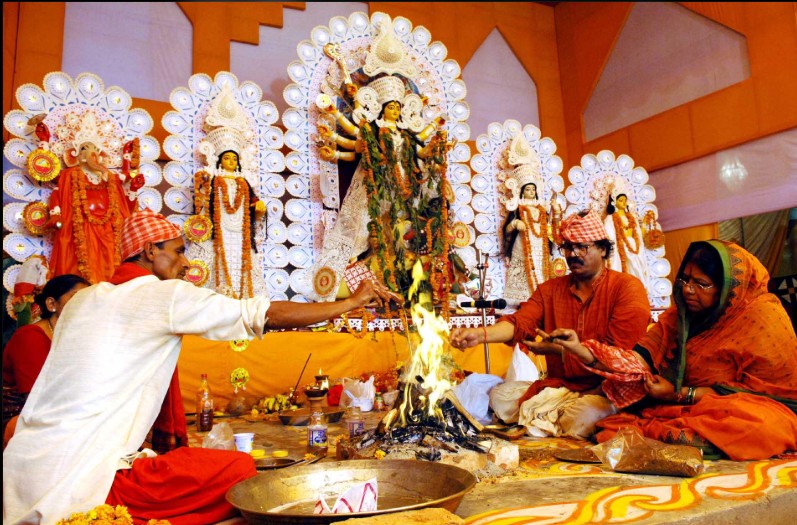
Maha Navami, observed on Tuesday, October 20, marks a major stage of the concluding worship of Goddess Durga during Sharadiya Durga Puja in Bangladesh. The day’s rituals are rooted in the mythology of the goddess’s struggle against destructive forces, most prominently her battle with Mahishasura, the buffalo demon.
The story of Mahishasura
The principal textual account of Durga’s battle with Mahishasura appears in the Devi Mahatmya, a Sanskrit work forming part of the Markandeya Purana. The text describes how Mahishasura and his forces challenge the gods, who are unable to defeat him.
The gods’ combined energies give rise to the goddess, who receives weapons from them and confronts the demon’s army. After defeating his commanders and destroying his forces, Durga faces Mahishasura himself.
The demon changes forms during the battle, including that of a buffalo. The goddess ultimately defeats him, restoring order and demonstrating the power of the divine feminine.
The story is told across several chapters of the Devi Mahatmya, particularly Chapters Two to Four. It is a religious narrative explaining the goddess’s power and victory; it should not be presented as a documented historical battle.
Why Navami matters
Maha Navami is one of the final principal days of Durga Puja. The day’s worship includes prayers and offerings to the goddess, while many communities also perform homa, a ritual involving offerings into a consecrated fire.
The details of Navami worship vary according to the tradition followed by a temple or household. In some Bengali observances, the day includes the concluding phase of the main worship and special offerings of food to the goddess.
The ritual calendar is important because the sequence of worship is determined by lunar dates rather than the Gregorian calendar alone. In Bangladesh this year, Navami falls on October 20, followed by Bijoya Dashami on October 21.

What history can establish
The history of Durga Puja rituals is documented in part through religious manuals, which prescribe ceremonies and explain how worship should be conducted. In a 2012 study published in the Journal of the Royal Asiatic Society, scholar Bihani Sarkar examined the medieval Bengali ritual manual Durgapuja-tattva, associated with Raghunandana Bhattacharya, alongside related texts.
Such works provide evidence for reconstructing ritual practice in Bengal during the medieval period. They do not establish a single historical date for the origin of every Navami observance, and the mythological account of Durga’s victory must remain distinct from the history of the festival’s ceremonies.
Worship and the triumph of good
For devotees, Maha Navami is a time to offer prayers and seek the goddess’s blessings before the festival’s final day. The story of Mahishasura’s defeat gives the worship its wider religious meaning: the restoration of order through the destruction of destructive forces.
As Durga Puja approaches Bijoya Dashami, Navami brings the main sequence of worship towards its conclusion. The day connects the ritual practices of contemporary Bengal and Bangladesh with a mythology that has shaped devotion to the goddess for centuries.
Sources: Devi Mahatmya; Journal of the Royal Asiatic Society; BSS

Loading...
Loading...
Also read




Editor : Iqbal Sobhan Chowdhury
Published by the Editor on behalf of the Observer Ltd. from Globe Printers, 24/A, New Eskaton Road, Ramna, Dhaka.
Editorial, News and Commercial Offices : Aziz Bhaban (2nd floor), 93, Motijheel C/A, Dhaka-1000.
Phone: PABX- 41053001-06; Advertisement: 41053012; 01793317829, 01550707291, E-mail: [email protected], [email protected] Online: email: [email protected] 41053014; 01550707297 Advertisement: 01550707296


