



| HEADLINE |

|

Measles to take 2-3 months to bring under control: Health Minister
Published : Wednesday, 19 August, 2026 at 1:48 PM
Observer Online Report


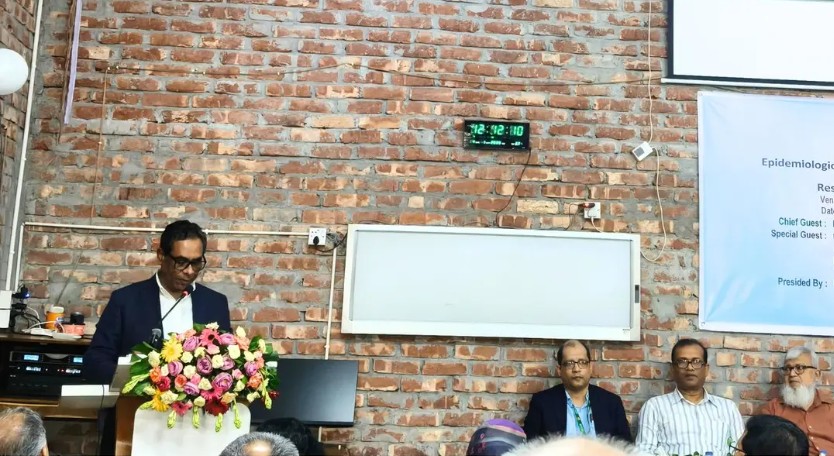
Health and Family Welfare Minister MA Muhit has said it may take at least two to three months to bring measles under control and improve the overall situation.
He made the remarks while speaking as the chief guest at a meeting on the findings of a study on measles among children at the auditorium of Bangladesh Shishu Hospital and Institute in the capital on Wednesday.
Muhit said there should be no unrealistic expectation that a long-standing problem can be resolved in a day or within the next week.
He said around 80 per cent of the country's population depends on the public healthcare system, which has faced various crises due to long-standing mismanagement, corruption and negligence.
He also said that although private hospitals and diagnostic centres have a large network, issues of quality control and profit are involved in the sector. Institutions such as Bangladesh Shishu Hospital, Holy Family and BIRDEM, however, have created a balance between the public and private healthcare sectors.
Outlining the government's future plans for child healthcare, the minister said the government is giving the highest priority to child health.
Five full-fledged children's hospitals will start operating in five divisional cities within the next two to three months, he said.
He added that 5,000 new doctors, 1,000 nurses and 100,000 new field workers would be recruited very soon to address the shortage of manpower in the health sector.
At the meeting, the findings of a joint study conducted by Bangladesh Shishu Hospital and Institute and the International Centre for Diarrhoeal Disease Research, Bangladesh (icddr,b) were also presented.
The study found that 65 per cent of children admitted to hospital with measles were suffering from malnutrition. Of them, 12 per cent had severe malnutrition and 53 per cent had moderate malnutrition.
According to the study, 43 per cent of the hospitalised children were aged between three and nine months.
It also found that 38 per cent of the affected children were not exclusively breastfed for the first six months after birth. Among children who died, however, the rate was 82 per cent.
The study further found that measles was detected in 97.3 per cent of children below nine months who were not yet eligible for routine vaccination and in 97 per cent of children who were eligible for vaccination but had not received any dose.
The meeting was chaired by Bangladesh Shishu Hospital and Institute Board Chairman Prof AKM Azizul Haque.
Director General of the Directorate General of Health Services Prof Prabhat Chandra Biswas, Director Md Nurul Islam and Institute of Epidemiology, Disease Control and Research (IEDCR) Director Kazi Ahmed Zaki spoke as special guests.
Hospital Director Prof Mirza Mohammad Ziaul Islam and icddr,b Senior Director Mustafizur Rahman presented the main findings of the study.
SKS

Loading...
Loading...
Also read



Editor : Iqbal Sobhan Chowdhury
Published by the Editor on behalf of the Observer Ltd. from Globe Printers, 24/A, New Eskaton Road, Ramna, Dhaka.
Editorial, News and Commercial Offices : Aziz Bhaban (2nd floor), 93, Motijheel C/A, Dhaka-1000.
Phone: PABX- 41053001-06; Advertisement: 41053012; 01793317829, 01550707291, E-mail: [email protected], [email protected] Online: email: [email protected] 41053014; 01550707297 Advertisement: 01550707296
Published by the Editor on behalf of the Observer Ltd. from Globe Printers, 24/A, New Eskaton Road, Ramna, Dhaka.
Editorial, News and Commercial Offices : Aziz Bhaban (2nd floor), 93, Motijheel C/A, Dhaka-1000.
Phone: PABX- 41053001-06; Advertisement: 41053012; 01793317829, 01550707291, E-mail: [email protected], [email protected] Online: email: [email protected] 41053014; 01550707297 Advertisement: 01550707296


