



| HEADLINE |

|

13,000 dwellers of two isolated chars deprived of civic services
Published : Saturday, 22 August, 2026 at 12:00 AM
Our Correspondent


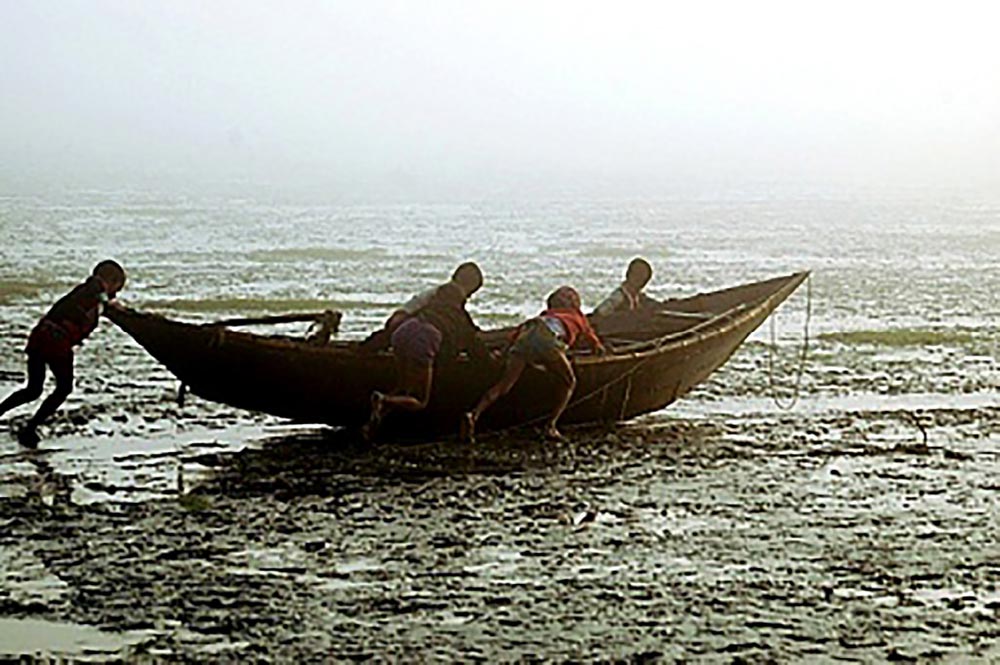 CHAR FASSON, BHOLA, Aug 21: Around 13,000 people living on two isolated chars in Char Fasson Upazila have been deprived of basic civic services for decades, struggling with poor transport, healthcare, education and safe drinking water.
Char Nizam and Char Alam, under Dhalchar Union, are located near the confluence of the Meghna River and the Bay of Bengal.
People have been living there for around five decades, but geographical isolation has kept them largely beyond the reach of essential public services.
Residents have to depend on engine-powered trawlers or boats to travel to the mainland. During the monsoon, crossing the turbulent Meghna becomes particularly risky. There are no proper roads inside the chars, forcing people to walk through mud and water.
There is also no hospital or community clinic. Seriously ill patients and pregnant women requiring emergency treatment have to be taken to Char Fasson Upazila headquarters by trawler. Residents said some patients die on the way.
Safe drinking water is another major problem. Tube-well water in the chars is often affected by salinity and high iron levels. Most of the few deep tube wells installed by the government are now out of order.
Women often have to travel long distances to collect drinking water from ponds, increasing the risk of waterborne diseases.
"We could not drink tube-well water for a long time. We have been surviving by drinking salty river water," said local resident Bibi Nargis.
Education facilities are also inadequate. Some children receive scattered religious education through mosque-based initiatives, but most stop studying after completing it. Boys often start fishing, while girls are married off at an early age, residents said.
The chars are also highly vulnerable to cyclones, tidal surges and river erosion. The absence of strong embankments means tidal and storm surges frequently inundate homes, while cattle and poultry are also washed away.
Although the government has undertaken projects such as cluster villages and solar panel distribution, residents say geographical isolation has hampered proper implementation and monitoring.
Landless residents, including Sabuj Mannan, also alleged that some influential people were trying to evict them from the chars.
Char Fasson Assistant Commissioner (Land) and Executive Magistrate Emadul Hossain said the two chars were brought under Char Fasson through a mouza change following a petition signed by 524 residents of Char Nizam on April 28, 2018.
"Survey work is currently under way. A permanent solution will be possible after it is completed," he said.
Char Fasson UNO Rumana Afroz said the administration was aware of the residents' hardships.
"The coverage of the government's social safety-net programmes has already been expanded, and new plans are being taken to provide education and healthcare services to the people of the chars," she said.

Loading...
Loading...
Also read



Editor : Iqbal Sobhan Chowdhury
Published by the Editor on behalf of the Observer Ltd. from Globe Printers, 24/A, New Eskaton Road, Ramna, Dhaka.
Editorial, News and Commercial Offices : Aziz Bhaban (2nd floor), 93, Motijheel C/A, Dhaka-1000.
Phone: PABX- 41053001-06; Advertisement: 41053012; 01793317829, 01550707291, 01550707296
E-mail: [email protected], [email protected]. [email protected], [email protected], [email protected], [email protected], Online-email: [email protected]


