



| HEADLINE |

|
Bangladesh’s Climate Reckoning and the Weight of Unfinished Business
Published : Monday, 31 August, 2026 at 12:00 AM
Dr Matiur Rahman


 There is a particular kind of denial that does not announce itself as denial. It operates through the displacement of urgency - through the substitution of well-crafted policy documents for the difficult transformations those documents demand, through the projection of climate suffering onto a foreign-made crisis while looking away from the institutional failures breeding vulnerability at home. Bangladesh has long been among the most eloquent voices in the global climate conversation. It has, with considerable justification, placed itself at the centre of the world's moral conscience on this issue. What it has not yet done with equal fortitude is confront the full depth of the reckoning that climate change demands within its own borders - in its governance structures, its finance systems, its agricultural planning, and its treatment of the millions of citizens who will either be protected or abandoned by the decisions made in the coming decade.
The planetary crisis surrounding Bangladesh is, by now, beyond scientific dispute. The World Meteorological Organisation's ‘State of the Global Climate 2025’ establishes that the period from 2015 to 2025 constitutes the eleven hottest years in recorded history, with the global mean temperature in 2025 reaching approximately 1.43 to 1.44 degrees Celsius above pre-industrial levels. Atmospheric carbon dioxide concentrations, ocean heat content, and global sea levels all set simultaneous records. The WMO's findings confirm that even optimistic mitigation scenarios will not arrest the momentum already embedded in the Earth's climate system. For a country whose geography is defined by rivers, tidal plains, and a coastline shaped by delta dynamics, this is not background information. It is an announcement of consequences already in motion.
Bangladesh contributes less than 0.5 per cent of global greenhouse gas emissions. Yet, a 2025 review published in the ‘International Journal of Business, Social and Scientific Research’, synthesising peer-reviewed literature from 2020 to 2025, confirms that the country ranks among the top ten nations most affected by climate-related disasters. Sea levels, that review finds, could rise by 1.17 metres by 2100, potentially displacing over 900,000 people in coastal zones by 2050 alone. The World Bank's Climate Change Knowledge Portal projects that even under lower-emission trajectories, sea-level rise along Bangladesh's coast will be relentless and irreversible within any human planning horizon. The IPCC's Sixth Assessment Report, drawing on contributions from climate scientists worldwide, makes the same finding with greater specificity: warming of one degree above pre-industrial averages has already fundamentally altered precipitation patterns, storm behaviour, and the saltwater dynamics of the Bay of Bengal.
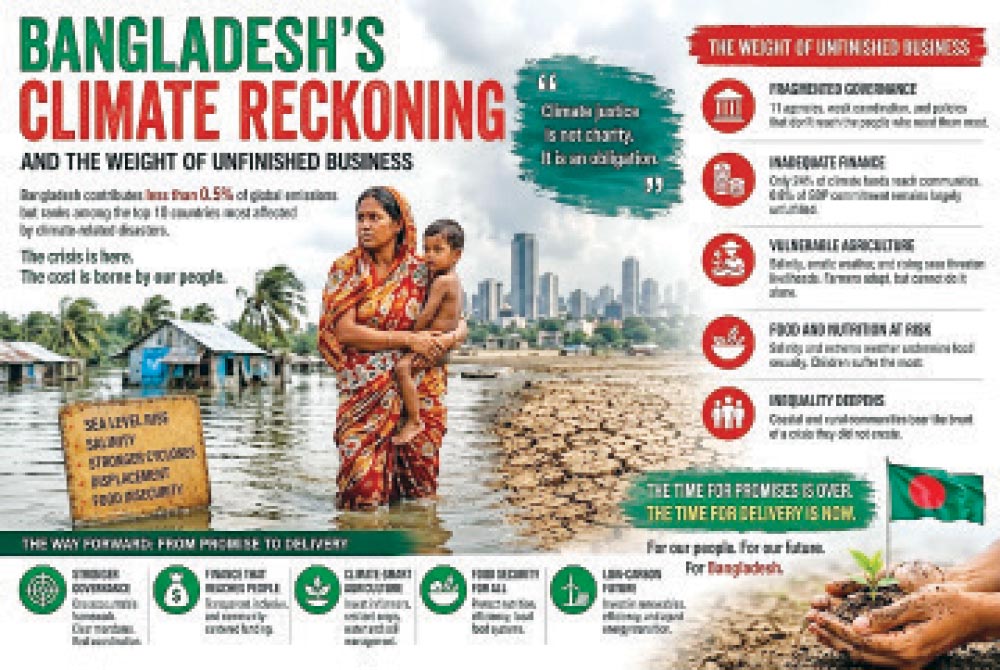 The governance response to this reality has been substantive in form but troubled in function. A 2025 review published in ‘Open Access Library Journal’ by Hossain, Odri, and Islam provides an unflinching assessment: Bangladesh's National Adaptation Plan is administered by eleven separate government agencies, creating structural rather than incidental coordination failures. The Bangladesh Climate Change Trust Act of 2010, which represented a genuine and historic domestic commitment to allocate 0.8 per cent of GDP to climate initiatives, has reportedly seen only 24 per cent of its funds reach target communities. The remainder has been absorbed by administrative inefficiency, rent-seeking, and a preference for visible, politically legible physical infrastructure projects over community-level interventions that are diffuse and harder to claim. A more recent CGIAR report by Nandi, Shahrin, Kabir, and Krupnik, published in early 2026, identifies 57 active climate policy initiatives in Bangladesh and finds that while adaptation dominates over mitigation - appropriately, given the country's exposure - the overall institutional framework remains fragmented. Mitigation efforts in renewable energy and low-carbon transition are critically underfunded and under-operationalised.
These structural deficiencies fall most heavily on agrarian communities, which are most exposed to climate shocks and least protected by state mechanisms. Agriculture employs more than 40 per cent of Bangladesh's labour force and remains the primary livelihood for coastal populations already experiencing the advance of salinity. Research published in ‘Food and Energy Security’ by Khatun and colleagues in 2025, applying resilience theory to Bangladeshi farming communities, finds that while farmers have demonstrated remarkable capacity for autonomous adaptation - switching to salt-resistant crop varieties, adjusting planting calendars, constructing informal drainage - this adaptive ingenuity is being systematically overwhelmed by the scale and pace of climatic change. State intervention and governance structures, the authors conclude, are essential for long-term resilience; informal coping cannot indefinitely substitute for institutional support. A parallel study published in ‘Agriculture and Food Security’ in late 2025 documents stark regional disparities, finding that climate-vulnerable divisions such as Barishal face significantly worse food security and nutritional outcomes than less-exposed regions, with children disproportionately bearing the health consequences of these inequalities.
The food security picture is inseparable from salinity. A scholarship published in ‘Food Security’ by Springer Nature, drawing on field research in the Ganges River Delta, documents that virtually every dimension of household food production in southwest coastal Bangladesh - rice cultivation, homestead gardening, livestock, aquaculture - is being adversely affected by salinity intrusion. Despite households attempting multiple adaptation strategies, effective adaptation remains elusive at the individual level. The paper's broader observation is pointed: adaptation and development efforts that fail to account for socioeconomic power imbalances risk increasing dispossession and deepening existing environmental problems, a finding that resonates beyond the Sundarbans and applies to the entire architecture of Bangladesh's climate response.
This is the domestic dimension of climate justice that remains insufficiently debated. Nicholas Stern, in ‘The Economics of Climate Change’ (2007), characterised climate change as the greatest market failure in history, arguing that the costs of inaction would far exceed the costs of early, ambitious intervention. Bangladesh has cited this analysis in international forums to demand climate finance from historical emitters. The argument is entirely valid. But Stern's logic applies with equal force domestically: the failure to invest adequately in community-level adaptation, climate-resilient agricultural extension, urban infrastructure for climate migrants, and the protection of informal workers constitutes a market failure embedded in Bangladesh's own development model. The World Bank estimated in its November 2025 South Asia report that by 2030, nearly 90 per cent of the region's population will face risks from extreme heat, and a quarter will face severe flooding. A survey across 250 coastal villages in Bangladesh found that climate-resilient infrastructure is the single most urgent unmet need expressed by communities - yet current finance flows remain biased toward bankable, large-scale, commercially legible projects that serve institutional investors far more reliably than they serve fishing families in Satkhira or char-land farmers in Jamalpur.
The question of intergenerational justice has begun to find expression in unexpected places. Research published in ‘TIJER’ in August 2025 on youth engagement in climate justice in Bangladesh documents a generation acutely aware that they are inheriting consequences they did not cause. Young Bangladeshis from Khulna to Sylhet describe climate change not as a scientific abstraction but as the daily experience of salinity destroying crops, floods arriving earlier and staying longer, and heat making outdoor work physiologically dangerous. Their framing is instinctively one of justice and intergenerational equity, reflecting a recognition that institutional responses have been inadequate to meet the urgency of the situation. Philosophers and ethical theorists have long argued this point from first principles: Henry Shue's foundational work on ‘Basic Rights’ (1980), extended into the climate domain by scholars including Simon Caney and Henry Shue's own later writing, establishes that the emissions released by one generation impose enforceable moral obligations on present political actors toward future people. For Bangladesh, this moral logic operates in two directions simultaneously - outward, as a demand on wealthy emitters for loss-and-damage compensation, and inward, as a demand on its own institutions to stop deferring the investments that could protect the next generation.
The climate finance gap is real and large. Bangladesh requires approximately USD 12.5 billion annually - roughly three per cent of GDP - to address its growing climate risks, according to World Bank estimates cited in a 2025 policy brief by the Centre for Policy Dialogue. Clean energy investment in 2023 totalled only USD 333.89 million, far short of the USD 1.5-1.7 billion per year needed to meet the country's 40 per cent renewable electricity target by 2041. Green bonds and Green Climate Fund allocations have expanded. Still, the CGIAR 2026 analysis notes that climate finance innovation remains weakly operationalised, and that ministries, including health, shipping, and women and children's affairs, receive only small proportional allocations despite the profound climate exposures of the populations they serve. The principle of common but differentiated responsibilities - the cornerstone of international climate law since the Rio Declaration of 1992 - must translate not only into demands at COP negotiations but into transparent, community-auditable budget allocations at home.
Elinor Ostrom's ‘Governing the Commons’ (1990) demonstrated that the tragedy of the commons - the degradation of shared resources through individual self-interest - is not inevitable. Communities can and do develop institutions for collective governance of shared resources, provided certain conditions are met: clearly defined boundaries, congruence between rules and local conditions, participatory decision-making, accountability mechanisms, and nested governance structures that connect local management to higher institutional levels. Bangladesh's climate governance challenge maps almost perfectly onto Ostrom's framework. The failures are not failures of knowledge or will alone; they are failures of institutional design. Eleven agencies coordinating a single National Adaptation Plan without clear lines of authority and accountability is precisely the kind of institutional incoherence that Ostrom's work would predict will fail. Decentralising climate adaptation finance to local government institutions, subjecting climate fund allocations to independent community-level audits, and establishing clear accountability mechanisms for the 24 per cent fund delivery problem identified in the 2025 policy review would not require new knowledge. They would require political will.
The late Dr Saleemul Huq, whose three decades of scholarship and diplomacy placed adaptation and loss and damage at the centre of the global climate agenda, consistently argued that adaptation is not a technocratic problem. It is a political one, requiring the redistribution of resources, the inclusion of marginalised voices in governance, and the recognition that those who have contributed least to the crisis are bearing its highest costs. His legacy, continued through the International Centre for Climate Change and Development and through the scholars and advocates he mentored, is a challenge to Bangladesh's institutional class: to hold domestically the standards of justice it demands internationally.
Bangladesh is not without resources for this task. It has a growing body of climate scientists producing world-class research. It has, in its history of building cyclone shelters, scaling early-warning systems, and reducing disaster mortality against enormous odds, demonstrated that when political will and institutional design align, lives can be saved at scale. What remains is the courage to turn that same disciplined, evidence-based ambition toward the governance failures, financial leakages, and structural inequalities that are quietly ensuring that the costs of the coming decades of climate change will be borne by those who can least afford to bear them.
The writer is a researcher and development professional
Loading...
Loading...
Also read



Editor : Iqbal Sobhan Chowdhury
Published by the Editor on behalf of the Observer Ltd. from Globe Printers, 24/A, New Eskaton Road, Ramna, Dhaka.
Editorial, News and Commercial Offices : Aziz Bhaban (2nd floor), 93, Motijheel C/A, Dhaka-1000.
Phone: PABX- 41053001-06; Advertisement: 41053012; 01793317829, 01550707291, E-mail: [email protected], [email protected] Online: email: [email protected] 41053014; 01550707297 Advertisement: 01550707296
Published by the Editor on behalf of the Observer Ltd. from Globe Printers, 24/A, New Eskaton Road, Ramna, Dhaka.
Editorial, News and Commercial Offices : Aziz Bhaban (2nd floor), 93, Motijheel C/A, Dhaka-1000.
Phone: PABX- 41053001-06; Advertisement: 41053012; 01793317829, 01550707291, E-mail: [email protected], [email protected] Online: email: [email protected] 41053014; 01550707297 Advertisement: 01550707296


