



| HEADLINE |

|
When the Mountains Break
Published : Saturday, 5 September, 2026 at 12:00 AM
Dr Matiur Rahman


 The disaster unfolding in Nepal is more than another monsoon tragedy �" it is a warning from the Himalayas to all of South Asia. On August 26, a massive collapse of rock, ice and glacial material near the Nepal-Tibet border triggered a flash flood down the BhoteKoshi and connected rivers, wiping out villages, roads, bridges and hydropower plants within hours.
As of August 30, Nepal's disaster authority had recovered 734 bodies, with 2,498 still missing; China's Gyirong County reported 16 deaths and 546 missing, pushing the combined toll past 750 with over 3,000 unaccounted for. More than 930 hydropower workers remain missing at flood-hit sites, and the USGS estimates over 100 million cubic metres of ice, rock and debris were displaced in the initial collapse. The IFRC earlier estimated 90,000 people needed urgent help; Washington has pledged $3.6 million in emergency aid, up from an initial $500,000.
For Bangladesh, this deserves attention beyond sympathy: it shows how climate change is turning familiar hazards into cascading disasters that overwhelm conventional preparedness. Mountains collapse, glaciers retreat, lakes form suddenly, rivers shift course, infrastructure fails �" and communities downstream get little time to escape. Bangladesh has no Himalayas, but it sits at the receiving end of one of the world's most climate-sensitive river systems. The lesson is uncomfortable but clear: disasters no longer happen in isolation.
This was not simply heavy rain producing a flood. Satellite data suggest a more complex sequence: a mountain collapse destabilised the terrain, sent debris into the valleys, and generated a surge that destroyed infrastructure with terrifying speed. Nepali authorities are still monitoring downstream rivers, since the disaster created new hazards, including freshly formed lakes at risk of bursting.
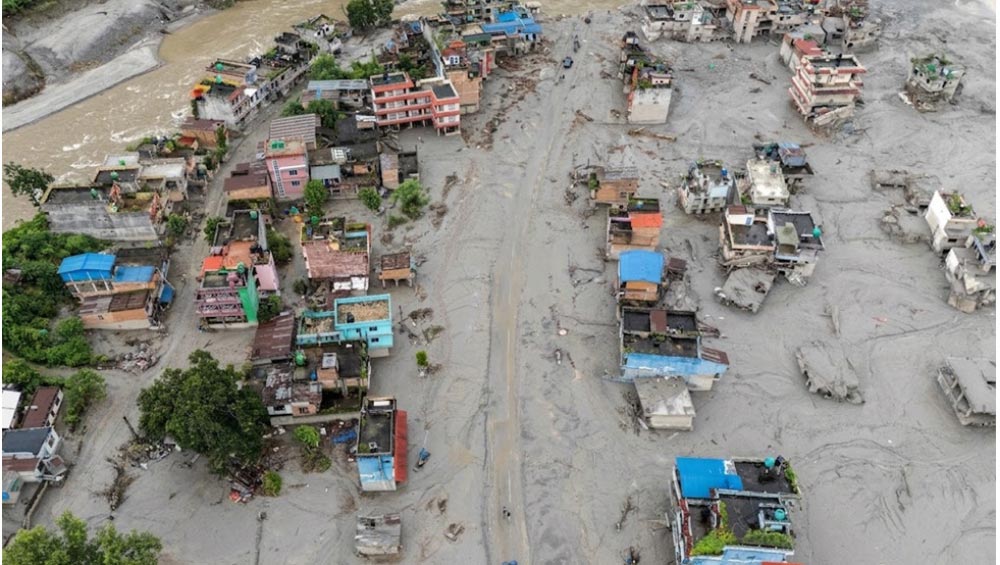 This is what experts call cascading risk �" one shock triggers another. A collapse becomes a flood; the flood destroys roads and bridges, delaying rescue; damaged water systems raise disease risk; wrecked power facilities cripple hospitals; displacement breeds overcrowding. UNICEF reports at least 17,000 children affected, with homes, schools and clinics damaged. This is exactly the interconnected thinking Bangladesh must adopt.
It would be scientifically premature to blame this single event entirely on climate change before attribution studies are done, but equally irresponsible to ignore the broader transformation underway. The Himalayas are warming, glaciers retreating, snowfall patterns shifting, permafrost thawing.
ICIMOD reports Hindu Kush Himalayan glaciers losing ice at double the rate seen since 2000, with some losing up to 27 metres of thickness since 1975. A 2026 assessment found glacier area shrank roughly 12 percent between 1990 and 2020, and loss accelerated 65 percent faster in the 2010s than the previous decade �" even as this ice supplies fresh water to roughly two billion people across Asia.
Nepal's mountains and Bangladesh's delta are part of the same environmental system. Rivers don't respect borders �" glacial melt, extreme rain, landslides and sediment flows upstream shape hydrology downstream, and Bangladesh's own river flooding can coincide with heavy local rain, tidal surges and sea-level rise.
The IPCC projects more frequent heavy precipitation and rising flood frequency across South, Southeast and East Asia. Bangladesh does not need to imagine such compounding: its own July-August 2026 monsoon floods and landslides killed at least 59 people, affected 1.28 million across seven districts, and damaged over 74,000 homes, while the UN's 2026 Joint Response Plan remains $45 million short. The IOM estimates 4.96 million people were internally displaced by disasters in Bangladesh in 2025 alone. Preparing separately for floods, cyclones, landslides and erosion is no longer enough �" the real challenge ahead is simultaneous risk.
What stands out in Nepal is the sheer speed of destruction �" river levels reportedly rose dramatically within a short window, leaving little time to evacuate. A warning system only works if it reaches people fast, is understood, and is followed by an evacuation system that actually protects them.
Forecasting is not preparedness. Bangladesh needs end-to-end warning systems linking meteorology, river monitoring, satellite data, local government and mobile communication �" reaching every household, including the elderly and people with disabilities. Warnings must describe consequences, not just measurements: which villages will flood, when to leave, where shelter is. The World Bank warns that by 2030 nearly 90 percent of South Asians could face extreme heat exposure, and nearly a quarter could face severe flooding.
Nepal's roads, bridges and hydropower plants became casualties, complicating rescue. Bangladesh's roads, embankments, drainage, schools and hospitals face similar exposure. Infrastructure built for yesterday's rainfall may not survive tomorrow's. Every major investment needs climate-risk screening, and critical facilities must stay operational through floods.
National disaster management alone cannot manage a shared ecological region; mountain hazards cross borders, and rivers certainly do. Nepal, Bangladesh, Bhutan, India and China need faster, transparent sharing of data on glaciers, rainfall and river discharge. ICIMOD calls changes in the Himalayan cryosphere unprecedented and largely irreversible �" water diplomacy must become climate diplomacy.
Are wetlands protected or filled? Are floodplains occupied without safeguards? The IPCC notes urbanisation worsens flood risk by reducing land permeability. Dhaka's recurring waterlogging is proof enough: adaptation cannot succeed if development blocks water's natural movement.
Rescue, shelter and healthcare must come first for Nepal. But the longer-term lesson is resilience �" reducing the odds that hazards become disasters at all: stronger local institutions, climate-resilient infrastructure, ecosystem restoration and social protection, so poor households aren't pushed permanently into poverty by one flood. Adaptation in South Asia has increasingly fallen on households and firms, though real solutions need public infrastructure and institutional investment. A village cannot monitor Himalayan glaciers alone; the state must lead.
Climate change is reshaping not just temperatures and rainfall but the stability of landscapes and river systems. Bangladesh should not wait for its own catastrophe to find the gaps in its preparedness. Nepal's shattered valleys remind us that nature can change faster than policy. The mountains have delivered their warning �" Bangladesh must listen before the water delivers its own.
The writer is a researcher and development professional
Loading...
Loading...
Also read



Editor : Iqbal Sobhan Chowdhury
Published by the Editor on behalf of the Observer Ltd. from Globe Printers, 24/A, New Eskaton Road, Ramna, Dhaka.
Editorial, News and Commercial Offices : Aziz Bhaban (2nd floor), 93, Motijheel C/A, Dhaka-1000.
Phone: PABX- 41053001-06; Advertisement: 41053012; 01793317829, 01550707291, E-mail: [email protected], [email protected] Online: email: [email protected] 41053014; 01550707297 Advertisement: 01550707296
Published by the Editor on behalf of the Observer Ltd. from Globe Printers, 24/A, New Eskaton Road, Ramna, Dhaka.
Editorial, News and Commercial Offices : Aziz Bhaban (2nd floor), 93, Motijheel C/A, Dhaka-1000.
Phone: PABX- 41053001-06; Advertisement: 41053012; 01793317829, 01550707291, E-mail: [email protected], [email protected] Online: email: [email protected] 41053014; 01550707297 Advertisement: 01550707296


