



| HEADLINE |

|

Govt committed to building inclusive, liveable and climate-resilient cities: State Minister
Published : Sunday, 6 September, 2026 at 9:28 PM
Observer staff correspondent


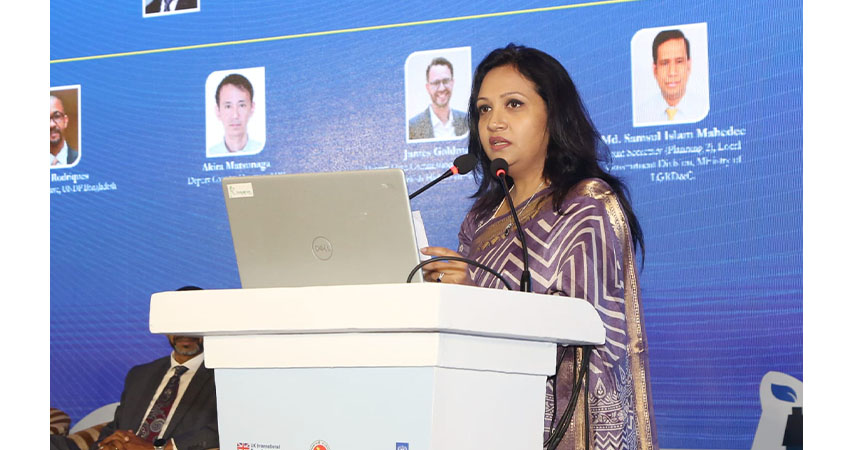
File Photo
The government is committed to building inclusive, liveable and climate-resilient cities and has taken effective steps to implement the country’s urban policy, State Minister for Social Welfare Barrister Farazana Sharmin has said.
She made the remarks on Sunday while speaking as a special guest at the opening ceremony of the National Urban Forum in the capital. The forum was jointly organised by the Local Government Division and UNDP Bangladesh, with support from the Asian Development Bank (ADB), Japan International Cooperation Agency (JICA), Islamic Development Bank, Bangladesh University of Engineering and Technology (BUET) and Bangladesh Institute of Planners (BIP). The forum will conclude on Monday.
The state minister said coordinated initiatives have been undertaken to develop liveable cities through the implementation of a sustainable framework for the urban policy. Every person living in cities should be able to live with dignity and security, while efforts are being made to ensure that natural disasters do not cause suffering to urban residents.
“We do not want to make our beloved cities liveable only for ourselves. We want to ensure a supportive environment for the next generation and our children so that they can breathe freely in a pollution-free environment,” she said.
Speaking at the event, UNDP Bangladesh Resident Representative Stephen Rodriques said the forum was not an end in itself but the beginning of a shared responsibility to act on the discussions held at the event.
British High Commission Dhaka Deputy High Commissioner and Development Director James Goldman expressed hope that the forum would further strengthen cooperation among development partners supporting sustainable urban development in Bangladesh.
ADB Deputy Country Director Akira Matsunga said the ADB has been a longstanding partner in Bangladesh’s urban sector. “Our priority is to coordinate this support to make cities more inclusive, liveable and competitive,” he said.
The forum also highlighted the concentration of economic activities and investment in Dhaka and along the Dhaka-Chattogram corridor, alongside persistent challenges including traffic congestion, waterlogging, waste management, pollution and limited institutional capacity.
-HIS

Loading...
Loading...
Also read






Editor : Iqbal Sobhan Chowdhury
Published by the Editor on behalf of the Observer Ltd. from Globe Printers, 24/A, New Eskaton Road, Ramna, Dhaka.
Editorial, News and Commercial Offices : Aziz Bhaban (2nd floor), 93, Motijheel C/A, Dhaka-1000.
Phone: PABX- 41053001-06; Advertisement: 41053012; 01793317829, 01550707291, E-mail: [email protected], [email protected] Online: email: [email protected] 41053014; 01550707297 Advertisement: 01550707296
Published by the Editor on behalf of the Observer Ltd. from Globe Printers, 24/A, New Eskaton Road, Ramna, Dhaka.
Editorial, News and Commercial Offices : Aziz Bhaban (2nd floor), 93, Motijheel C/A, Dhaka-1000.
Phone: PABX- 41053001-06; Advertisement: 41053012; 01793317829, 01550707291, E-mail: [email protected], [email protected] Online: email: [email protected] 41053014; 01550707297 Advertisement: 01550707296


