



| HEADLINE |

|

Dhaka’s Gas Woes: Cold Stoves, Rising Costs
Published : Thursday, 10 September, 2026 at 12:00 AM
Humaira Parvin


 Dhaka’s recurring gas crisis is no longer just a kitchen problem. Low pressure and irregular supply is disrupting household cooking, increasing reliance on LPG and electric appliances, and raising living costs. Restaurants, small food businesses and other gas-dependent establishments are also struggling to operate normally. For residents, the problem is simple: they pay their utility bills but cannot always rely on the service when they need it.
When gas pressure falls during cooking hours, families must wait, cook late or switch to alternative fuels. This adds to household expenses, particularly for low- and middle-income families. A basic utility has thus become a source of financial strain, uncertainty and daily frustration. The crisis requires urgent attention because its impact extends beyond the kitchen. It affects workers, students, restaurants, small businesses, public health and the quality of life in one of the world’s most densely populated cities.
A family may plan breakfast around school and office hours, only to find the gas pressure too low for cooking. In some areas, residents wait for the pressure to return; in others, they adjust their routines to the uncertain supply. For working families, even a one-hour delay can disrupt the day. Breakfast is postponed, children may leave without eating, and parents risk being late for work. Women often bear the greater burden because they continue to shoulder much of the household cooking and care work. A gas shortage does not reduce these responsibilities; it simply makes them more time-consuming and costly.
One of the most frustrating aspects of the crisis is that households may have to pay twice for the same basic need. When piped gas is unavailable or pressure is insufficient, families often turn to LPG cylinders or electric cooking appliances. LPG brings the cost of refilling or purchasing cylinders, while electric cooking adds to electricity consumption. For affluent households, this may be manageable. For families living on fixed or modest incomes, however, every additional expense matters.
The broader problem is therefore not merely whether gas is available. It is whether citizens are being forced to absorb the financial consequences of an unreliable public utility.
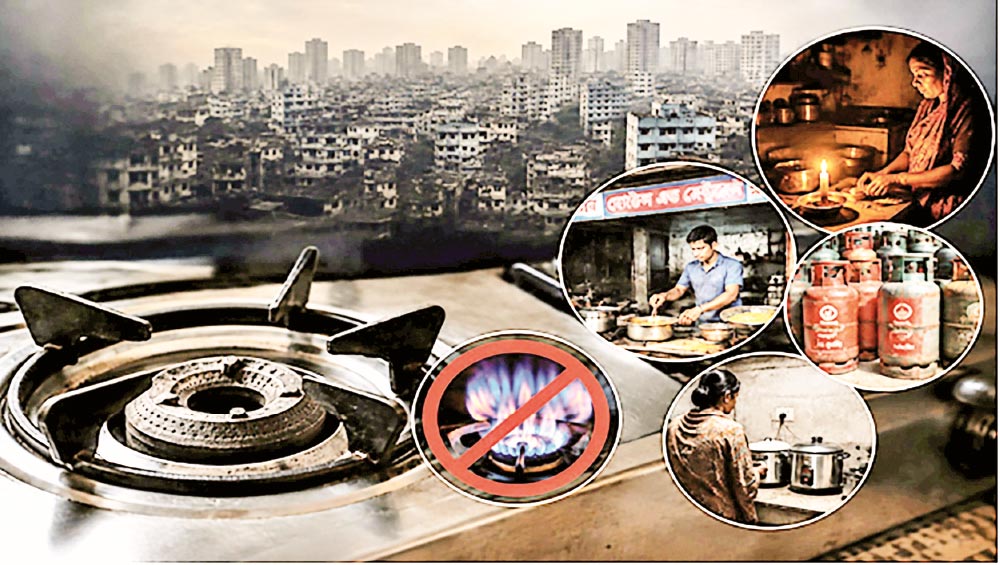 The impact is also clear in Dhaka’s restaurants, bakeries, tea stalls and other small food businesses. Commercial kitchens need reliable energy. Low gas pressure slows cooking and raises operating costs as businesses turn to LPG or other alternatives. Small businesses are hit hardest because they have little room to absorb higher fuel costs. Raising food prices may drive customers away, while keeping prices unchanged cuts profit margins. In the end, consumers may bear the cost through higher food prices.
However, Dhaka’s gas shortage is not new. Bangladesh has long faced a gap between gas demand and supply, along with declining output from some domestic fields, infrastructure and distribution constraints, system losses and rising urban demand. The capital city’s growing population has put further pressure on already strained infrastructure. National gas availability also does not guarantee reliable supply to every household. Gas must be produced or imported, transported and distributed through a complex network, and a weakness at any stage can affect consumers.
So, adding gas to the system alone cannot ensure steady supply in every neighbourhood. Reliable service also requires efficient transmission, distribution and infrastructure management.
Another major problem is uncertainty. When supply is disrupted, consumers often do not know how long the shortage will last or when pressure will return to normal. This makes planning almost impossible. Utility authorities should therefore improve communication with consumers. If maintenance work, technical problems or supply limitations are expected to affect particular areas, residents should be informed in advance whenever possible. Clear information would not solve the shortage, but it would reduce some of the uncertainty and frustration. A modern utility system should not leave consumers guessing about whether they will be able to cook dinner.
The search for alternatives also creates safety concerns. Improper use of LPG cylinders can cause serious accidents. Poor ventilation and unsafe cooking arrangements may increase risks inside homes and commercial kitchens. At the same time, households that resort to unsuitable fuels because of gas shortages may be exposed to smoke and indoor air pollution. Therefore, any policy response to the gas crisis should include public awareness about the safe use of LPG and electrical cooking equipment. Alternative energy should be accessible, affordable and, above all, safe.
Temporary measures may ease shortages, but Dhaka needs a long-term energy strategy.
First, the authorities must improve the efficiency and reliability of the gas distribution network. Old or damaged infrastructure should be properly maintained, while leakage and illegal connections must be addressed through effective monitoring.
Second, Bangladesh needs greater diversification of its energy sources. Dependence on a single fuel source makes households and businesses vulnerable whenever supply is disrupted.
Third, investment in domestic gas exploration, infrastructure and alternative energy sources should be guided by long-term demand projections rather than short-term crises.
Finally, the government and utility authorities must strengthen accountability. Consumers need to know what is causing shortages, what measures are being taken and when improvements can reasonably be expected.
A city cannot function efficiently when a basic household necessity becomes unpredictable. Gas may seem like a narrow energy-sector issue, but its consequences reach into almost every part of urban life. A mother trying to prepare breakfast, a student waiting for dinner, a restaurant worker preparing meals and a small business owner calculating daily expenses are all affected by the same problem.
The solution, therefore, cannot be limited to supplying more gas whenever a crisis becomes visible. It requires better planning, stronger infrastructure, transparent communication and a serious commitment to energy security. Dhaka’s residents do not expect luxury. They expect a basic service for which they pay to be available when needed.
The writer is a journalist

Loading...
Loading...
Also read



Editor : Iqbal Sobhan Chowdhury
Published by the Editor on behalf of the Observer Ltd. from Globe Printers, 24/A, New Eskaton Road, Ramna, Dhaka.
Editorial, News and Commercial Offices : Aziz Bhaban (2nd floor), 93, Motijheel C/A, Dhaka-1000.
Phone: PABX- 41053001-06; Advertisement: 41053012; 01793317829, 01550707291, E-mail: [email protected], [email protected] Online: email: [email protected] 41053014; 01550707297 Advertisement: 01550707296
Published by the Editor on behalf of the Observer Ltd. from Globe Printers, 24/A, New Eskaton Road, Ramna, Dhaka.
Editorial, News and Commercial Offices : Aziz Bhaban (2nd floor), 93, Motijheel C/A, Dhaka-1000.
Phone: PABX- 41053001-06; Advertisement: 41053012; 01793317829, 01550707291, E-mail: [email protected], [email protected] Online: email: [email protected] 41053014; 01550707297 Advertisement: 01550707296


