



| HEADLINE |

|
New Wave of War Drums Beat in the Middle East
Published : Tuesday, 15 September, 2026 at 12:00 AM
Khandaker Azizur Rahman


 Right after the Mecca Agreement, the Houthis seized Mokha and other strategically vital areas including Bab al-Mandeb, while the United States expanded its military presence in Saudi Arabia. Is this chain of events truly coincidental or does it reflect a well-planned strategy to reshape the Middle East’s balance of power?
On August 7, 2026, Saudi Arabia, Turkey and Pakistan signed a joint defence agreement in Mecca whose core condition is simple: an armed attack on any one of the three will be treated as an attack on all, requiring a collective military response. Saudi officials insist the pact is purely defensive and not aimed at any specific country, but the first major test could well emerge from the conflict in Yemen.
Pakistan’s Defence Minister Khawaja Asif has already warned that if Houthi attacks spread to the Saudi border, member states will have to respond under the terms of the Mecca alliance. In other words, the agreement is no longer just words on paper; it is waiting to be activated by events on the ground.
Soon after the Mecca deal, the Houthis took control of Mokha and other key locations around Bab al-Mandeb. At the same time, the United States increased its number of military advisers in Saudi Arabia from about 100 to between 100 and 200, providing intelligence support and targeting assistance to Saudi forces.
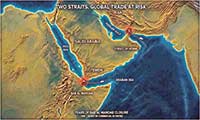
Is this merely a coincidence of timing or a calculated advance by Iran-backed Houthis taking advantage of a regional power vacuum? Though militarily weaker, the Houthis, with direct and indirect Iranian support are consolidating control over Bab al-Mandeb, one of the world’s most important trade routes. Nearly 10 percent of global oil and commercial shipping passes through this corridor. With Houthi influence growing, two of the most critical energy and gas trade routes, Bab al-Mandeb and the Strait of Hormuz are effectively moving under Iranian sway. Stronger Houthi control will have major consequences for maritime security and the economy of the Middle East.
Israel’s long-term strategic objective is the establishment of a Greater Israel. For this, it needs powerful Muslim countries in the Middle East to become weaker. In the 1960s, Egypt sent nearly 70,000 troops to Yemen. That campaign left the Egyptian military in serious difficulty and caused both military and economic strain, from which Israel benefited by strengthening its own regional position amid the resulting power vacuum.
The same logic is at work today. Creating religious differences, political divisions and military conflicts among Middle Eastern Muslim states to drain their strength fits the broader Israeli and Western strategy. If the Houthis are attacked, Iran may not intervene openly but will be fully involved behind the scenes, pushing Pakistan and other regional countries deeper into instability. Israel and Western powers stand to gain from precisely this kind of turmoil.
Recent discussions have highlighted how Iran is encircling Israel with its proxy forces like Hezbollah in Lebanon, Hamas in Palestine and Iran-backed Shia militias in Iraq and Syria. Together, these groups are creating significant strategic pressure on Israel. The question now is whether Israel is deliberately drawing Arab countries into the battlefield to manage this pressure, with the aim of further dividing and weakening Muslim states.
American presence in the Middle East is steadily shrinking. What was once justified as a security guarantee has now become a source of uncertainty. Recent attacks on US bases during the Iran crisis have shaken confidence in traditional security arrangements, pushing US allies to lean toward alternative security frameworks.
The Mecca Agreement now faces its moment of truth. How effective it proves to be will shape how global powers plan their next moves in the Middle East.
The most painful part is that all the conflicting and potentially conflicting parties are Muslim. If they exhaust their strength through internal wars and create lasting enmity, who really benefits? History shows that Israel and Western powers have gained from internal conflicts among Middle Eastern Muslim countries.
An invisible signal or a grim grand strategy is slowly pulling the Muslim countries of the Middle East toward war. If every step is not taken with extreme caution, Israel will once again sit on the throne of regional dominance and that needs no elaboration.
The Mecca Agreement is no longer just a paper deal. It is the litmus test for the future security architecture of the Middle East. If the Muslim world cannot show unity and strategic awareness in this test, history will witness the same mistake repeated.
The writer is Head of Photography, The Daily Observer
Loading...
Loading...
Also read



Editor : Iqbal Sobhan Chowdhury
Published by the Editor on behalf of the Observer Ltd. from Globe Printers, 24/A, New Eskaton Road, Ramna, Dhaka.
Editorial, News and Commercial Offices : Aziz Bhaban (2nd floor), 93, Motijheel C/A, Dhaka-1000.
Phone: PABX- 41053001-06; Advertisement: 41053012; 01793317829, 01550707291, E-mail: [email protected], [email protected] Online: email: [email protected] 41053014; 01550707297 Advertisement: 01550707296
Published by the Editor on behalf of the Observer Ltd. from Globe Printers, 24/A, New Eskaton Road, Ramna, Dhaka.
Editorial, News and Commercial Offices : Aziz Bhaban (2nd floor), 93, Motijheel C/A, Dhaka-1000.
Phone: PABX- 41053001-06; Advertisement: 41053012; 01793317829, 01550707291, E-mail: [email protected], [email protected] Online: email: [email protected] 41053014; 01550707297 Advertisement: 01550707296


