



| HEADLINE |

|

DUCSU Museum sparks row over Jinnah, Mujib displays
DU says Jinnah, Malek displays conflict with history; forms probe body
Published : Tuesday, 15 September, 2026 at 12:00 AM
DU Correspondent


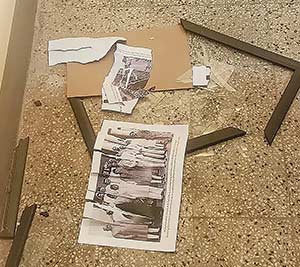 A controversy has erupted over the renovated DUCSU Museum, with the display of photographs of Muhammad Ali Jinnah drawing objections and the absence of several prominent photographs of Sheikh Mujibur Rahman raising questions about the gallery’s historical narrative.
Former Dhaka University student Abu Toyeb Habilder vandalised two of Jinnah’s photographs at the gallery on Monday, while the Jatiotabadi Chhatra Dal (JCD) demanded that the photographs be removed within 24 hours. DUCSU General Secretary SM Farhad, however, accused the group of trying to shield Jinnah from criticism.
The university administration also said the display of Jinnah and former student leader Abdul Malek was unacceptable and warned of administrative action.
Toyeb, a 2001-02 session student of the Urdu department and former DUCSU vice-presidential candidate, visited the gallery around noon and broke the frames and tore two of Jinnah’s photographs.
Before vandalising them, he said Jinnah had no place in DUCSU because of his opposition to Bangla as a state language in then Pakistan. He referred to Jinnah’s 1948 declaration that Urdu would be Pakistan’s only state language and linked it to the repression that fuelled the Language Movement.
The incident came a day after DUCSU reopened its renovated gallery on Sunday. It was inaugurated by DUCSU Liberation War and Democratic Movement Affairs Secretary Fatima Tasnim Zuma in the presence of Vice-President Shadik Kayem, a former Shibir leader, General Secretary SM Farhad and others.
The gallery contains three images featuring Jinnah. One shows his March 21, 1948 speech at Suhrawardy Udyan, then known as Racecourse Ground, in which he declared Urdu would be Pakistan’s state language. Another is a group photograph from the All-India Muslim League’s 1940 Lahore conference, where a resolution calling for a separate Muslim state was adopted. The third is a Dawn newspaper clipping related to the 1970 election.
The gallery also documents the Language Movement, Liberation War, anti-autocracy movement, major political events and student movements, including the July Uprising. It contains photographs and documents related to the killings of BUET student Abrar Fahad and tailor Biswajit Das, the Pilkhana carnage, Ganaroom and Guestroom culture and anti-Modi protests.
Visitors, however, noted the absence of prominent standalone photographs of Sheikh Mujibur Rahman in sections covering the Language Movement, Six-Point Movement, Agartala Conspiracy Case, 1969 Mass Uprising, 1970 election and his 7 March speech. His images appear in three newspaper clippings and photographs related to his sons’ weddings between 1971 and 1975.
Zuma said, “After 5 August 2024, photographs of the figures that we considered symbols of ‘fascism’ were removed. Photographs of Sheikh Mujib remained in the 1972-75 section.”
JCD leaders met DU Vice-Chancellor and DUCSU President Prof ABM Obaidul Islam on Monday and demanded the removal of Jinnah’s photographs within 24 hours.
“If photographs are not removed within the next 24 hours, we will be forced to hold programmes at the vice-chancellor’s office and DUCSU gallery,” said DU JCD President Ganesh Chandra Roy Sahos.
Farhad, however, said the photographs were displayed specifically to document Jinnah’s opposition to Bangla as a state language.
“If we remove the photograph, it could obscure Jinnah’s role in the context that led to the Language Movement,” he said, accusing JCD of either misunderstanding the historical context or deliberately trying to shield Jinnah from criticism.
Meanwhile, the Chhatra Federation’s DU unit placed a photograph of former Jamaat-e-Islami chief Ghulam Azam being beaten with shoes at Baitul Mukarram in 1981 at the same spot where Jinnah’s photographs had been displayed. Revolutionary Chhatra Maitree and Ganotantrik Chhatra Jote also held a protest procession at TSC on Monday night over the gallery display and JCD’s attacks on their leaders and activists.
Following the vandalism, members of the University Teachers’ Network, including Prof Samina Lutfa and Prof Mohammad Tanzimuddin Khan, visited the gallery.
In a statement issued through DU Public Relations Office Deputy Director Farrukh Mahmud, the university administration said displaying photographs of Jinnah and former student leader Abdul Malek, whom it described as figures whose roles conflict with the history of the Language Movement and Bangladesh’s independence, was “not acceptable”. It said administrative action would be taken against those responsible under existing rules.
The administration also said DUCSU must operate within university laws, regulations and its administrative framework, stressing that the university would not allow any parallel administrative structure.
It cited Article 24(a) of the Dhaka University Order, 1973, which places responsibility for supervising, maintaining and controlling university property with the Syndicate, while relevant university ordinances require DUCSU decisions to be made under the direction of the vice-chancellor.
The administration said it would not compromise on protecting the historical significance of the Language Movement and Liberation War.

Loading...
Loading...
Also read



Editor : Iqbal Sobhan Chowdhury
Published by the Editor on behalf of the Observer Ltd. from Globe Printers, 24/A, New Eskaton Road, Ramna, Dhaka.
Editorial, News and Commercial Offices : Aziz Bhaban (2nd floor), 93, Motijheel C/A, Dhaka-1000.
Phone: PABX- 41053001-06; Advertisement: 41053012; 01793317829, 01550707291, E-mail: [email protected], [email protected] Online: email: [email protected] 41053014; 01550707297 Advertisement: 01550707296
Published by the Editor on behalf of the Observer Ltd. from Globe Printers, 24/A, New Eskaton Road, Ramna, Dhaka.
Editorial, News and Commercial Offices : Aziz Bhaban (2nd floor), 93, Motijheel C/A, Dhaka-1000.
Phone: PABX- 41053001-06; Advertisement: 41053012; 01793317829, 01550707291, E-mail: [email protected], [email protected] Online: email: [email protected] 41053014; 01550707297 Advertisement: 01550707296


