



| HEADLINE |

|
Uranium discovery: Is Saudi the next geopolitical ‘trump card’ of the world?
Published : Tuesday, 15 September, 2026 at 1:10 PM
Shahman Abir


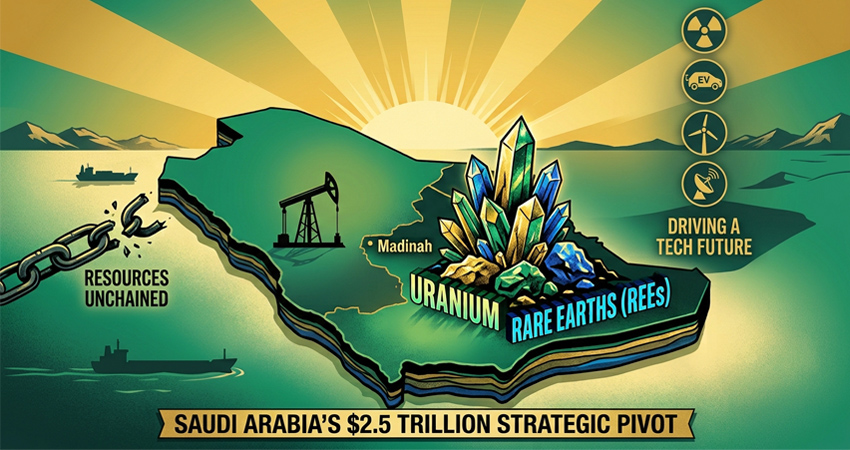
AI Illustration
Recent reports from Saudi Ministry confirmed existence of vast amount of Uranium found under Saudi soils while the state is already abundant with wells of ‘liquid gold’ - also known as crude oil.
As the modern world is desperately searching energy sources that does not pollute the environment–the absolute best alternative of fossil fuels have always been nuclear energy. Fission reactors can produce electricity with minimum risk for environment.
Thus, discovery of Uranium, along with other heavy minerals beside the holy land of Medina could potentially alter the chessboard of world politics.
What Saudi Arabia Found
Energy Minister of Saudi Arabia Prince Abdulaziz bin Salman previously confirmed that roughly 110 million tons of raw mineral deposits containing rare earth elements (REEs), significant uranium deposits, and essential heavy rare earths like dysprosium, terbium, europium, and gadolinium were located in the Jabal Sayid geological zone within the Madina region near Jeddah.
Official reports from the Saudi Press Agency and national mining champion Ma’aden highlight that ongoing exploration has bumped the kingdom's total estimated untapped mineral reserves to $2.5 trillion—a staggering 90 per cent valuation increase over earlier conservative estimates.
Such findings place Jabal Sayid site as fourth ranked in terms of minerals deposits around the world, rivaling other global reserves.
What could be Achieved with It
With such massive reserves, Saudi Arabia holds the potential to transition from a purely oil-dependent economy into a green energy and technological manufacturing powerhouse under its Vision 2030 banner. Heavy Rare Earth Elements (HREEs) are crucial for manufacturing high-temperature permanent magnets used in electric vehicles, wind turbines, and defense electronics.
Furthermore, developing local uranium deposits offers Riyadh domestic fuel security for its planned civilian nuclear reactors. By controlling both the raw materials and building processing partnerships with Western and Eastern allies, Saudi Arabia can position itself as an indispensable alternative supplier in a market long dominated by China.
Other Countries with High Reserve of Uranium
While Saudi discoveries bolster its regional energy sovereignty, global nuclear supplies remain grounded in established major markets. Australia holds the world's largest known recoverable uranium reserves at roughly 28 per cent, followed by Kazakhstan, which dominates actual annual mine output.
Canada, Namibia, and Uzbekistan also hold significant global market shares.
Meanwhile, countries like Myanmar play a notable role in heavy rare earth mining output alongside China. Saudi Arabia's entry into this field adds another financially formidable state to the short list of nations possessing both fossil fuel dominance and critical nuclear fuel potential.
US Dependency over HREEs
Despite possessing substantial raw deposits, the United States faces a distinct structural vulnerability regarding its rare earth element profile. According to the U.S. Geological Survey (USGS), domestic measured and indicated rare earth resources stand at roughly 3.6 million metric tons.
However, the vast majority of active domestic production—centered at California's Mountain Pass mine—is dominated by Light Rare Earth Elements (LREEs) like cerium and lanthanum, while critical Heavy Rare Earth Elements (HREEs) such as dysprosium and terbium are exceptionally scarce in domestic commercial deposits.
Because the U.S. lacks integrated, large-scale commercial refining infrastructure for heavy elements, domestic ore concentrates have historically been shipped abroad for separation, leaving Western supply chains heavily reliant on foreign processing hubs.
To bridge this strategic gap, Washington has poured significant federal funding into developing domestic separation plants and expanding HREE extraction projects—such as heavy mineral sand processing in the Southeast and carbonatite exploration across Western states—to build a fully localized supply chain for defense, clean energy, and high-tech industries.
Loading...
Loading...
Also read



Editor : Iqbal Sobhan Chowdhury
Published by the Editor on behalf of the Observer Ltd. from Globe Printers, 24/A, New Eskaton Road, Ramna, Dhaka.
Editorial, News and Commercial Offices : Aziz Bhaban (2nd floor), 93, Motijheel C/A, Dhaka-1000.
Phone: PABX- 41053001-06; Advertisement: 41053012; 01793317829, 01550707291, E-mail: [email protected], [email protected] Online: email: [email protected] 41053014; 01550707297 Advertisement: 01550707296
Published by the Editor on behalf of the Observer Ltd. from Globe Printers, 24/A, New Eskaton Road, Ramna, Dhaka.
Editorial, News and Commercial Offices : Aziz Bhaban (2nd floor), 93, Motijheel C/A, Dhaka-1000.
Phone: PABX- 41053001-06; Advertisement: 41053012; 01793317829, 01550707291, E-mail: [email protected], [email protected] Online: email: [email protected] 41053014; 01550707297 Advertisement: 01550707296


