



| HEADLINE |

|

NASA rover finds evidence of complex water activity on early Mars
Published : Tuesday, 22 September, 2026 at 5:48 PM
Observer online report


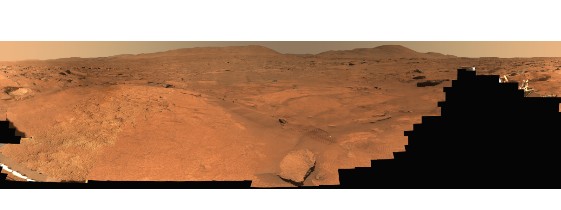
NASA’s Perseverance rover has found evidence that rocks in Mars’ Jezero Crater interacted with water on at least three separate occasions, offering new clues about the planet’s ancient climate and habitability.
The findings come from the “Margin Unit”, a geological area along the inner edge of Jezero Crater that was once thought to be part of the shoreline of an ancient Martian lake.
Scientists had expected to find sedimentary rocks there because orbital observations had detected strong signals of carbonate minerals. Instead, Perseverance found igneous rocks, which formed from magma and preserved evidence of repeated interactions with water.
The findings were published on September 21 in the journal Communications Earth & Environment.
Using its SuperCam instrument, Perseverance analysed more than 185 bedrock targets across the Margin Unit. The instrument uses a laser to study the chemical composition of rocks from a distance.
At higher elevations, the rover found coarse-grained, crystalline olivine-rich rocks that showed little evidence of water exposure. Scientists say the rocks formed from magma deep underground and cooled slowly before reaching the surface after erosion removed the overlying material.
At lower elevations, the rocks had been altered. Olivine grains were fractured, with silica found between them.
Scientists identified at least three episodes of water-rock interaction. During the first, carbon-dioxide-rich groundwater reacted with olivine and formed carbonate along fractures in the bedrock.
A second episode may have involved water from the ancient lake that once occupied Jezero Crater. This process appears to have contributed to the formation of silica in the rocks.
The third episode involved heated underground water. Mineral veins containing calcium sulphate and fluorite formed in younger fractures in the eastern part of the Margin Unit.
The presence of fluorite is significant because the mineral typically forms when hot water circulates through volcanic rocks, indicating a later hydrothermal event.
Candice Bedford, a research scientist at Purdue University and lead author of the study, said the Margin Unit became a “crossroads” for different water systems.
The findings are significant because Jezero Crater contains one of the largest exposed carbonate deposits on Mars, NASA said.
Perseverance’s mission includes studying the planet’s geology and past climate and searching for signs of ancient microbial life. The rover also collects and stores Martian rock and regolith for possible future study.
sks

Loading...
Loading...
Also read

Editor : Iqbal Sobhan Chowdhury
Published by the Editor on behalf of the Observer Ltd. from Globe Printers, 24/A, New Eskaton Road, Ramna, Dhaka.
Editorial, News and Commercial Offices : Aziz Bhaban (2nd floor), 93, Motijheel C/A, Dhaka-1000.
Phone: PABX- 41053001-06; Advertisement: 41053012; 01793317829, 01550707291, E-mail: [email protected], [email protected] Online: email: [email protected] 41053014; 01550707297 Advertisement: 01550707296
Published by the Editor on behalf of the Observer Ltd. from Globe Printers, 24/A, New Eskaton Road, Ramna, Dhaka.
Editorial, News and Commercial Offices : Aziz Bhaban (2nd floor), 93, Motijheel C/A, Dhaka-1000.
Phone: PABX- 41053001-06; Advertisement: 41053012; 01793317829, 01550707291, E-mail: [email protected], [email protected] Online: email: [email protected] 41053014; 01550707297 Advertisement: 01550707296


