



| HEADLINE |

|
Feed Shock Pushes Bangladesh Poultry Farms to the Brink
Published : Friday, 25 September, 2026 at 12:00 AM
Mohosinul Karim


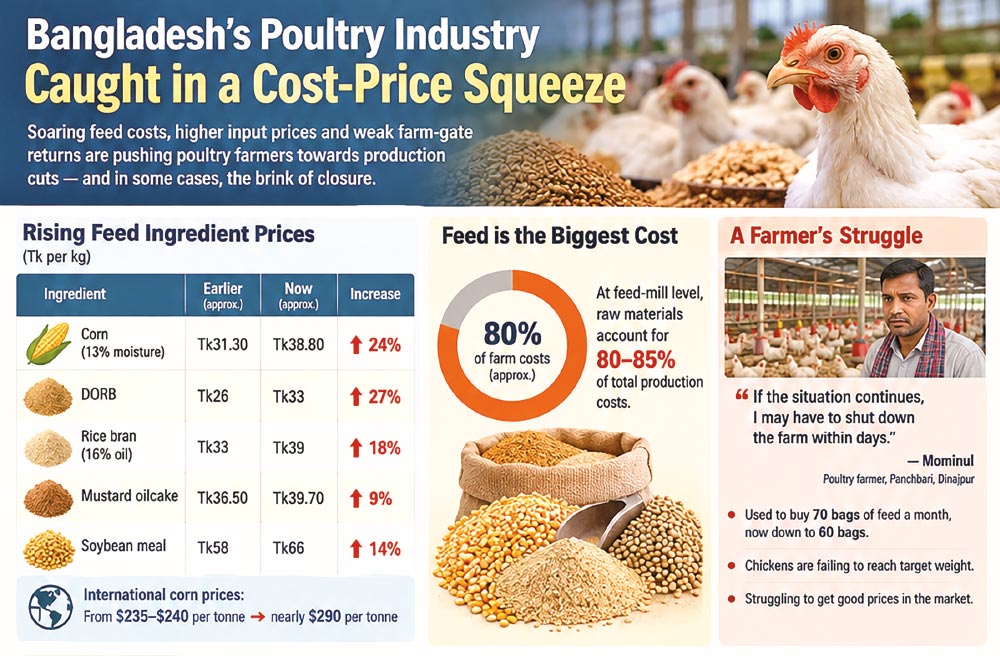 Bangladesh's poultry industry is being squeezed from both ends as soaring feed costs, higher input prices and weak farm-gate returns push farmers towards production cuts and, in some cases, the brink of closure.
The crisis is being driven primarily by a sharp rise in the prices of corn, soybean meal, rice bran and de-oiled rice bran (DORB)�"the basic ingredients of poultry feed. Higher import costs, exchange-rate volatility, supply disruptions and rising energy costs have compounded the pressure on an industry that supplies a major share of the country's affordable animal protein.
For farmers, the arithmetic is becoming increasingly unforgiving.
Mominul, a poultry farmer in Panchbari, Dinajpur Sadar, used to buy around 70 bags of feed a month for his broiler chickens. After two successive price increases, he has cut purchases to about 60 bags.
The consequences are already visible: his chickens are failing to reach their target weight, while he is struggling to secure remunerative prices in the market. “If the situation continues, I may have to shut down the farm within days,” he said.
His predicament is being repeated across the country.
Feed is the single largest cost in poultry production and can account for up to 80 per cent of farm costs. At feed-mill level, raw materials typically account for 80-85 per cent of total production costs. Any sustained increase in major ingredients therefore travels quickly from international commodity markets to feed mills, farms and ultimately consumers.
The latest price movements show the scale of the squeeze.
Corn containing 13 per cent moisture is selling at around Tk38.80 a kilogramme, up from Tk31.30 a month earlier. DORB has risen from Tk26 to Tk33, while rice bran containing 16 per cent oil has climbed from Tk33 to Tk39. Mustard oilcake has increased from Tk36.50 to Tk39.70, and soybean meal from Tk58 to Tk66 a kilogramme.
Industry estimates suggest corn was available at only Tk28-Tk29 a kilogramme during March-May, before climbing to Tk38-Tk40 during June-August. Internationally, corn prices have risen from roughly $235-$240 a tonne to nearly $290.
The impact is feeding directly into poultry-feed prices.
Hafizur, a poultry farmer in Bogura Sadar, said different types of feed had become Tk2-Tk3 a kilogramme more expensive within a week, adding up to Tk150 to the price of a 50kg bag.
The price of a 50kg bag of bran has risen from Tk1,300 to Tk1,800, while corn has jumped from Tk25 to Tk37 a kilogramme. A 50kg bag of poultry feed now costs as much as Tk3,675, he said.
Farmers cannot absorb these increases indefinitely,” Hafizur said.
The problem is not confined to feed. Prices of medicines, vaccines and other inputs have also increased, while egg and chicken prices have not consistently kept pace with rising production costs. That squeeze is forcing farmers to reduce flock sizes, while some are abandoning the business altogether.
Import dependence deepens the squeeze
Mosharraf Hossain Chowdhury, president of the Bangladesh Poultry Industries Association (BPIA), said the industry's heavy dependence on imported raw materials was leaving it exposed to global price shocks.
“Corn is a major component of poultry feed. Locally produced corn can meet demand for less than three months, while imported corn is required for the rest of the year,” he said.
Global conflicts have also pushed up freight costs, he said, while higher prices of soybean meal, rice bran and DORB have added further pressure.
“With corn now costing Tk39-Tk40 a kilogramme, even a Tk4 increase in feed prices leaves little or no profit margin for feed mill owners,” Chowdhury said.
Several feed mills have already reduced production, he added.
Feed sellers are also blaming energy shortages. Salim Sheikh, an animal-feed seller in Kapasia, Gazipur, said shortages of gas and electricity were disrupting feed production and forcing traders to buy at higher prices.
“As feed becomes more expensive, the number of customers is falling,” he said.
Farmers take to the streets
The crisis has spilled into the streets.
Between June and September, poultry farmers staged human chains, rallies, road blockades, egg-smashing protests and memorandum submissions in Rajshahi, Gazipur, Pabna, Kishoreganj, Cumilla, Narsingdi, Dhaka, Kushtia and Mymensingh.
Their demands include lower feed prices, reduced import duties and taxes on raw materials and fairer prices for eggs and chickens.
Industry stakeholders say simply fixing retail feed prices will not solve the problem. Authorities must also monitor the prices, stocks and distribution of raw materials to prevent artificial shortages and supply manipulation.
Calls for targeted intervention
Russell Pradhan, general secretary of the Bangladesh Marginal Poultry Farmers Association, called for domestic supplies of DORB and rice bran to be prioritised for local consumers.
He suggested temporary export restrictions could be considered when domestic supplies become tight, alongside reductions in VAT, taxes and duties on imported feed ingredients.
Dr Md Shafiqur Rahman Sishir, associate professor and head of the Department of Animal Nutrition at Bangladesh Agricultural University, also stressed the need to prioritise domestic demand.
However, he cautioned against imposing a blanket export ban, arguing that the interests of producers and domestic industries must also be protected.
“If international raw-material prices rise, import duties and taxes could be adjusted temporarily,” he said.
In the longer term, Bangladesh must expand domestic production of corn and other feed crops to reduce its vulnerability to global commodity and currency shocks, he said.
BPIA's Chowdhury also called for a reduction in the corporate tax burden, arguing that a lower rate would give industry operators greater room to absorb rising costs and sustain production.
Policy overhaul meets cost crisis
The industry's cost crisis comes as the government introduces a major regulatory overhaul.
The Ministry of Fisheries and Livestock has enacted the National Poultry Development Policy 2026, replacing the 18-year-old framework. The new policy strengthens biosecurity requirements and bans imports of meat and bone meal (MBM) over food-safety concerns.
At the same time, the Bangladesh Poultry Industries Central Council (BPICC) has launched campaigns against antibiotic misuse and sought to rebuild consumer confidence in commercial broiler meat.
Md Shahjaman Khan, acting director general of the Department of Livestock Services, said the government was working to reduce feed and other input costs.
“Ensuring safe and affordable poultry products for consumers requires reducing production costs at the farm level,” he said, adding that the authorities planned to meet feed-mill owners to explore ways of lowering input costs.
The stakes are high. With an estimated value of around Tk40,000 crore, Bangladesh's poultry industry is a major source of rural employment, entrepreneurship and affordable protein. But the sector now faces a dangerous cost-price squeeze.
Unless feed costs come under control and farmers receive viable returns, today's production cuts could become tomorrow's supply crisis�"putting both thousands of poultry farms and the affordability of eggs and chicken at risk.
Loading...
Loading...
Also read



Editor : Iqbal Sobhan Chowdhury
Published by the Editor on behalf of the Observer Ltd. from Globe Printers, 24/A, New Eskaton Road, Ramna, Dhaka.
Editorial, News and Commercial Offices : Aziz Bhaban (2nd floor), 93, Motijheel C/A, Dhaka-1000.
Phone: PABX- 41053001-06; Advertisement: 41053012; 01793317829, 01550707291, E-mail: [email protected], [email protected] Online: email: [email protected] 41053014; 01550707297 Advertisement: 01550707296
Published by the Editor on behalf of the Observer Ltd. from Globe Printers, 24/A, New Eskaton Road, Ramna, Dhaka.
Editorial, News and Commercial Offices : Aziz Bhaban (2nd floor), 93, Motijheel C/A, Dhaka-1000.
Phone: PABX- 41053001-06; Advertisement: 41053012; 01793317829, 01550707291, E-mail: [email protected], [email protected] Online: email: [email protected] 41053014; 01550707297 Advertisement: 01550707296


