



| HEADLINE |

|
LGD orders solar power setups in all hat-bazars
Published : Friday, 25 September, 2026 at 11:22 AM
Observer Online Report


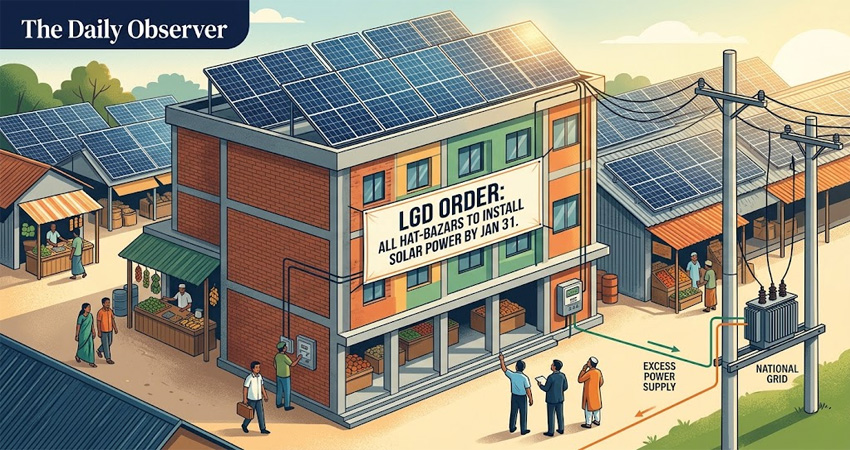
AI Illustration
The Local Government Division (LGD) has issued directives to install solar power systems in all union-level hat-bazars across the country by January 31, with surplus electricity fed into the national grid.
The LGD sent letters to all Upazila Parishad administrators and Upazila Nirbahi Officers (UNOs) on Thursday (September 24) outlining the decision.
To ensure sustainable energy security, the government has launched extensive initiatives to expand renewable energy. Under these directives, roof-top solar power systems with batteries must be installed on main and auxiliary official buildings at local, district, and upazila levels. These systems must provide at least two hours of battery backup.
Revenue Generation through Net Metering
After meeting their own power needs, institutions must supply excess electricity to the national grid through net metering. Under the 'Net Metering Guidelines 2025', institutions will receive Tk 10.50 per unit of electricity supplied to the grid. The guideline notes that this initiative will boost the revenue earnings of local government institutions.
Funding from Market Lease Earnings
The instruction further mandates ensuring solar power usage across all union hat-bazars in every upazila. Under Rule 10 (E) and (F) of the 'Hat and Bazar (Establishment and Management) Rules 2025', 10 per cent of lease revenue is allocated for the maintenance or development of the respective hat-bazar, and another 10 per cent is designated for upazila-wide hat-bazar maintenance. This fund must be used to install and commercially expand solar power systems.
Implementation and Contract Guidelines
Authorities must execute agreements on non-judicial stamps with solar system providers to cover repair and maintenance for the next 20 years. The entire solar setup must be completed by January 31.
The LGD stated that solar panels should be installed on permanent sheds in hat-bazars and on roofs of 4-5 storey market buildings constructed by the Local Government Engineering Department (LGED). Measures must be taken to route all surplus electricity to the national grid after fulfilling local consumption needs.
-SA
Loading...
Loading...
Also read








Editor : Iqbal Sobhan Chowdhury
Published by the Editor on behalf of the Observer Ltd. from Globe Printers, 24/A, New Eskaton Road, Ramna, Dhaka.
Editorial, News and Commercial Offices : Aziz Bhaban (2nd floor), 93, Motijheel C/A, Dhaka-1000.
Phone: PABX- 41053001-06; Advertisement: 41053012; 01793317829, 01550707291, E-mail: [email protected], [email protected] Online: email: [email protected] 41053014; 01550707297 Advertisement: 01550707296
Published by the Editor on behalf of the Observer Ltd. from Globe Printers, 24/A, New Eskaton Road, Ramna, Dhaka.
Editorial, News and Commercial Offices : Aziz Bhaban (2nd floor), 93, Motijheel C/A, Dhaka-1000.
Phone: PABX- 41053001-06; Advertisement: 41053012; 01793317829, 01550707291, E-mail: [email protected], [email protected] Online: email: [email protected] 41053014; 01550707297 Advertisement: 01550707296


