



| HEADLINE |

|
BAU develops plantain-based technology to enhance poultry meat nutrition
Published : Sunday, 27 September, 2026 at 7:40 PM
Toriqul Islam Sumon


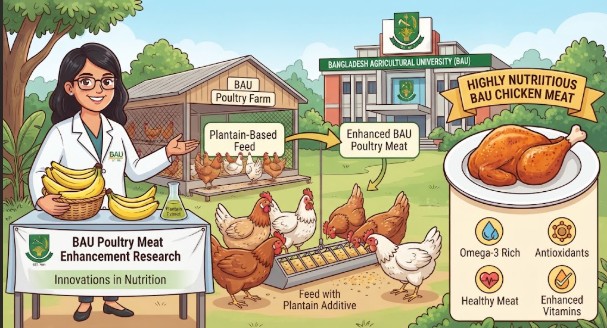
The Department of Animal Nutrition at Bangladesh Agricultural University (BAU) has achieved success in research utilising plantain to enhance the nutritional value of poultry meat.
Project Director and BAU researcher Prof Dr Md Mohammad Al-Mamun said that, following nearly two decades of continuous research, an initiative has been launched to utilise the potential of the medicinal plant plantain (Plantago lanceolata L.) to develop an integrated technology and value chain for producing safe, functional and nutrient-rich broiler meat.
The researcher shared the information during a recent interview.
The project director said the research originated in Japan and was subsequently carried out through continuous studies in Bangladesh to evaluate plantain’s antioxidant and phytogenic properties, its impact on broiler production performance, and the functional nutritional value of the meat. The research has received several national and international awards and honours.
Following successful outcomes in Phases 1 and 2, and after demonstrating the efficacy of plantain-based phytogenic feed technology in Phase 3, the ongoing Phase 5 project, titled “Sustainable commercialisation of plantain (Plantago lanceolata L.) and seed value chain development for safe and functional broiler meat production”, primarily focuses on the sustainable and commercial expansion of the technology across Bangladesh.
Highlighting the project’s achievements, Prof Al-Mamun said G1 seeds were successfully cultivated in Bangladesh from imported parental seeds, followed by the production of G2 seeds for future commercial expansion. Trials showed that G2 seed production holds significant promise, paving the way for the development of a domestic plantain seed industry while reducing reliance on imported seeds.
Plantain cultivation was conducted in both AC and non-AC greenhouses, as well as open fields in Mymensingh and Manikganj. Field results indicate prospects for commercial plantain farming. This has laid the groundwork for a potential domestic raw material supply chain covering seed production, cultivation, harvesting, drying and powder processing.
A phytogenic feed additive technology, named BAU-Plantive, was developed using plantain as the primary component, combined with selected medicinal plants. Continuous research under the current project, including trials on two broiler breeds and one local (Deshi) chicken, demonstrated satisfactory production results using locally grown plantain.
Furthermore, positive accumulation of polyunsaturated fatty acids (PUFAs), particularly omega-3 fatty acids, HDL and iron (Fe), was recorded in the meat. Compared with standard broiler meat, chicken produced using BAU-Plantive exhibited a more appealing reddish colour and improved taste, indicating potential to offer nutrient-rich, visually appealing and consumer-friendly poultry products.
In his presentation, Prof Al-Mamun said that, rather than confining the technology to laboratories, initiatives had been undertaken to produce functional broilers at the commercial farm level in Manikganj.
Efforts are also underway to establish market linkages with retail markets and supershops in Dhaka. These market-integration activities identified the need for processing and blast-freezing cold-chain facilities to support large-scale distribution.
Prof Al-Mamun outlined key steps for domestic plantain production, including large-scale quality seed production using G2 seeds, seed company involvement, contract farming, production and use through feed mills, functional broiler farming at selected farms, and marketing through proper processing and cold-chain networks.
He emphasised that coordinated collaboration among the government, research institutions, seed companies, feed mills, the poultry industry and market management systems will not only ensure safe and nutritious poultry production, but also foster new seed and feed-additive industries, increase farmers’ incomes and create new employment opportunities.
sks
Loading...
Loading...
Also read








Editor : Iqbal Sobhan Chowdhury
Published by the Editor on behalf of the Observer Ltd. from Globe Printers, 24/A, New Eskaton Road, Ramna, Dhaka.
Editorial, News and Commercial Offices : Aziz Bhaban (2nd floor), 93, Motijheel C/A, Dhaka-1000.
Phone: PABX- 41053001-06; Advertisement: 41053012; 01793317829, 01550707291, E-mail: [email protected], [email protected] Online: email: [email protected] 41053014; 01550707297 Advertisement: 01550707296
Published by the Editor on behalf of the Observer Ltd. from Globe Printers, 24/A, New Eskaton Road, Ramna, Dhaka.
Editorial, News and Commercial Offices : Aziz Bhaban (2nd floor), 93, Motijheel C/A, Dhaka-1000.
Phone: PABX- 41053001-06; Advertisement: 41053012; 01793317829, 01550707291, E-mail: [email protected], [email protected] Online: email: [email protected] 41053014; 01550707297 Advertisement: 01550707296


