



| HEADLINE |

|

Bangladesh’s journey towards women’s empowerment
Published : Tuesday, 13 October, 2026 at 6:57 PM
Maliha Tabassum


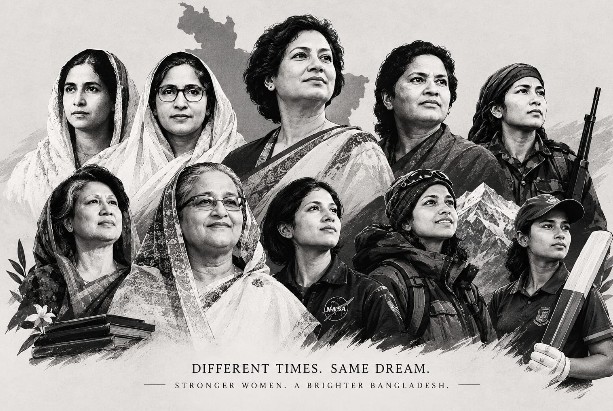
Bangladesh has produced women who challenged social conventions, led political movements and excelled in fields once considered beyond their reach. Yet, while some have reached the highest positions of power, many others continue to struggle for basic freedom and equal opportunities.
In 1873, Nawab Faizunnesa Chowdhurani established a girls' school in Cumilla, challenging the barriers to women's education. Decades later, Begum Rokeya Sakhawat Hossain carried that struggle forward through her writing and activism, arguing that education was essential to women's liberation.
Their vision found echoes in later generations. Poet and activist Sufia Kamal became a prominent voice for women's rights and cultural freedom, while Jahanara Imam mobilised public opinion for justice for the victims of the 1971 Liberation War. During the war itself, freedom fighter Taramon Bibi took up arms against Pakistani forces, challenging conventional expectations of women's roles in national struggle.
Women also began breaking barriers in politics. Khaleda Zia became Bangladesh's first female prime minister in 1991. Sheikh Hasina subsequently became the country's longest-serving prime minister, holding office from 1996 to 2001 and again from 2009 to 2024. Both led major political parties and spent years in opposition as well as in government.
Beyond politics, Bangladeshi women have continued to expand the boundaries of possibility. Nishat Majumder became the first Bangladeshi woman to summit Mount Everest in 2012, while cricketer Nigar Sultana Joty has captained the national women's team, helping bring greater visibility to women's sport.
If Bangladeshi women can lead governments, scale the world's highest mountain and represent their country internationally, why does empowerment remain so uncertain for so many others?
These achievements tell a story of progress. But they also raise an uncomfortable question, one that becomes clearer when we look beyond individual success stories.
A woman may lead a country while another struggles to convince her family to let her continue studying. A woman may earn an income but have little control over how it is spent. Others face early marriage, restrictions on mobility, workplace discrimination and barriers to reporting violence.
According to the World Bank's modelled estimates for 2025, women's labour force participation in Bangladesh stood at 38.6 per cent, compared with 80.4 per cent for men. The gap illustrates the continuing inequality in access to economic opportunities.
Empowerment is not simply about having women in parliament, in boardrooms or at the head of political parties. It is also about whether a woman can choose her education, earn and control her own money, move safely through public spaces and make decisions about her future.
Faizunnesa challenged educational exclusion in the 19th century. Rokeya challenged the social attitudes that sustained it. Later generations pushed into politics, sports and public life. Their achievements demonstrate what becomes possible when women are given opportunities to lead.
But exceptional women cannot, by themselves, guarantee equal rights for everyone. That requires accessible education, decent work, effective protection from violence and a society that recognises women's choices as their own.
Bangladesh's story of women's empowerment is therefore both remarkable and unfinished. Its next chapter will not be measured only by the women who reach the highest offices, but by whether ordinary women, regardless of their income or where they live, gain the freedom to shape their own lives.

Loading...
Loading...
Also read





Editor : Iqbal Sobhan Chowdhury
Published by the Editor on behalf of the Observer Ltd. from Globe Printers, 24/A, New Eskaton Road, Ramna, Dhaka.
Editorial, News and Commercial Offices : Aziz Bhaban (2nd floor), 93, Motijheel C/A, Dhaka-1000.
Phone: PABX- 41053001-06; Advertisement: 41053012; 01793317829, 01550707291, E-mail: [email protected], [email protected] Online: email: [email protected] 41053014; 01550707297 Advertisement: 01550707296
Published by the Editor on behalf of the Observer Ltd. from Globe Printers, 24/A, New Eskaton Road, Ramna, Dhaka.
Editorial, News and Commercial Offices : Aziz Bhaban (2nd floor), 93, Motijheel C/A, Dhaka-1000.
Phone: PABX- 41053001-06; Advertisement: 41053012; 01793317829, 01550707291, E-mail: [email protected], [email protected] Online: email: [email protected] 41053014; 01550707297 Advertisement: 01550707296


