



| HEADLINE |

|

A changing Indo-Pacific geopolitics for Bangladesh
Published : Friday, 2 October, 2026 at 5:33 PM
Rafsan Jani


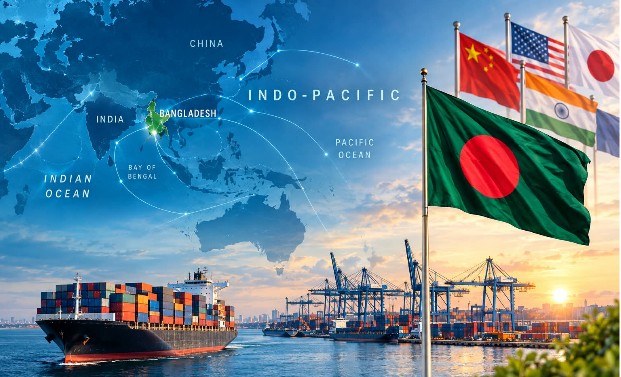
The changing geopolitics of the Indo-Pacific is creating new opportunities and challenges for Bangladesh as the region increasingly becomes a major arena of economic, trade, maritime, technological and strategic competition among global powers.
The Indo-Pacific is no longer merely a geographical concept. Stretching from the Indian Ocean to the Pacific, it has emerged as a critical theatre of global politics, while the Bay of Bengal is also gaining increasing geopolitical significance. Bangladesh’s geographical position is consequently placing the country in a more important position within the wider Indo-Pacific framework.
Bangladesh outlined its position through its 15-point Indo-Pacific Outlook in 2023, calling for a free, open, peaceful, secure and inclusive Indo-Pacific. Sovereignty, international law, the UN Convention on the Law of the Sea (UNCLOS), maritime security, connectivity, trade, climate action, energy, technology and regional cooperation were identified as key pillars.
Three years on, the central question for Bangladesh is no longer whether it will be part of the Indo-Pacific. Rather, it is how Dhaka can protect its national interests, strategic autonomy and economic opportunities amid the region’s changing geopolitical dynamics.
Geography gains new importance
Bangladesh’s geography is one of its most important strategic assets. Located at the northern end of the Bay of Bengal, the country is close to important maritime routes connecting the Indian Ocean with wider regional and global markets.
Its seaports, coastal areas, economic zones and regional connectivity networks could therefore acquire growing economic and strategic significance.
As competition in the Indo-Pacific intensifies, maritime security, supply chains and port infrastructure are becoming increasingly important. Bangladesh’s ports and connectivity infrastructure can no longer be viewed only as development projects; they also carry wider economic and geopolitical significance.
This presents both opportunities and risks. Bangladesh can potentially strengthen its role in regional trade and connectivity through its access to the Bay of Bengal. At the same time, growing competition among major powers could increase their strategic interest in Bangladesh’s infrastructure and maritime resources.
China remains central to the equation
China is one of the most important dimensions of Bangladesh’s Indo-Pacific reality. It is Bangladesh’s largest trading partner, while Bangladeshi industries depend heavily on Chinese raw materials and intermediate goods.
According to information from the Bangladesh Embassy in China, Chinese investment and cooperation extend across infrastructure, power, communications, ICT and port development, among other sectors.
Bilateral relations entered a new phase in 2026 following Prime Minister Tarique Rahman’s visit to China in June. The two countries announced steps towards building a “China-Bangladesh Community with a Shared Future in the New Era”. Trade, investment, the Belt and Road Initiative and broader cooperation were also discussed.
For Bangladesh, the relationship with China is therefore not limited to diplomacy. It is closely connected with the country’s economy, infrastructure, industrialisation and supply chains.
At the same time, the deepening economic relationship requires strategic caution. As Bangladesh’s engagement with China expands, its geopolitical significance to the United States and its allies is also likely to receive greater attention.
For Dhaka, the challenge is not to avoid China but to manage the relationship within a framework that protects Bangladesh’s economic requirements and national interests.
India remains indispensable
India represents another essential pillar of Bangladesh’s Indo-Pacific calculations.
The relationship between the two countries extends beyond diplomacy. Their geographical proximity links their interests in borders, rivers, energy, trade, connectivity with northeastern India and security in the Bay of Bengal.
India is also one of the major powers in the Indo-Pacific and is expanding its strategic role in the Indian Ocean region. As a result, the India-China competition is not a distant issue for Bangladesh. Its economic and security implications can directly affect the country.
Bangladesh therefore faces an important policy question over whether the India-China competition should be viewed as a zero-sum game.
India’s connectivity, markets and regional cooperation are important for Bangladesh, while China’s industrial capacity, investment and supply chains are also significant. Excluding one relationship in favour of the other may not always be compatible with Bangladesh’s broader economic interests.
US ties add a new economic dimension
The changing trade policy of the United States has added another layer to Bangladesh’s Indo-Pacific calculations.
Bangladesh and the United States signed a Reciprocal Trade Agreement on February 9, 2026. The agreement covers issues including tariff and non-tariff barriers, market access, trade and investment. The United States has maintained a 19 per cent reciprocal tariff rate on Bangladeshi goods, with separate arrangements for certain products.
The agreement also illustrates how Bangladesh’s Indo-Pacific engagement is moving beyond traditional security and military considerations.
Economic security, market access, supply chains and trade policy are increasingly becoming strategic issues.
For Bangladesh, this is particularly important because its export-oriented economy depends heavily on global markets. The US market, China’s manufacturing capacity, India’s regional market and Japan’s investment and technology therefore need to be considered as interconnected elements of a broader economic strategy.
Japan’s role is also expanding
Japan remains another important partner in Bangladesh’s Indo-Pacific equation.
At the seventh Bangladesh-Japan Foreign Office Consultations in August 2026, the two countries agreed to deepen their Strategic Partnership. Discussions included trade and investment, energy security, green energy, an Economic Partnership Agreement, the BIG-B Initiative and defence cooperation.
Japan is important not only as a long-standing development partner of Bangladesh but also as a major economic and strategic power in the Indo-Pacific.
For Bangladesh, stronger engagement with Japan could therefore contribute to infrastructure development, technology, skills, investment and maritime cooperation.
Strategic autonomy is the real challenge
Taken together, the biggest challenge for Bangladesh is maintaining strategic autonomy.
Simply describing the policy as “balancing” major powers may oversimplify the issue. Bangladesh needs to develop relationships with different partners while keeping its own economic and security interests at the centre of its foreign policy.
The core principles of the 2023 Indo-Pacific Outlook remain relevant in this context. Bangladesh called for a free, open, peaceful, secure and inclusive Indo-Pacific, with emphasis on international law, UNCLOS, maritime security, connectivity, resilient supply chains and technological cooperation.
But policy declarations alone will not be sufficient. They need to be translated into national capabilities.
Bangladesh needs to strengthen its maritime capabilities, including maritime resource management, maritime domain awareness, search and rescue, environmental protection and the wider blue economy.
Connectivity should also go beyond infrastructure construction. Bangladesh’s objective should be to become an effective part of regional and global supply chains.
Relations with China, India, the United States and Japan should be managed within an integrated framework of economic and national interests rather than as separate geopolitical calculations.
At the same time, greater engagement through multilateral platforms such as BIMSTEC, IORA and the United Nations could provide Bangladesh with additional diplomatic space amid growing great-power competition.
The question is not ‘with whom’ but ‘how’
The most important question for Bangladesh in the changing Indo-Pacific may not be whether the country is closer to China, India or the United States.
The more important question is how Bangladesh can develop an effective strategy centred on its own national interests.
Major powers will continue to pursue their own interests. Bangladesh cannot determine the course of their competition. But it can seek to maximise its economic and diplomatic space within that competition.
That requires diversified relationships without policy ambiguity, partnerships without excessive dependence, connectivity with careful consideration of strategic risks, and investment based on economic viability and long-term national interests.
Bangladesh’s geography has given it a significant advantage, but geography alone does not constitute a strategy.
Turning that advantage into strategic strength will require effective diplomacy, a stronger economy, enhanced maritime capabilities and consistent long-term planning.
The Indo-Pacific is likely to become even more competitive in the coming years. US-China rivalry, India’s expanding regional role, Japan’s growing strategic engagement and the rising importance of the Bay of Bengal will continue to shape Bangladesh’s external environment.
In this changing landscape, Bangladesh’s challenge is to maintain productive relations with all major partners while preserving its freedom of decision-making.
Ultimately, the Indo-Pacific is not merely a geopolitical question for Bangladesh. It is also about the country’s economy, maritime interests, trade, technology, security and future development model.
The task for Bangladesh is therefore to turn the strategic opportunity created by its Bay of Bengal geography into greater economic and diplomatic capability while keeping its own national interests at the centre.
The writer is a geopolitical analyst

Loading...
Loading...
Also read









Editor : Iqbal Sobhan Chowdhury
Published by the Editor on behalf of the Observer Ltd. from Globe Printers, 24/A, New Eskaton Road, Ramna, Dhaka.
Editorial, News and Commercial Offices : Aziz Bhaban (2nd floor), 93, Motijheel C/A, Dhaka-1000.
Phone: PABX- 41053001-06; Advertisement: 41053012; 01793317829, 01550707291, E-mail: [email protected], [email protected] Online: email: [email protected] 41053014; 01550707297 Advertisement: 01550707296
Published by the Editor on behalf of the Observer Ltd. from Globe Printers, 24/A, New Eskaton Road, Ramna, Dhaka.
Editorial, News and Commercial Offices : Aziz Bhaban (2nd floor), 93, Motijheel C/A, Dhaka-1000.
Phone: PABX- 41053001-06; Advertisement: 41053012; 01793317829, 01550707291, E-mail: [email protected], [email protected] Online: email: [email protected] 41053014; 01550707297 Advertisement: 01550707296


