



| HEADLINE |

|

Poverty rises to 22.5pc as 62mn face risk of falling below the line
Published : Saturday, 17 October, 2026 at 1:05 PM
Tanjeem


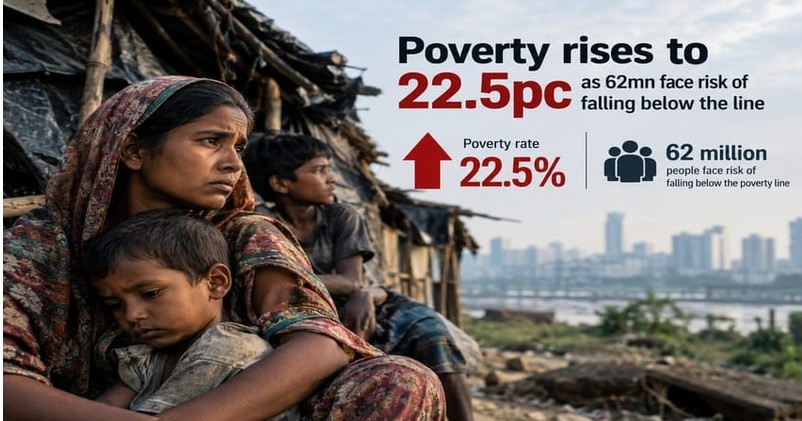
Poverty is on the rise in Bangladesh, with an additional eight million people falling into poverty over the past four years, according to World Bank estimates. Another 62 million people living just above the poverty line remain vulnerable to economic shocks that could push them into poverty.
Economists warn that without increased investment, job creation and wider access to skills-based education, reversing the trend will be difficult. Rising income inequality and the growing cost of living are putting additional pressure on low- and middle-income households.
Under Bangladesh’s food-based poverty measurement, people who cannot afford food providing around 2,122 calories a day are considered poor.
World Bank estimates indicate that the number of people living in poverty has increased by eight million over the past four years. According to the Bangladesh Bureau of Statistics (BBS), at least 47.5 million people were living below the poverty line in 2022. With the population growing since then, the World Bank estimates that the number of people in poverty has now reached approximately 55 million.
The impact of rising living costs is increasingly evident in the daily lives of ordinary people.
“Rice prices are high, vegetable prices are high, cooking oil prices are high, and gas prices are high. Everything has become more expensive. How are poor people supposed to survive?” a woman in Dhaka said.
Another resident described the struggle to make ends meet, saying, “There is no end to hardship now. Even earning enough to eat each day has become difficult.”
A third woman pointed to the lack of employment opportunities and factory closures.
According to the figures cited in the report, Bangladesh’s poverty rate is projected to reach 22.5% in 2026, up 1.1 percentage points from 2025. The rate stood at 20.5% in 2024, compared with 18.7% in 2022, indicating a sustained reversal of the poverty-reduction trend in the post-pandemic period.
Income inequality has also widened. The income inequality measure cited in the report rose from 30.9% in 2022 to 34.9% in 2025, reflecting a growing gap between richer and poorer sections of society.
Analysts attribute the worsening situation to higher expenses for food, housing, healthcare and transportation, which consume an increasing share of household income. At the same time, sluggish investment and difficulties in the industrial sector have constrained the creation of new jobs.
As earnings fail to keep pace with expenses, more families risk slipping into poverty.
Economist MM Akash said the structural challenges could not be addressed without fresh investment and industrial expansion.
“Without new industrialisation, new investment and new employment, this structural crisis will not ease. The tendency for people to fall below the poverty line will persist,” he said.
The World Bank estimates that around 62 million people in Bangladesh live slightly above the poverty line, leaving them vulnerable to sudden financial setbacks.
A decline in income, job loss, natural disasters such as floods or a sudden spike in the prices of essential commodities could push many of these people below the poverty threshold.
The scale of this vulnerable population highlights the broader challenge facing Bangladesh: poverty reduction will require not only lifting people out of poverty but also protecting millions of households from falling back into it.
Economists warn that without increased investment, job creation and wider access to skills-based education, reversing the trend will be difficult. Rising income inequality and the growing cost of living are putting additional pressure on low- and middle-income households.
Under Bangladesh’s food-based poverty measurement, people who cannot afford food providing around 2,122 calories a day are considered poor.
World Bank estimates indicate that the number of people living in poverty has increased by eight million over the past four years. According to the Bangladesh Bureau of Statistics (BBS), at least 47.5 million people were living below the poverty line in 2022. With the population growing since then, the World Bank estimates that the number of people in poverty has now reached approximately 55 million.
The impact of rising living costs is increasingly evident in the daily lives of ordinary people.
“Rice prices are high, vegetable prices are high, cooking oil prices are high, and gas prices are high. Everything has become more expensive. How are poor people supposed to survive?” a woman in Dhaka said.
Another resident described the struggle to make ends meet, saying, “There is no end to hardship now. Even earning enough to eat each day has become difficult.”
A third woman pointed to the lack of employment opportunities and factory closures.
“There are no jobs. Many garment factories have shut down, and we cannot find work. Meanwhile, the prices of essential goods keep rising,” she said.
Poverty and inequality deepen
According to the figures cited in the report, Bangladesh’s poverty rate is projected to reach 22.5% in 2026, up 1.1 percentage points from 2025. The rate stood at 20.5% in 2024, compared with 18.7% in 2022, indicating a sustained reversal of the poverty-reduction trend in the post-pandemic period.
Income inequality has also widened. The income inequality measure cited in the report rose from 30.9% in 2022 to 34.9% in 2025, reflecting a growing gap between richer and poorer sections of society.
Analysts attribute the worsening situation to higher expenses for food, housing, healthcare and transportation, which consume an increasing share of household income. At the same time, sluggish investment and difficulties in the industrial sector have constrained the creation of new jobs.
As earnings fail to keep pace with expenses, more families risk slipping into poverty.
Economist MM Akash said the structural challenges could not be addressed without fresh investment and industrial expansion.
“Without new industrialisation, new investment and new employment, this structural crisis will not ease. The tendency for people to fall below the poverty line will persist,” he said.
He added that reducing interest rates and expanding small and medium-sized enterprises (SMEs) would be important to addressing the employment crisis.
Millions vulnerable to economic shocks
The World Bank estimates that around 62 million people in Bangladesh live slightly above the poverty line, leaving them vulnerable to sudden financial setbacks.
A decline in income, job loss, natural disasters such as floods or a sudden spike in the prices of essential commodities could push many of these people below the poverty threshold.
The scale of this vulnerable population highlights the broader challenge facing Bangladesh: poverty reduction will require not only lifting people out of poverty but also protecting millions of households from falling back into it.

Loading...
Loading...
Also read






Editor : Iqbal Sobhan Chowdhury
Published by the Editor on behalf of the Observer Ltd. from Globe Printers, 24/A, New Eskaton Road, Ramna, Dhaka.
Editorial, News and Commercial Offices : Aziz Bhaban (2nd floor), 93, Motijheel C/A, Dhaka-1000.
Phone: PABX- 41053001-06; Advertisement: 41053012; 01793317829, 01550707291, E-mail: [email protected], [email protected] Online: email: [email protected] 41053014; 01550707297 Advertisement: 01550707296
Published by the Editor on behalf of the Observer Ltd. from Globe Printers, 24/A, New Eskaton Road, Ramna, Dhaka.
Editorial, News and Commercial Offices : Aziz Bhaban (2nd floor), 93, Motijheel C/A, Dhaka-1000.
Phone: PABX- 41053001-06; Advertisement: 41053012; 01793317829, 01550707291, E-mail: [email protected], [email protected] Online: email: [email protected] 41053014; 01550707297 Advertisement: 01550707296


