



| HEADLINE |

|

Maha Ashtami: The story behind Sandhi Puja and Goddess Chamunda
Published : Monday, 19 October, 2026 at 5:49 PM
Sakia Kawser Siddique


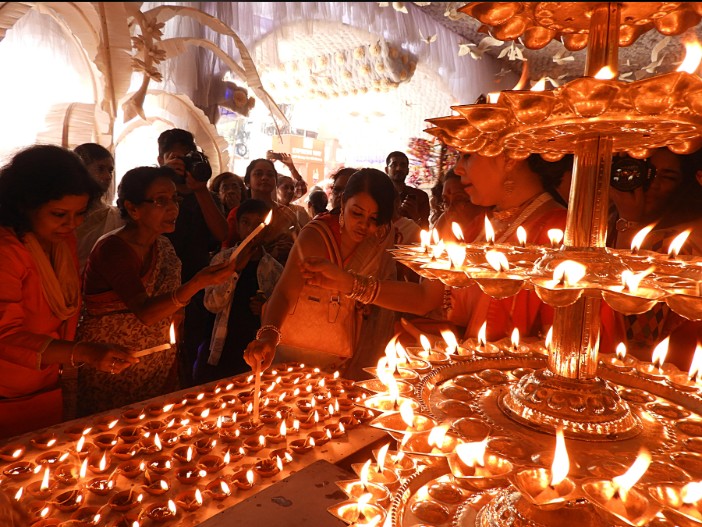
Maha Ashtami, observed on Monday, October 19, is one of the most significant days of Sharadiya Durga Puja in Bangladesh. Among its most distinctive observances is Sandhi Puja, performed at the transition between Ashtami and Navami and associated with the fierce form of the goddess known as Chamunda.
What is Sandhi Puja?
The Sanskrit word sandhi means a junction or meeting point. In Durga Puja, Sandhi Puja is performed during the final 24 minutes of Ashtami and the first 24 minutes of Navami, creating a ritual period of approximately 48 minutes.
The exact timing depends on when the lunar tithi changes, so devotees follow the local panjika for the ceremony. The observance is commonly marked by special offerings, lamps, flowers and prayers. Some temples also arrange 108 lamps or flowers, although practices vary.
Sandhi Puja is important because it connects two principal days of worship. Its religious significance is rooted in the tradition that the goddess’s fierce power becomes manifest at this transitional moment.
The story of Chanda, Munda and Chamunda
The mythology associated with Sandhi Puja is drawn from the Devi Mahatmya, also known as the Durga Saptashati or Chandi, a Sanskrit text incorporated into the Markandeya Purana.
In Chapter Seven, the demons Chanda and Munda approach the goddess with their forces. In response to their attack, a fierce form of the goddess emerges from the brow of Ambika. Identified as Kali in the narrative, she destroys the demons and brings their heads to Chandika.
The goddess then names her Chamunda, a name formed from those of the defeated demons, Chanda and Munda.
This account explains the religious association between Sandhi Puja and Chamunda. The connection between the demons’ defeat and the precise Ashtami–Navami junction belongs to the ritual tradition of Durga Puja; the text’s account of the battle itself appears in Chapter Seven of the Devi Mahatmya

Other Ashtami observances
Maha Ashtami is also associated with Pushpanjali, the offering of flowers accompanied by prayers. Devotees gather before the goddess to recite prayers and seek blessings.
Some communities observe Kumari Puja, in which a young girl is worshipped as a manifestation of the divine feminine. Its performance and timing vary across traditions; it is not conducted in exactly the same way at every temple or community mandap.
In Bangladesh, devotees observe Ashtami at temples and temporary mandaps, including Dhakeshwari National Temple in Dhaka. The scale and details of the celebrations differ between locations, but the day’s worship centres on devotion to Durga and the power attributed to the goddess.
A moment of transition
Sandhi Puja gives a particular ritual significance to the brief transition between two lunar dates. Through the story of Chamunda, the observance recalls the goddess’s destruction of forces that threaten divine order.
Maha Ashtami thus combines the broader worship of Durga with a specific episode from the Devi Mahatmya. Its central message is not merely the defeat of two demons, but the manifestation of the goddess’s power in the face of destructive forces.
Sources: Devi Mahatmya; BSS; MandirBD

Loading...
Loading...
Also read









Editor : Iqbal Sobhan Chowdhury
Published by the Editor on behalf of the Observer Ltd. from Globe Printers, 24/A, New Eskaton Road, Ramna, Dhaka.
Editorial, News and Commercial Offices : Aziz Bhaban (2nd floor), 93, Motijheel C/A, Dhaka-1000.
Phone: PABX- 41053001-06; Advertisement: 41053012; 01793317829, 01550707291, E-mail: [email protected], [email protected] Online: email: [email protected] 41053014; 01550707297 Advertisement: 01550707296


