



| HEADLINE |

|

Bijoya Dashami: Durga’s farewell and immersion
Published : Wednesday, 21 October, 2026 at 4:28 PM
Sakia Kawser Siddique


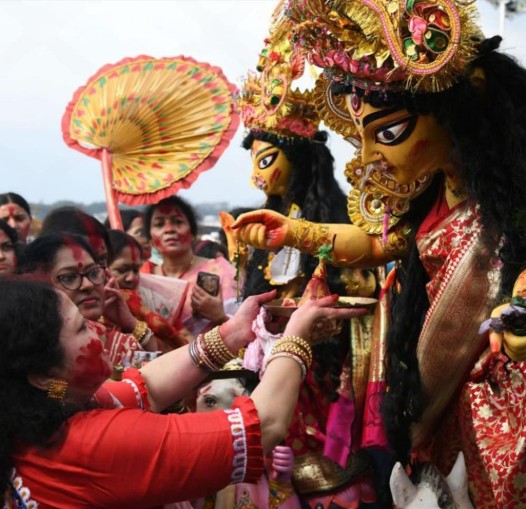
Bijoya Dashami, observed on Wednesday, October 21, marks the final day of Sharadiya Durga Puja in Bangladesh. Devotees bid farewell to Goddess Durga through prayers, traditional greetings and the immersion of idols, bringing the festival’s principal days of worship to a close.
The meaning of Bijoya Dashami
The word Vijaya means victory, while Dashami refers to the tenth lunar day. The occasion is associated with the triumph of good over evil and, in Durga Puja tradition, with the goddess’s victory over Mahishasura.
The mythology of that victory is described in the Devi Mahatmya, part of the Markandeya Purana. The text recounts how Durga defeats the buffalo demon and restores order. Although this story provides an important religious context for the festival, Dashami’s farewell customs developed through particular regional and community traditions.
In Bengali culture, Durga is also understood as a daughter returning to her parental home for the festival. Her departure at Dashami is therefore associated with both religious celebration and the sadness of farewell.

Why are idols immersed?
Idol immersion, known as Bisarjan or Visarjan, is one of the defining observances of Dashami. Following the concluding rituals, the images of the goddess are taken in procession to a river, pond or another designated water body.
The immersion marks the end of the temporary installation of the deity’s image for the festival. The ritual should not be reduced to a single universal explanation: its meaning is shaped by religious practice, local customs and the understanding of the devotees.
In Bangladesh, immersion processions take place at designated water bodies, subject to local arrangements. At temples and community mandaps, the ceremonies may include prayers, farewell offerings and the exchange of greetings among devotees.
The tradition of Sindoor Khela
In many Bengali communities, married Hindu women observe Sindoor Khela on Dashami. They apply vermilion to the goddess and then exchange it with other women, often accompanied by prayers and greetings before the immersion.
The custom is associated with marital well-being, auspiciousness and bonds among women. It is observed in Bangladesh as well as West Bengal, although participation and practices vary between communities.
The precise historical origin of Sindoor Khela is not firmly established. A 2025 report by Mint, discussing the tradition, notes that scholars have not identified a definitive documented point of origin. It is therefore more accurate to describe it as an established Bengali custom whose early history remains uncertain than to assign it a specific date or founder.
Bangladesh Sangbad Sangstha documented Sindoor Khela and idol immersion during the 2023 Bijoya Dashami celebrations, including observances at Dhakeshwari National Temple, Ramna Kali Temple and Siddheswari Kalimandir in Dhaka.

From farewell to Bijoya greetings
After the rituals, devotees exchange Bijoya greetings, visit relatives and friends, and share sweets in many Bengali households. These customs extend the festival beyond the mandap and give its final day a strong social dimension.
Bijoya Dashami is both an ending and a renewal. The goddess’s departure concludes the annual cycle of worship, while the exchange of greetings carries the spirit of the festival into everyday life.
For devotees across Bangladesh, the immersion of Durga’s image marks a farewell to the goddess until her next annual visit. The combination of religious observance, community participation and farewell traditions makes Dashami the emotional conclusion of Sharadiya Durga Puja.
Sources: Devi Mahatmya; BSS; Mint

Loading...
Loading...
Also read








Editor : Iqbal Sobhan Chowdhury
Published by the Editor on behalf of the Observer Ltd. from Globe Printers, 24/A, New Eskaton Road, Ramna, Dhaka.
Editorial, News and Commercial Offices : Aziz Bhaban (2nd floor), 93, Motijheel C/A, Dhaka-1000.
Phone: PABX- 41053001-06; Advertisement: 41053012; 01793317829, 01550707291, E-mail: [email protected], [email protected] Online: email: [email protected] 41053014; 01550707297 Advertisement: 01550707296


