



| HEADLINE |

|

Non-party local polls rock Feb alliances
Published : Tuesday, 27 October, 2026 at 12:00 AM
Tanvir Raihan


 Non-party local elections are shaking up the parliamentary alliances forged in February in the aftermath of the July Uprising, forcing political parties to rethink their strategies for grassroots contests.
With party symbols removed from local government elections, the Bangladesh Nationalist Party (BNP) and Bangladesh Jamaat-e-Islami are leaning towards backing preferred candidates rather than fielding nominees under official party banners.
Meanwhile, seven Islamic parties rooted in the Qawmi madrasa tradition are exploring a joint platform, Samomona Islami Dalshomuh (Like-minded Islamic Parties), facilitated by Hefazat-e-Islam Bangladesh. The initiative could redraw local political alignments, although no final decision has been announced on joint electoral participation.
Without party symbols, candidate selection, grassroots strength and voter consolidation are gaining importance. Major parties are seeking to rally support behind locally popular contenders, while smaller parties are weighing whether collective strength can translate into electoral gains.
An ordinance issued in August 2025 removed party symbols from Union Parishad, Upazila Parishad, municipality and city corporation elections, paving the way for non-party contests. Political affiliations and organisational networks, however, are expected to remain influential.
The BNP wants to back a single candidate in each union to prevent divisions among grassroots supporters. Where several contenders emerge, the party is expected to encourage negotiations to reach a consensus.
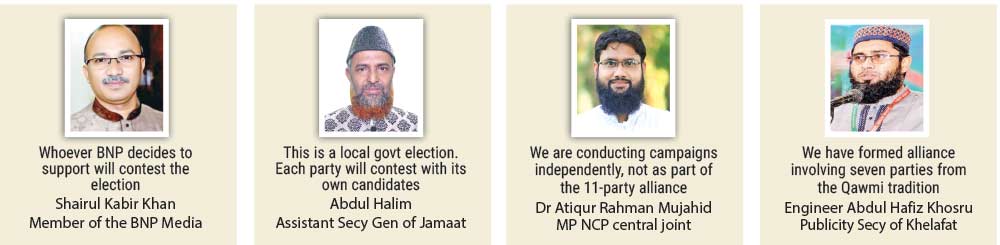
“We are moving forward in our own way. Whoever we decide to support will contest the election. The Union Parishad elections will be held first, followed by the city corporation elections,” Shairul Kabir Khan, a member of the BNP Media Cell, told The Daily Observer.
The strategy suggests that the BNP intends to preserve its local influence by backing candidates it considers suitable, despite the absence of official party symbols.
Jamaat-e-Islami, however, appears inclined to pursue its own candidates rather than automatically extend national-level alliances to local contests.
“We formed an alliance for the national election. But this is a local government election. Each party will contest with its own candidates. We will work to secure support for our candidates and are making every possible effort in that regard,” Mawlana Abdul Halim, assistant secretary-general of Jamaat-e-Islami, told The Daily Observer.
Dr Atiqur Rahman Mujahid, central joint convener of the National Citizen Party (NCP) and a member of parliament, said, “We are campaigning for our candidates in the local elections. We are conducting these campaigns independently, not as part of the 11-party alliance. Each party is campaigning separately. However, we have no objection if anyone chooses to work through mutual understanding or an agreement.”
Khelafat Majlish, meanwhile, has moved away from the broader 11-party alliance and joined a new grouping of seven Qawmi-oriented parties.
“We left the 11-party alliance a long time ago. We have now formed an alliance involving seven parties from the Qawmi tradition,” said Engineer Abdul Hafiz Khosru, the party’s central publicity and information secretary.
The National Citizen Party (NCP) is also preparing for local elections, but its media representatives did not respond to calls seeking comment.
Seven-party platform takes shape
The proposed Islamic alliance came into focus at an October 22 meeting at Al-Jamiatul Islamia Makhzanul Ulum Madrasa in Dhaka’s Khilgaon, attended by leaders of Hefazat-e-Islam Bangladesh.
According to participants, Hefazat is acting as a senior guiding body and facilitator rather than directly leading the political parties.
The seven parties are Islami Andolan Bangladesh, Jamiat Ulema-e-Islam Bangladesh, Khelafat Majlish, Bangladesh Khelafat Majlish, Bangladesh Khelafat Andolan, Islami Oikya Jote and Bangladesh Nezam-e-Islam Party.
The parties are discussing cooperation while retaining their separate identities, with joint participation in local government elections among the key issues under consideration.
However, candidate selection, constituency-level arrangements and the division of electoral contests remain unsettled. Further discussions are expected, with the next meeting scheduled for December 5, according to information provided by the parties.
The initiative carries wider political significance, as some participating parties have previously been associated with broader alliances led by the BNP or Jamaat. Their move towards a separate platform could trigger fresh calculations over political partnerships, organisational priorities and local electoral interests.
The key question is whether the seven-party grouping will remain a forum for common political and religious positions or evolve into a functioning electoral alliance. Coordinating candidates, assessing local popularity and maintaining unity will test the parties' ability to turn shared interests into practical cooperation.
For the BNP and Jamaat, the challenge is to prevent internal divisions and build consensus around preferred candidates. For the seven Islamic parties, it is to convert emerging cooperation into an effective electoral strategy without sacrificing their individual identities.
As Bangladesh moves towards local elections without party symbols, two parallel trends are emerging: major parties are seeking to consolidate support behind selected candidates, while smaller Islamic parties are exploring collective strength.
Whether these calculations produce durable electoral alliances will depend on candidate choices, constituency-level negotiations and the ability to mobilise voters on the ground.

Loading...
Loading...
Also read



Editor : Iqbal Sobhan Chowdhury
Published by the Editor on behalf of the Observer Ltd. from Globe Printers, 24/A, New Eskaton Road, Ramna, Dhaka.
Editorial, News and Commercial Offices : Aziz Bhaban (2nd floor), 93, Motijheel C/A, Dhaka-1000.
Phone: PABX- 41053001-06; Advertisement: 41053012; 01793317829, 01550707291, E-mail: [email protected], [email protected] Online: email: [email protected] 41053014; 01550707297 Advertisement: 01550707296


