



| HEADLINE |

|

Fish shortage in Chalan Beel threatens dried fish industry
Published : Thursday, 5 November, 2026 at 12:00 AM
Ashok Benarjee


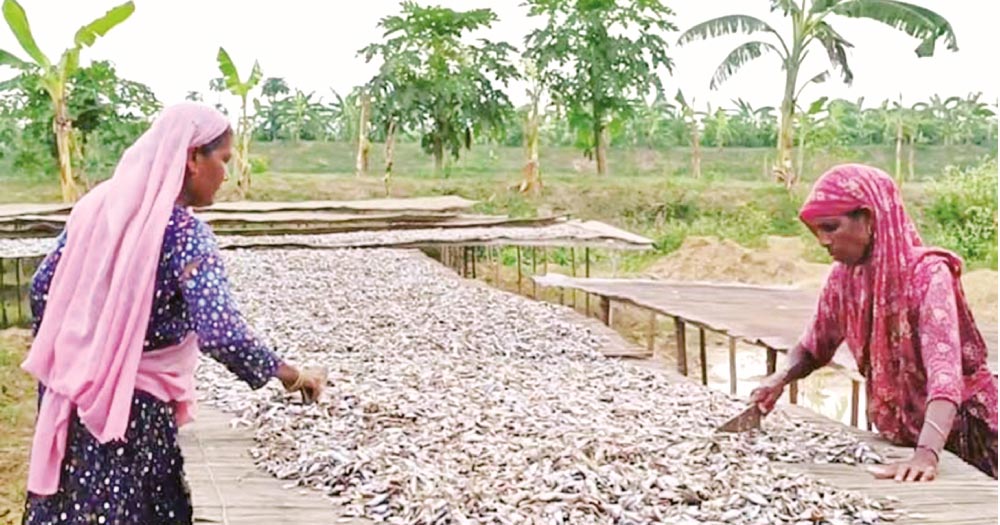 SIRAJGANJ, Nov 4: A shortage of local fish in Chalan Beel has hit the traditional dried fish industry in Sirajganj, reducing production and forcing many drying yards to shut down. The decline is affecting kiln owners, traders, fishermen and hundreds of workers who depend on the seasonal business for their livelihoods.
Dried fish produced from freshwater species in the Chalan Beel areas of Tarash, Ullapara and Shahjadpur upazilas has long been popular across the country and has demand abroad. However, the once-busy drying yards, where fish were spread across bamboo platforms, are now seeing less activity as supplies of raw fish dwindle.
According to the district fisheries office, Ullapara and Tarash produced 5,230.73 tonnes of fish in the 2024-25 fiscal year. In 2023-24, 60 dried fish yards in the two upazilas produced 302 tonnes of dried fish, worth around Tk 8 crore. Production fell to 185.17 tonnes in 2024-25, a decline of 38.7 per cent in a year.
The production season usually runs from late September to February. Small indigenous fish, including punti, kholse, chela, tengra, batashi, boal, shol, nala and taki, are dried during this period.
But this season, the supply of fish from the beel has fallen further, raising concerns among those involved in the industry. Local people say nearly 50 per cent of the drying yards have stopped production because of the shortage.
Abdul Alim, a drying yard owner, said the current period was supposed to be the peak season, but he was struggling to collect enough fish from Chalan Beel. He now has to buy raw fish from other areas, raising production costs and reducing profits.
"Last year, I produced around 35 tonnes of dried fish at my yard. Given the current supply, I doubt whether I will be able to produce even 10 to 15 tonnes this year," he said.
Abdus Sobahan of Udunia in Ullapara said Chalan Beel's dried fish had a strong reputation across the country and abroad, but declining production was making the market increasingly dependent on imports.
He said the area lacked large modern processing facilities and scientific storage systems. Government support for modern technology, improved preservation facilities and loans on easy terms could help increase production and exports, he added.
The shortage has also affected workers, particularly women who depend on seasonal employment at the drying yards.
Worker Shilpi Begum said hundreds of women used to earn money at the yards during the season to support their families. But with production declining, many are now struggling to find work.
Abdus Salam, a dried fish trader from Mannannagar in Tarash, said around half of the yards had stopped operating due to the lack of raw fish. Even those still in operation could not collect enough supplies to maintain production.
Prices vary according to fish species, size and quality. Small dried fish currently sell for Tk 15,000-25,000 per maund, while larger varieties fetch Tk 22,000-36,000. Despite the high prices, traders say rising collection and transportation costs, along with lower production, are limiting their profits.
Locals and environmental observers blame the decline in fish stocks on the shrinking of natural water bodies, unplanned roads and embankments, destructive fishing practices and damage to breeding grounds. Areas that once remained underwater throughout the year now retain water only during the monsoon, they said.
Haji Abdus Sattar, Director of the Sirajganj Chamber of Commerce and Industry, said the dried fish sector had significant economic potential but continued to rely on traditional production methods.
He called for modern processing and storage facilities in suitable locations in Sirajganj, as well as easy-term loans for traders. Such measures could help meet domestic demand, expand exports and create employment, he said.
Dr Md Abdus Sattar, Principal of Ullapara Science College, said protecting indigenous fish breeding grounds and habitats was essential for the industry's survival. He also called for improved drying technology, hygienic processing centres, quality control and storage facilities.
District Fisheries Officer Mahbubur Rahman said the department was providing regular training to drying yard owners to improve product quality and preserve indigenous fish species.
He said measures were also being taken to prevent the use of illegal current nets and duari nets, protect fish fry and conserve breeding grounds.

Loading...
Loading...
Also read



Editor : Iqbal Sobhan Chowdhury
Published by the Editor on behalf of the Observer Ltd. from Globe Printers, 24/A, New Eskaton Road, Ramna, Dhaka.
Editorial, News and Commercial Offices : Aziz Bhaban (2nd floor), 93, Motijheel C/A, Dhaka-1000.
Phone: PABX- 41053001-06; Advertisement: 41053012; 01793317829, 01550707291, 01550707296
E-mail: [email protected], [email protected]. [email protected], [email protected], [email protected], [email protected], Online-email: [email protected]


