



| HEADLINE |

|

RMG situation returns to normal
Published : Friday, 6 November, 2026 at 12:00 AM
Business Correspondent


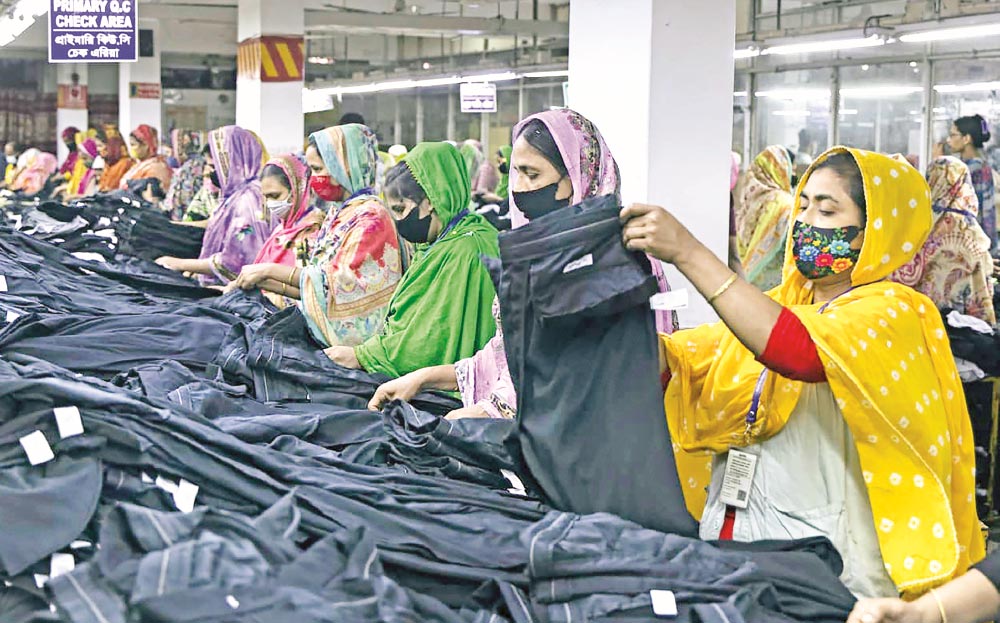 The garment industrial belt in Gazipur, Savar, Ashulia and Narayanganj is gradually returning to normal after several days of labour unrest over wage increases, with most factories reopening and workers resuming production on Thursday.
Law enforcement agencies remain on alert at key industrial locations and along major highways to prevent further violence. Traffic movement on the Dhaka-Tangail and Dhaka-Narayanganj roads has also returned to normal.
Meanwhile, the Minimum Wage Board will hold its second meeting on November 9 to formulate recommendations for revising the minimum wages of workers and employees engaged in the country's readymade garment (RMG) industry.
According to the notice, the meeting will take place at 11:00am on November 9 at the board's meeting room in Segunbagicha, Dhaka. The meeting will be chaired by the board's chairman, Syed Azad Subhani, a District and Sessions Judge.
The agenda includes two key issues. First, representatives of the workers and employers will separately submit their written proposals on the proposed wage rates. Second, the board will discuss the proposed minimum wage rates for workers and employees across all grades in the garment industry.
According to local sources, garment workers have been staging demonstrations for several days, demanding that the minimum monthly wage be raised to Tk 30,000. As part of their protests, they blocked the Dhaka-Tangail highway, disrupting traffic.
During the demonstrations, incidents of arson, vandalism and violence were reported at several locations, including attacks on vehicles, markets and police boxes. In view of the situation, a number of factories remained closed for security reasons.
However, as the situation improved on Thursday morning, most factories reopened. Workers were seen entering their respective workplaces in groups to resume production activities.
Several workers said they had been unable to attend work over the past few days due to the unrest. They said they had to return home whenever they saw demonstrations near their factories.
"As the situation has remained peaceful since Thursday morning, we have returned to our workplaces," they said, expressing hope that factories would continue operating in a peaceful environment and workers' legitimate wage demands would be addressed.
Gazipur Industrial Police Superintendent Mohammad Amzad Hossain said no incident of disorder had been reported anywhere in the industrial area since Thursday morning.
"Nearly 99.99 per cent of garment factories in the district are operational. Instructions are being given to the concerned authorities to reopen the remaining factories and maintain normal production activities. The overall situation is normal," he said.
Meanwhile, a total of 25 platoons of security personnel have been deployed to ensure security across the industrial belt. Of them, 12 platoons belong to Border Guard Bangladesh (BGB), eight to the Special Reserve Battalion (SRB) and five to Ansar.
A total of 25 executive magistrates are also performing duties to oversee security operations. Patrols have been strengthened at key locations across the industrial areas and along the highway.
The situation has also improved in the Savar and Ashulia industrial belts, where workers returned to their workplaces and production resumed at most factories on Thursday morning. However, some factories remained closed.
According to Industrial Police data, of the 1,863 factories under the jurisdiction of Industrial Police-1, production was continuing at 1,793 factories as of 11:00am on Thursday, while 70 factories remained temporarily closed.
Industrial Police-1 Superintendent Mohammad Mominul Islam Bhuiyan said the overall situation was normal and under control.
However, he said incidents of brickbatting and vandalism of a police vehicle had occurred in some areas following the closure of several factories. Law enforcement agencies were working to bring the situation under control.
Dhaka Additional Superintendent of Police Subhash Chandra Saha said workers had returned to their workplaces after being reassured by the government's initiative to increase wages. No major fresh labour unrest had been reported since the morning, he added.
The situation has also started improving in different garment industrial areas of Narayanganj, including Fatullah. Workers joined their workplaces at most factories on Thursday morning.
Workers were seen entering factories in Katharpul, Ramarbagh, Shibu Market and Nayamati areas of Fatullah. Traffic movement on the Dhaka-Narayanganj connecting road and other local roads was also normal.
Narayanganj Superintendent of Police Habibur Rahman said no labour unrest had been reported anywhere since Thursday morning. Law enforcement agencies remained alert to maintain normalcy.
Additional police personnel have been deployed at key industrial locations, while patrols by BGB and industrial police have been strengthened. Security has been reinforced in areas including Chashara, Katharpul, Shibu Market and Nayamati.
To address the labour unrest, the government formed a six-member Minimum Wage Board on November 1. The board held its first meeting on Wednesday.
Following the meeting, representatives of factory owners and workers said the new wage structure would come into effect from December 1. Workers are expected to receive their increased wages in January along with their December salaries.
ABM Shamsuddin, representative of the owners' side and a director of the Bangladesh Garment Manufacturers and Exporters Association (BGMEA), said both parties had held discussions in a cordial atmosphere.
He said they had agreed to complete the wage-setting process within December so that workers could receive their increased salaries in January.
Babul Akhter, representative of the workers' side, also confirmed the consensus on implementing the new wage structure from December. He said the workers' representatives would submit their proposed wage structure at the next board meeting.
Minimum Wage Board Chairman Syed Azad Subhani said discussions on the new wage would begin after receiving proposals from the owners' and workers' representatives, as well as the independent members of the board.

Loading...
Loading...
Also read



Editor : Iqbal Sobhan Chowdhury
Published by the Editor on behalf of the Observer Ltd. from Globe Printers, 24/A, New Eskaton Road, Ramna, Dhaka.
Editorial, News and Commercial Offices : Aziz Bhaban (2nd floor), 93, Motijheel C/A, Dhaka-1000.
Phone: PABX- 41053001-06; Advertisement: 41053012; 01793317829, 01550707291, 01550707296
E-mail: [email protected], [email protected]. [email protected], [email protected], [email protected], [email protected], Online-email: [email protected]


