



| HEADLINE |

|

Can Politics Recognise A Red Line?
Dangerous weaponisation of Bangladesh's economic lifeline
Published : Sunday, 8 November, 2026 at 12:00 AM
Faruk Ahmed


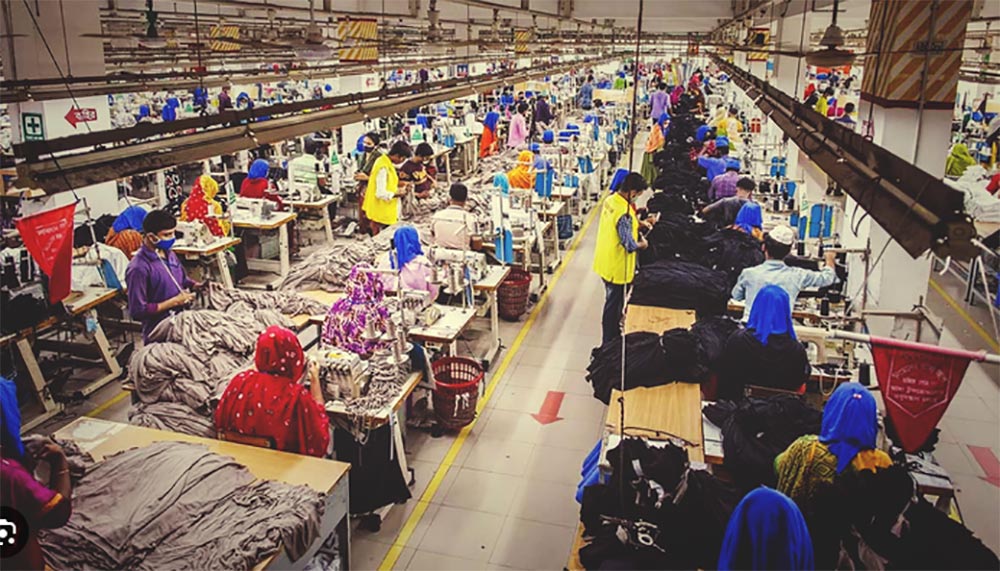 Entrepreneurs build factories, but political unity, policy continuity and a shared national vision build industrial nations. In mature economies, partisan warfare halts at the
factory gates.
Politicians understand that core sectors are the lifeblood of the nation and that using them as political leverage is equivalent to economic suicide. Governments may change, but the productive engines of the state must remain completely untouchable.
Bangladesh, however, stands on the precipice of a deeply unsettling reality, watching its ready-made garment sector-the absolute pillar of national survival-turn into a high-stakes political battlefield.
The shadows behind this industrial turmoil are darkening. Prime Minister Tarique Rahman has directly alleged that hostile elements operating from across the border are actively instigating garment workers, orchestrating industrial chaos to systematically destabilise the state and sabotage its economy.
This is not mere political rhetoric. The Detective Branch of the Dhaka Metropolitan Police has exposed a calculated network of subversion, revealing that influential actors, including former Awami League leaders and two former additional inspectors general of police, allegedly financed and incited violent disruptions under the guise of labour protests.
What began as a legitimate movement for workers' rights was hijacked and transformed into a cover for strategic violence and sabotage, as fully exposed during the investigation into the November 3 attack on a police officer in Mirpur.
As smoke rises from industrial hubs, a rare consensus is forming among social scientists, economists and lawmakers who see the catastrophic trajectory of this political game. Narayanganj-2 MP Nazrul Islam Azad, the lawmaker representing a constituency that contains a majority of the country's industries, including textile and garment factories, issued a fiery warning to those pulling the strings from the shadows, asserting that no conspiracy would succeed in hijacking the workers' demand for a Tk 30,000 minimum monthly wage for external political gain.
Standing amid the tension in Shibu Market and Katharpul, as protests blocked the critical Dhaka-Narayanganj Link Road, Azad reminded the nation that while the government and factory owners fully support the right to fair wages, a hidden hand is attempting to divert that movement towards national ruin.
The consequences of failing to protect this industry from partisan warfare are mathematical and absolute. The garment sector generates roughly 84 per cent of Bangladesh's total export earnings and accounts for over 10 per cent of its total GDP. If political sabotage succeeds in freezing this engine for just 90 days, the nation faces a total economic unwinding.
Economists warn that a three-month operational halt would instantly choke off the country's primary source of foreign exchange, draining the central bank's reserves, rendering the nation unable to import fuel or food, and sending the taka into a freefall fuelled by hyperinflation.
Beyond the spreadsheets lies a massive humanitarian disaster. A 90-day shutdown would directly threaten the livelihoods of over 4 million workers-mostly women-and leave more than 20 million dependent family members facing acute food insecurity and poverty, potentially sparking widespread unrest across Mirpur, Gazipur, Ashulia and Narayanganj.
The global fashion market will not wait for Bangladesh to resolve its political disputes. A single missed season could mean international brands permanently shifting multi-billion-dollar contracts to Vietnam, India and Cambodia, inflicting a wound that would take a decade to heal.
Simultaneously, the domestic banking sector, structurally tied to these factories through massive credit networks, would suffer widespread corporate defaults, locking up liquidity and paralysing the entire private economy.
A three-month freeze is not a temporary pause; it is a permanent dismantling of decades of poverty alleviation and industrial progress. As the government's newly formed wage commission moves to address the workers' real grievances, the country demands an immediate ceasefire from all political factions.
In a global landscape already fraught with climate threats and foreign wars, keeping politics out of the garment industry is no longer an option-it is the final line of defence for national sovereignty.

Loading...
Loading...
Also read



Editor : Iqbal Sobhan Chowdhury
Published by the Editor on behalf of the Observer Ltd. from Globe Printers, 24/A, New Eskaton Road, Ramna, Dhaka.
Editorial, News and Commercial Offices : Aziz Bhaban (2nd floor), 93, Motijheel C/A, Dhaka-1000.
Phone: PABX- 41053001-06; Advertisement: 41053012; 01793317829, 01550707291, 01550707296
E-mail: [email protected], [email protected]. [email protected], [email protected], [email protected], [email protected], Online-email: [email protected]


