



| HEADLINE |

|

Will WB’s $300m loan change BD’s pry edn?
At present, nearly half of 10-year-olds cannot read and understand a simple text
Published : Sunday, 8 November, 2026 at 12:00 AM
Tanvir Raihan


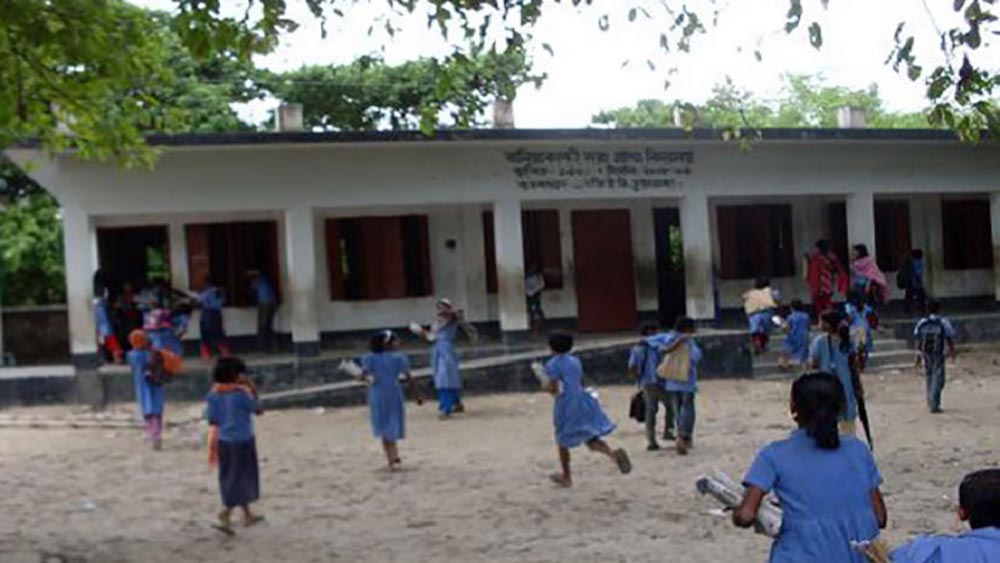 Despite billions of Taka in public investment and expanded school enrolment, nearly half of Bangladesh’s 10-year-olds cannot read and understand a simple text.
As The World Bank approves a $300 million loan for primary education, concerns persist over poor learning outcomes, classroom weaknesses, poverty and accountability in public spending.
According to studies, the country has expanded access to primary education. But school enrolment has not translated into effective learning for millions of children.
Nearly half of the country's 10-year-olds cannot read and understand a simple, age-appropriate text, exposing a persistent gap between classroom attendance and actual learning outcomes.
Despite years of investment in school infrastructure, teacher training and development programmes, many children still struggle with basic reading, writing and mathematics.
The situation raises questions about the effectiveness of public spending and the ability of successive education projects to improve learning standards.
Against this backdrop, The World Bank (WB) has approved a $300 million loan to improve learning outcomes for about 26 million children from pre-primary to Grade Five.
Equivalent to approximately Tk3,660 crore, the financing will support the government's Fifth Primary Education Development Programme (PEDP-5).
Approved on November 6, the programme, titled Learning Enhancement and Acceleration in Primary Education Program, aims to strengthen foundational literacy and numeracy.
According to WB data, around 50 per cent of 10-year-olds in Bangladesh cannot read and understand a simple text. The rate is 42 per cent in Malaysia and 47 per cent in Brazil.
A UNICEF-supported study conducted between 2023 and 2025 across 142 schools, involving more than 15,000 students and 800 teachers, found that 91 per cent of surveyed students entering Grade Six had not achieved expected Grade Five competency in mathematics. Another 65 per cent failed to meet the expected standard in Bangla.
Around 90 per cent of teachers said syllabus pressure prevented them from adequately supporting weaker students, while more than 60 per cent of headteachers reported that frequent curriculum changes disrupted classroom teaching.
At a policy dialogue in Dhaka on September 19, State Minister for Primary and Mass Education Bobby Hajjaj said education reforms should be assessed by improvements in students' learning rather than the completion of infrastructure projects. He stressed that constructing schools and ensuring effective classroom learning were fundamentally different tasks.
At the same discussion, Centre for Policy Dialogue (CPD) Distinguished Fellow Dr Debapriya Bhattacharya identified student failure, institutions with insufficient enrolment and the reluctance of talented young people to enter teaching as major challenges. CPD Executive Director Dr Nazneen Ahmed pointed to persistent disparities between children from wealthy and poor households.
Poverty further widens the learning gap. Educationist and former caretaker government adviser Rasheda K Chowdhury has warned that many children from marginalised communities, particularly urban poor households, remain outside formal and non-formal education.
A UNICEF-supported study found that around 64 per cent of students enrolled in catch-up education programmes dropped out, primarily because of poverty.
Manarat College Assistant Teacher Ruksana Khanum told the Daily Observer that primary education plays a vital role in shaping the future of the country's education system. She said meaningful and appropriate reforms would help establish a stronger foundation for future generations.
Speaking at a Campaign for Popular Education (CAMPE) dialogue in February 2026, Programme Manager Abdur Rauf said children in tea gardens, char areas, haors, hill tracts, ethnic minority communities and children with disabilities faced particular disadvantages. He called for stronger teacher capacity and education spending equivalent to 4-6 per cent of GDP.
A 2025 study by the BRAC Institute of Governance and Development, Primary School Governance in Bangladesh, identified irregular teacher attendance, misuse of stipends and development funds, weak supervision, inaccurate reporting and excessive dependence on private tuition as concerns affecting school governance.
The new World Bank programme will provide leadership training to 90 per cent of government primary school headteachers, introduce targeted learning packages and offer additional lessons to students falling behind. It will also prioritise districts with weaker learning outcomes and strengthen school management.
World Bank Bangladesh and Bhutan Country Director Jean Pesme said quality primary education was essential to developing a globally competitive workforce.
Senior Education Specialist Tashmina Rahman said a strong primary education foundation was crucial for acquiring skills needed for better employment. The bank also expects the programme to create opportunities for 843,000 new and relatively better-paid jobs.
The $300 million financing is an International Development Association (IDA) loan, with a 25-year repayment period and a five-year grace period.
With PEDP-5 involving more than Tk41,000 crore in planned expenditure, transparency and measurable results will be critical.
The government must demonstrate whether the investment improves teaching, helps weaker students catch up and enables children to read, write and perform basic mathematics by the end of primary school.
Without effective monitoring and stronger accountability, the latest financing risks adding to development spending without delivering the improvements children urgently need.

Loading...
Loading...
Also read



Editor : Iqbal Sobhan Chowdhury
Published by the Editor on behalf of the Observer Ltd. from Globe Printers, 24/A, New Eskaton Road, Ramna, Dhaka.
Editorial, News and Commercial Offices : Aziz Bhaban (2nd floor), 93, Motijheel C/A, Dhaka-1000.
Phone: PABX- 41053001-06; Advertisement: 41053012; 01793317829, 01550707291, 01550707296
E-mail: [email protected], [email protected]. [email protected], [email protected], [email protected], [email protected], Online-email: [email protected]


