



| HEADLINE |

|

Tk 92.60cr Fraud Losses Expose Banks' Cybersecurity Failure
Published : Wednesday, 18 November, 2026 at 12:00 AM
Faruk Ahmed


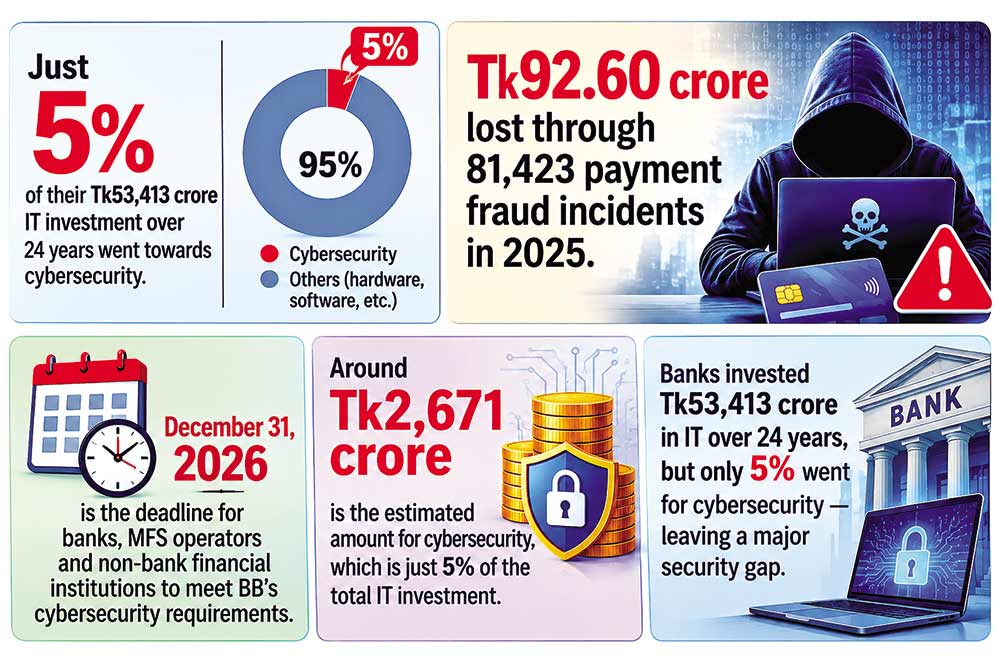 Commercial banks in Bangladesh are leaving customers exposed to digital fraud, having spent just 5 per cent of their Tk 53,413 crore IT investment on cybersecurity over 24 years, while fraudsters drained Tk 92.60 crore through 81,423 payment fraud incidents in 2025.
With most financial institutions struggling to meet Bangladesh Bank's mandatory cybersecurity requirements, the widening security gap threatens to turn the country's digital banking boom into a major financial vulnerability.
The December 31, 2026 deadline is fast approaching, but most commercial banks, mobile financial service (MFS) operators and non-bank financial institutions remain inadequately prepared, raising serious concerns about their ability to protect customers' deposits and sensitive financial information against increasingly sophisticated cyberattacks.
A senior Bangladesh Bank official acknowledged that commercial banks had yet to reach the expected level of cybersecurity preparedness. A cybersecurity drill conducted in late June identified vulnerabilities that could have posed serious risks to major banks and financial institutions, Bangladesh Bank Governor Md Mostaqur Rahman said on August 4.
"Only a few banks are ready to meet the central bank's requirements by December 31 next year, while most others remain vulnerable to cyberattacks because they have invested too little in protecting their funds," a senior banker told The Daily Observer.
The scale of underinvestment is particularly alarming. A study by the Bangladesh Institute of Bank Management (BIBM) found that banks invested Tk53,413 crore in information technology between 2000 and 2024, but only around 5 per cent went towards cybersecurity. The remaining 95 per cent was spent on hardware, software, networking, training, audits and other IT-related expenses. The study also revealed that Bangladesh's banking sector faces more than 400 cyberattacks on average every day, exposing the weakness of existing security arrangements despite substantial investment in digital infrastructure.
A survey of bank employees found that only 4 per cent demonstrated excellent cyber vigilance, while 28 per cent had critically low awareness of cybersecurity risks. The findings point to a serious shortage of institutional preparedness, both in technology and human resources.
Against this backdrop, Bangladesh Bank issued its Cybersecurity Framework, Version 1.0 (2026), through BRPD-2 Circular No. 02 on March 29, making full compliance mandatory by December 31, 2026.
The framework requires scheduled banks, finance companies, MFS providers, payment service providers and payment system operators to strengthen cybersecurity governance, risk management, data protection, network security, access controls, threat monitoring and incident management. It also requires stronger safeguards against third-party and outsourcing risks, alongside regular training and awareness programmes.
On the same day, the central bank issued its Guidelines on Partner Network, Version 1.0 (2026), requiring regulated institutions to establish secure digital connectivity, strengthen network segregation, restrict unauthorised access, conduct vulnerability assessments and ensure continuous monitoring. Compliance with these guidelines is also mandatory by December 31.
The growing threat is already reflected in Bangladesh Bank's latest Payment Systems Report 2025, which recorded 81,423 fraud cases across mobile financial services, cheque-based instruments and card transactions during the year, involving Tk926.01 million, equivalent to Tk92.60 crore.
Of the total amount, Tk827.21 million, or Tk82.72 crore, remained unrecovered, leaving the overall recovery rate at just 10.7 per cent.
MFS platforms accounted for the overwhelming share of the losses, with Tk81.33 crore stolen through fraudulent activities. The recovery rate in this segment was even lower, at just 8.7 per cent, as stolen money was rapidly withdrawn, dispersed or transferred through intermediary wallets before authorities could intervene.
The central bank's report identified impersonation, social engineering, compromised credentials and weaknesses in transaction monitoring as major challenges facing the payment ecosystem. It recommended real-time transaction monitoring, faster wallet-freezing mechanisms, stronger agent-level compliance and behavioural analytics to detect suspicious activities.
The report also highlighted the need for a centralised fraud registry covering all payment service providers and a real-time inter-operator wallet-freezing mechanism to prevent criminals from moving stolen money between platforms.
The problem extends beyond individual payment fraud. The Bangladesh Financial Intelligence Unit (BFIU) received a record 30,199 Suspicious Transaction Reports (STRs) and Suspicious Activity Reports (SARs) in FY2024-25, up 74 per cent from 17,345 in the previous fiscal year. Commercial banks accounted for nearly 95 per cent of the reports, reflecting intensified monitoring and reporting of suspicious financial activities involving online gambling, betting, foreign exchange, cryptocurrency trading and digital hundi networks.
The BFIU's annual report also pointed to the growing importance of technology in identifying suspicious transactions, as financial criminals increasingly exploit digital platforms and cross-border payment channels.
Meanwhile, the growing sophistication of cybercrime is forcing regulators to rethink conventional security arrangements. Fraudsters are increasingly exploiting artificial intelligence, identity theft, phishing, voice cloning and other digital tools to deceive customers and bypass existing authentication systems.
Recognising the emerging threat, Bangladesh Bank announced on November 1 that it was preparing an AI-based cybersecurity policy to help banks and financial institutions strengthen threat detection, upgrade IT infrastructure and respond to increasingly sophisticated cyberattacks.
The proposed policy is expected to provide additional guidance on adapting financial institutions' security arrangements to the risks arising from artificial intelligence and other emerging technologies.
Globally, financial institutions are also increasing investment in fraud detection and prevention, deploying behavioural biometrics, real-time transaction monitoring, stronger customer authentication and automated risk assessment to identify suspicious transactions before money is transferred.

Loading...
Loading...
Also read



Editor : Iqbal Sobhan Chowdhury
Published by the Editor on behalf of the Observer Ltd. from Globe Printers, 24/A, New Eskaton Road, Ramna, Dhaka.
Editorial, News and Commercial Offices : Aziz Bhaban (2nd floor), 93, Motijheel C/A, Dhaka-1000.
Phone: PABX- 41053001-06; Advertisement: 41053012; 01793317829, 01550707291, 01550707296
E-mail: [email protected], [email protected]. [email protected], [email protected], [email protected], [email protected], Online-email: [email protected]
Published by the Editor on behalf of the Observer Ltd. from Globe Printers, 24/A, New Eskaton Road, Ramna, Dhaka.
Editorial, News and Commercial Offices : Aziz Bhaban (2nd floor), 93, Motijheel C/A, Dhaka-1000.
Phone: PABX- 41053001-06; Advertisement: 41053012; 01793317829, 01550707291, 01550707296
E-mail: [email protected], [email protected]. [email protected], [email protected], [email protected], [email protected], Online-email: [email protected]


