



| HEADLINE |

|

What does 50% chance of rain actually mean on your iPhone?


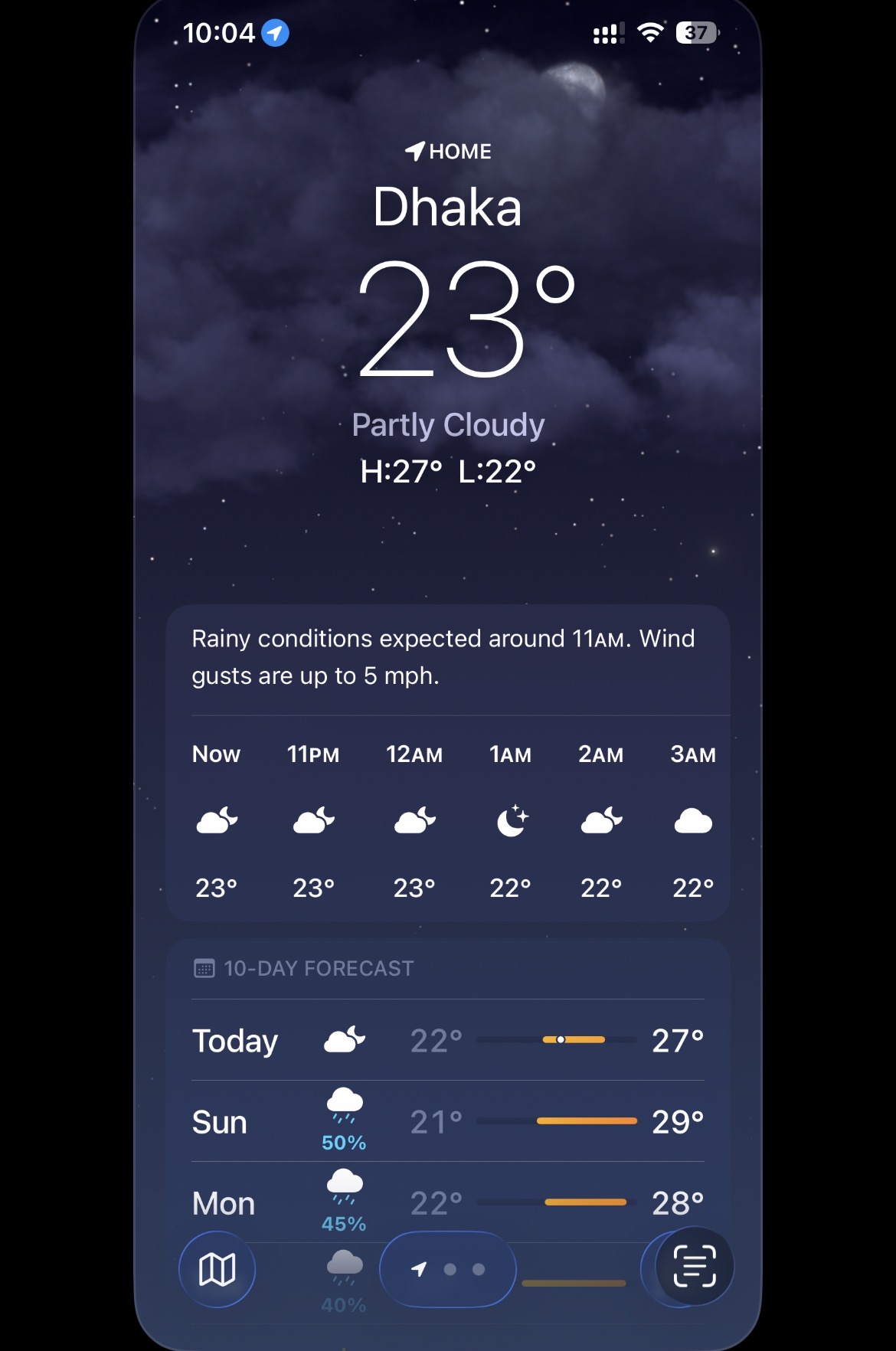
Before stepping outside, many smartphone users check the weather forecast to see whether they need an umbrella, a jacket or simply lighter clothing. For iPhone users, Apple Weather has become a convenient source of daily weather updates, displaying temperature, rain probability, humidity, wind speed and several other indicators.
But how accurately does the app reflect actual weather conditions? If Apple Weather shows 23°C in Dhaka, does that mean the temperature outside is exactly 23 degrees? And if it predicts an 86% chance of rain, does that mean rain will fall for 86% of the day?
These figures are often misunderstood. Understanding what they actually represent can help users make better decisions about their daily activities.
Does 23°C mean it is actually 23 degrees outside?
When Apple Weather displays a temperature of 23°C, it indicates the estimated or reported air temperature for the selected location. However, it does not necessarily mean that every neighbourhood in Dhaka is experiencing exactly the same temperature.
Temperature can vary across different parts of a city depending on building density, vegetation, nearby water bodies, surface materials and local weather conditions.
For example, temperatures in Rampura, Mirpur, Uttara and Motijheel may differ slightly at the same time.
There is also a difference between an observation from a weather station and a temperature estimate generated through weather models. Depending on the location and data availability, weather services may combine observations, forecasts and model-based estimates to provide current conditions.
Therefore, the 23°C reading should be understood as the temperature information for the selected location, not a guarantee that every part of Dhaka is experiencing precisely that temperature.
What does ‘Feels Like’ temperature mean?
One of the most useful features in Apple Weather is ‘Feels Like’.
It describes how warm or cold the weather may feel to the human body, rather than simply showing the measured or estimated air temperature.
For instance, the actual temperature might be 23°C while the Feels Like reading is 25°C.
This difference can be influenced by humidity, wind speed and other environmental conditions. High humidity can make warm weather feel more uncomfortable because sweat evaporates less efficiently. Meanwhile, stronger winds can make the body feel colder by increasing heat loss.
This is why checking the Feels Like reading can sometimes be more useful than looking at temperature alone.
Does an 50% chance of rain mean it will rain all day?
This is perhaps one of the most misunderstood figures in weather applications.
If Apple Weather displays an 50% chance of rain, it does not mean that it will rain for 86% of the day. Nor does it mean that rain will cover 50% of Dhaka.
Instead, the percentage represents the forecast probability of measurable precipitation at the specified location during the relevant forecast period.
The US National Weather Service defines Probability of Precipitation (PoP) as the likelihood of measurable precipitation occurring at a particular location during a specified period.
In simple terms, an 50% chance of rain indicates a high probability of measurable rainfall during that period, but it does not tell users how long the rain will last or how heavily it will fall.
Rain could last only a few minutes, continue for several hours or occur in multiple short spells.
To understand how much rain is expected, users should also check the precipitation amount and hourly forecast.
What does humidity of 80% mean?
Humidity is another frequently misunderstood weather indicator.
When Apple Weather displays 80% humidity, it does not mean that 80% of the air is water.
The figure generally represents relative humidity: the amount of water vapour in the air compared with the maximum amount the air can hold at the same temperature.
Higher humidity can make warm conditions feel more uncomfortable because sweat evaporates more slowly.
This is particularly relevant in Dhaka, where high humidity can make even moderately warm temperatures feel unpleasant.
Wind Speed and Wind Direction: Why should users check them?
Wind Speed indicates how quickly air is moving. It is commonly measured in kilometres per hour (km/h), miles per hour (mph) or metres per second (m/s).
Wind speed can influence how cold or warm the weather feels. Strong winds can also indicate potentially hazardous conditions, particularly during storms.
Wind Direction, meanwhile, shows the direction from which the wind is blowing.
Together, these indicators help users understand changes in atmospheric conditions and prepare for outdoor activities.
What does UV Index tell you?
The Ultraviolet (UV) Index measures the intensity of the sun’s ultraviolet radiation that can damage the skin and eyes.
It is not a measurement of temperature.
This means a day with a temperature of 23°C can still have a high UV Index. Similarly, a hot day does not automatically mean that ultraviolet radiation is at its highest level.
A higher UV Index indicates a greater need for sun protection, particularly for people spending extended periods outdoors.
What is Visibility?
Visibility indicates how far people can see clearly under prevailing atmospheric conditions.
Fog, rain, dust, smoke and other airborne particles can reduce visibility.
This information is particularly useful during winter mornings in Bangladesh, when fog can affect road conditions, or during heavy rainfall when visibility may drop significantly.
What does atmospheric pressure indicate?
Apple Weather also provides atmospheric pressure readings, generally measured in hectopascals (hPa) or millibars (mbar).
Atmospheric pressure refers to the force exerted by the weight of the air above a particular location.
Changes in pressure can help indicate shifts in weather conditions. Falling pressure is often associated with unsettled weather, clouds and possible rainfall, while rising pressure can be associated with more stable conditions.










Published by the Editor on behalf of the Observer Ltd. from Globe Printers, 24/A, New Eskaton Road, Ramna, Dhaka.
Editorial, News and Commercial Offices : Aziz Bhaban (2nd floor), 93, Motijheel C/A, Dhaka-1000.
Phone: PABX- 41053001-06; Advertisement: 41053012; 01793317829, 01550707291, 01550707296
E-mail: [email protected], [email protected]. [email protected], [email protected], [email protected], [email protected], Online-email: [email protected]


