



| HEADLINE |

|

Naogaon University aims to be a knowledge-based institution
Published : Wednesday, 25 November, 2026 at 12:00 AM
Professor Dr Moha. Hasanat Ali


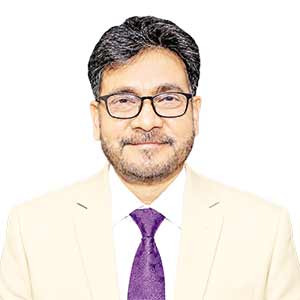 Establishing a new university is challenging, but transforming it into a centre of academic excellence, research and employment generation requires long-term planning, investment and commitment. Professor Dr Moha. Hasanat Ali, Vice-Chancellor of newly established Naogaon University (NaU), envisions the institution becoming a distinctive centre for higher education and research, with a particular focus on the agriculture, economy, environment and historical heritage of northern Bangladesh.
Established in 2023, Naogaon University currently offers academic programmes in Law and Accounting and Information Systems. It has received approval to introduce Computer Science and Engineering (CSE) and English from the 2026-27 academic session. Meanwhile, the university is preparing to develop its permanent campus on approximately 97 acres of land.
In an exclusive interview with Tanvir Raihan of The Daily Observer, the Vice-Chancellor discussed the university's five-year development plan, permanent campus, academic expansion, research initiatives, employment opportunities, international collaboration and student welfare. Selected excerpts follow:
VC: When I took charge, the university was operating with extremely limited facilities. We had an office of around 700 square feet, two computers, one printer and 12 staff members. There were no classrooms, students, library or permanent campus. That was the starting point of our journey.
Since then, we have launched academic activities in two departments and established modern classrooms, a computer laboratory, a library containing more than 2,000 books, a reading room and a digital library.
Free Wi-Fi is also available. Academic activities for the first batch of students are progressing, and we have conducted first-semester examinations in accordance with the academic calendar. A coding system has also been introduced to ensure greater transparency in evaluating examination scripts.
Over the next five years, our ambition is to transform Naogaon University into a fully developed, research-oriented and technology-driven institution. We want to produce graduates who possess not only academic knowledge but also professional skills, ethical values, creativity and leadership abilities.
DO: The development of a permanent campus is crucial for a new university. What progress has been made in this regard?
VC: Developing permanent infrastructure while maintaining academic activities is one of our biggest challenges. Government approval has been obtained for acquiring approximately 97 acres of land for the permanent campus, and the feasibility study for infrastructure development has been completed.
A project worth approximately Tk 12.69 billion, covering land acquisition and infrastructure development, has been included in the Annual Development Programme (ADP) for the 2026-27 fiscal year.

DO: Naogaon has considerable agricultural and economic potential. How will these local strengths influence your academic expansion?
VC: Naogaon is an important agricultural district, particularly known for rice, mangoes and food-grain production. Its agricultural economy, environmental characteristics and rural development offer significant opportunities for academic research and innovation.
We are considering introducing additional disciplines, including agriculture, food technology, environmental science, biological sciences, agribusiness and applied sciences.
DO: How do you plan to modernise the curriculum to make graduates more competitive in the changing job market?
VC: A university's responsibility extends far beyond awarding degrees. It must prepare students to face real-world challenges through critical thinking, analytical ability, problem-solving and practical knowledge.
We want to strengthen practical classes, research projects, presentations, technology-based learning and industry-oriented education alongside conventional classroom teaching.
For Law students, we plan to introduce moot court activities and legal research opportunities. Students of Accounting and Information Systems will receive exposure to modern accounting software, financial management systems and data analytics. We will also emphasise English communication, digital literacy, teamwork and entrepreneurship.
DO: What initiatives are being considered to establish a strong research culture and expand international academic collaboration?
VC: Research and knowledge creation are essential to establishing a university's identity. We want to develop a comprehensive research policy, provide research grants for teachers and students, establish modern laboratories and expand access to international journals and digital research resources.
Naogaon offers considerable opportunities for research on agricultural productivity, food preservation, agricultural marketing, climate change, environmental protection and rural economic development.
We also want to establish academic partnerships with foreign universities through joint research, faculty exchange, student exchange and collaborative academic programmes. Our aim is to create an environment where research becomes an integral part of university life.
DO: What role should the university play in creating employment opportunities and encouraging entrepreneurship among graduates?
VC: A university cannot guarantee employment for every graduate, but it can prepare students with the knowledge and skills required by the job market. We want to develop partnerships with government and private organisations, banks, technology companies and industries to facilitate internships and practical training.
We will particularly encourage entrepreneurship based on Naogaon's agricultural economy. Food processing, preservation, agricultural marketing and technology-based agricultural ventures offer significant opportunities.
DO: How will you ensure a politically neutral, safe and session-jam-free academic environment?
VC: A university should be a centre of free thinking, academic freedom, tolerance and democratic values. Administrative and academic decisions must be guided by laws, institutional policies and professional standards. We will not allow unethical influence or partisan dominance to undermine the academic environment.
Students must have the freedom to express their opinions while maintaining discipline and mutual respect. We also want to ensure timely examinations, transparent evaluation and strict adherence to the academic calendar.
Ensuring the safety of female students, preventing harassment and creating an inclusive, student-friendly environment will remain among our key priorities.
DO: Lastly, what is your long-term vision for establishing Naogaon University as a nationally and internationally recognised institution?
VC: I want Naogaon University to become more than a regional institution and earn recognition at both national and international levels. We have an opportunity to develop it as a specialised centre of knowledge and research focusing on agriculture, food grains, mangoes, the rural economy and the historical heritage of Naogaon and northern Bangladesh.
Following a decision of the university's Syndicate, an initiative has been taken to establish an International Language Centre, which is expected to offer courses in Japanese, Chinese and Korean. We also want to expand international research partnerships, faculty and student exchanges, and opportunities for publication in international academic journals.
Achieving this vision requires collective efforts. The government, local administration, industries, business community and expatriate Bangladeshis can contribute through scholarships, research funding, modern laboratories and library facilities.
Naogaon University is not merely an asset for one district; it is an asset for Bangladesh. Establishing a university through legislation is one thing, but transforming it into a centre of quality higher education requires visionary planning, research, commitment and sustained investment. We do not want to expand in haste. Our priority is to build a quality, sustainable and prestigious university that will contribute to national development for generations.

Loading...
Loading...
Also read



Editor : Iqbal Sobhan Chowdhury
Published by the Editor on behalf of the Observer Ltd. from Globe Printers, 24/A, New Eskaton Road, Ramna, Dhaka.
Editorial, News and Commercial Offices : Aziz Bhaban (2nd floor), 93, Motijheel C/A, Dhaka-1000.
Phone: PABX- 41053001-06; Advertisement: 41053012; 01793317829, 01550707291, 01550707296
E-mail: [email protected], [email protected]. [email protected], [email protected], [email protected], [email protected], Online-email: [email protected]


