



| HEADLINE |

|

Graduate unemployment continues to rise
The number of unemployed university graduates reached 885,000 in 2024, up from 405,000 in 2017. This represents an increase of approximately 119 per cent over eight years.
Published : Wednesday, 11 November, 2026 at 12:00 AM
Tanvir Raihan


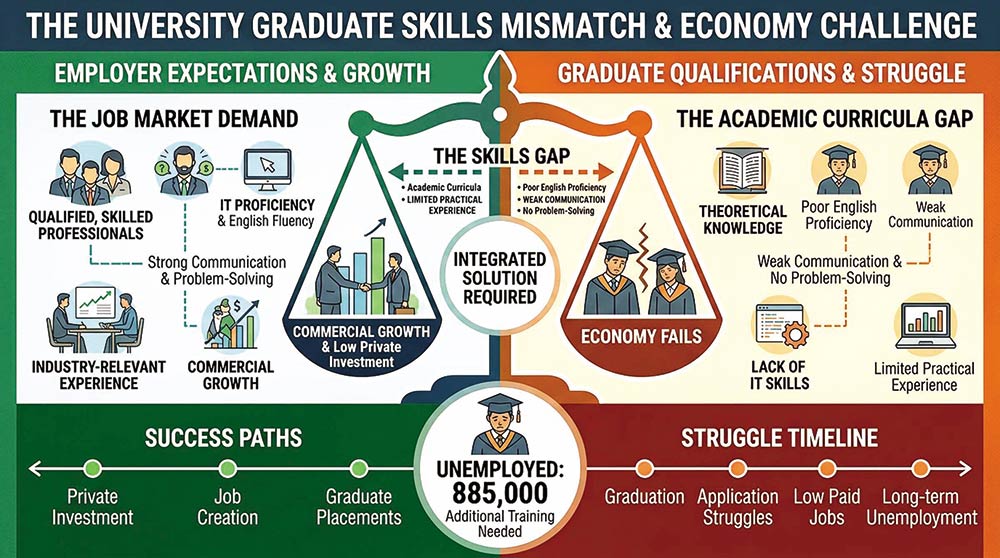 Hundreds of thousands of young people in Bangladesh are struggling to find jobs even after obtaining university degrees. Some spend years preparing for competitive government recruitment examinations, while others submit applications to private companies without receiving a positive response. Many are also compelled to accept low-paid or part-time jobs that do not match their academic qualifications.
At the same time, employers say there is a demand for skilled workers in various sectors. This apparent contradiction raises an important question: Is graduate unemployment the result of weaknesses in higher education, or does it primarily reflect the failure to create sufficient employment opportunities? Can university teachers, through research and analysis, identify the underlying causes of this crisis?
According to the Bangladesh Bureau of Statistics (BBS) Labour Force Survey 2024, the unemployment rate among people with university-level education stood at 13.54 per cent, compared with 13.11 per cent in 2023.
The number of unemployed university graduates reached 885,000 in 2024, up from 405,000 in 2017. This represents an increase of approximately 119 per cent over eight years.
According to BBS data, the unemployment rate among people without any formal education was 1.25 per cent during the same period. The significantly higher rate among university graduates has raised fresh questions about the effectiveness of the education system and its connection with the labour market.
One of the frequently discussed causes of graduate unemployment is the mismatch between university curricula and the skills required in the workplace. Many students acquire theoretical knowledge at undergraduate and postgraduate levels but have limited opportunities to develop practical experience, information technology skills, English proficiency, communication abilities, problem-solving capacity and teamwork.
A study presented by SM Zulfikar Ali, research director at the Bangladesh Institute of Development Studies (BIDS), examined the employment situation of graduates from colleges affiliated with the National University.
According to the study, published in December 2024, 28.24 per cent of National University graduates remained unemployed after completing their studies. The research collected opinions from 1,340 graduates, 670 students, 61 college principals and 100 employers across 61 colleges.
The study found that 90 per cent of employers considered information technology and English language skills important. Communication skills were identified as important by 78 per cent of employers, problem-solving abilities by 75 per cent and teamwork by 61 per cent.
The findings also highlighted limited opportunities for practical, technical and soft-skills development at colleges, alongside weak links between educational institutions and industries.
Professor M Nazrul Islam of the Department of Economics at the University of Dhaka has emphasised the need to increase the number of graduates in STEM subjects, science, technology, engineering and mathematics.
According to his comments published, the proportion of STEM graduates in Bangladesh's higher education system has increased relatively slowly. Between 2014-15 and 2023-24, the proportion rose from 11.20 per cent to 12.10 per cent. The rate of increase was comparatively higher in countries such as Vietnam, Thailand and India.
His analysis suggests that expanding STEM education is closely linked to economic productivity and competitiveness. However, increasing enrolment in science and technology subjects alone will not be sufficient unless students also receive opportunities to develop practical skills.
Meanwhile, the BIDS research presented by SM Zulfikar Ali highlighted the importance of recruiting qualified teachers, providing regular teacher training, improving laboratory and technological facilities, and aligning education with labour market requirements.
These findings indicate that educational institutions need to move beyond textbook-based learning and create opportunities for students to acquire skills relevant to real-world employment.
Another dimension of graduate unemployment is the gap between employers' expectations and the qualifications of job applicants.
In a report published, technology entrepreneur Tasfia Tasbin said that although her company receives hundreds of applications for individual positions, only 10 to 15 applicants perform well in problem-solving assessments. Ultimately, the company finds only five or six suitable candidates.
She recommended updating academic curricula, involving industry experts in education and expanding opportunities for long-term internships.
Abdul Muqtadir, president of the Bangladesh Association of Pharmaceutical Industries, also said that the supply of skilled graduates has not kept pace with the expansion of industries. As a result, companies often have to invest additional time and money in training newly recruited employees.
He emphasised the need to strengthen practical education and basic professional skills while expanding research activities at universities.
However, the responsibility for unemployment cannot be placed solely on universities or graduates. Even highly skilled young people may struggle to find jobs if the economy fails to generate enough quality employment opportunities.
The pace of industrialisation, private investment, development of new businesses, expansion of technology-based industries and geographical disparities in employment opportunities also influence the situation.
Toufiq-ul Islam Khan, additional research director at the Centre for Policy Dialogue (CPD) said that although the number of jobseekers is high, their skills often do not match employers' requirements. He emphasised the need to provide students with relevant knowledge and practical skills while they are still pursuing higher education.
Universities also need to develop their own employment databases to identify the causes of graduate unemployment. They should regularly publish information on how many students graduate from each department, how many secure jobs, how long it takes them to find employment and how many work outside their areas of academic specialisation.
Regular consultations with employers, department-based internships, career counselling and research-oriented curriculum reforms could also help bridge the gap between higher education and the labour market.
University teachers can play an important role in explaining the causes of graduate unemployment through research and analysis. However, addressing the problem requires coordinated efforts from the government, the University Grants Commission, educational institutions, employers and industrial entrepreneurs.
Unless Bangladesh focuses not only on increasing the number of degree holders but also on improving skills, productivity and the availability of quality jobs, reducing graduate unemployment will remain a major challenge.

Loading...
Loading...
Also read



Editor : Iqbal Sobhan Chowdhury
Published by the Editor on behalf of the Observer Ltd. from Globe Printers, 24/A, New Eskaton Road, Ramna, Dhaka.
Editorial, News and Commercial Offices : Aziz Bhaban (2nd floor), 93, Motijheel C/A, Dhaka-1000.
Phone: PABX- 41053001-06; Advertisement: 41053012; 01793317829, 01550707291, 01550707296
E-mail: [email protected], [email protected]. [email protected], [email protected], [email protected], [email protected], Online-email: [email protected]


