



| HEADLINE |

|

1.5m undergrad seats available for 0.65m students
Published : Wednesday, 11 November, 2026 at 12:00 AM
Staff Correspondent


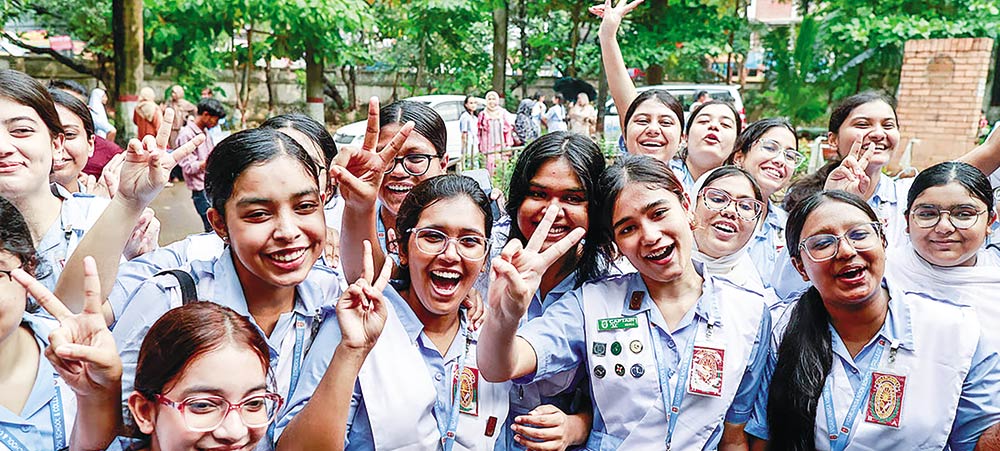 A total of 646,685 students have passed this year’s Higher Secondary Certificate (HSC) and equivalent examinations. Against this number, nearly 1.5 million undergraduate seats are available across public and private universities and their affiliated institutions. This means a substantial number of seats could remain vacant even if all successful candidates pursue higher education. However, despite the overall surplus of seats, competition for admission to preferred public universities, subjects and institutions is expected to remain intense. This is because public universities offer only 63,656 seats for direct admission to their main campuses.
According to updated information from the University Grants Commission (UGC, a total of 1,492,288 undergraduate seats are available for the 2026-27 academic session. Of these, 1,082,288 seats are in 61 public universities and their affiliated institutions, while 410,000 seats are available in 107 private universities.
Meanwhile, results of the HSC and equivalent examinations, published on October 31, showed an overall pass rate of 52.12 per cent across 11 education boards. Of the 1,240,798 candidates, 646,685 passed, while 40,084 secured GPA-5. The pass rate was 58.83 per cent last year, representing a decline of 6.71 percentage points in a year.
Although public universities and their affiliated institutions account for 1,082,288 undergraduate seats, only 63,656 are available for direct admission to the main campuses of public universities.
The University of Dhaka has 6,125 seats, Rajshahi University 3,956, Chittagong University 4,033, Jahangirnagar University 1,848 and Islamic University 2,515.
Seats are also limited in engineering institutions. Bangladesh University of Engineering and Technology (BUET) has 1,309 seats, Chittagong University of Engineering and Technology (CUET) 931, Rajshahi University of Engineering and Technology (RUET) 1,235, Khulna University of Engineering and Technology (KUET) 1,105 and Dhaka University of Engineering and Technology (DUET) 780. Bangladesh Agricultural University has 1,034 seats, while Sher-e-Bangla Agricultural University has 705.
Consequently, intense competition is expected for admission to public universities’ main campuses. Demand may particularly exceed available seats in popular disciplines such as science, engineering, medicine, business studies and social sciences.
According to UGC data, a large share of the seats under public universities and their affiliated institutions is in colleges affiliated with the National University. These colleges offer 946,095 undergraduate seats.
Bangladesh Open University has 42,434 seats, while madrasas affiliated with the Islamic Arabic University have 11,055. Dhaka Central University has 11,290 seats.
In addition, 107 private universities offer a combined 410,000 seats. However, whether students can secure admission to their preferred institutions or subjects will depend on their academic qualifications, admission test results, financial capacity and the respective institutions’ admission policies.
UGC data show that 37 government medical colleges offer 5,100 seats, while 72 private medical colleges have 6,001 seats. There are also 545 seats in nine government dental colleges, 1,490 in 28 private dental colleges and 375 at the Armed Forces Medical College.
Admission to these institutions is subject to separate eligibility requirements and admission procedures.
The Ministry of Education has said that sufficient seats are available in higher education compared with the number of students who passed this year.
Education and Primary and Mass Education Minister Dr A N M Ehsanul Haque Milon said that nearly 1.5 million seats were available in higher education, against around 650,000 successful HSC candidates.
Universities would admit students according to their own standards and policies. He said there would be no overall shortage of seats and that students would have opportunities to enrol in institutions and subjects based on their qualifications.

Loading...
Loading...
Also read



Editor : Iqbal Sobhan Chowdhury
Published by the Editor on behalf of the Observer Ltd. from Globe Printers, 24/A, New Eskaton Road, Ramna, Dhaka.
Editorial, News and Commercial Offices : Aziz Bhaban (2nd floor), 93, Motijheel C/A, Dhaka-1000.
Phone: PABX- 41053001-06; Advertisement: 41053012; 01793317829, 01550707291, 01550707296
E-mail: [email protected], [email protected]. [email protected], [email protected], [email protected], [email protected], Online-email: [email protected]


