



| HEADLINE |

|
Cover Story
Sharadindu Bandyopadhyay: A chronicler of Bengali detective genre
Published : Thursday, 30 March, 2017 at 12:00 AM
Krishti Aung Leona


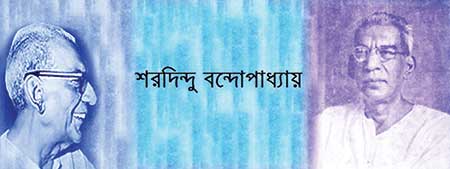 When the names like Byomkesh Bakshi and Baroda flock around our mind, it reminds us the creator of these characters that is Sharadindu Bandyopadhyay, considered as Arthur Canon Doyle of Bengal. Unique qualities of Sharadindu's novels are his vivid portrayal of detectives and contemporary life in West Bengal. One who has read his Byomkesh Bakshi series must have seen how finely he has knitted the character of Byomkesh and picture of China Town in Kolkata.
He was born on March 30, 1899 in West Bengal. He passed matriculation examination in the year 1915 and after that took admission in Vidyasagar College, Calcutta. While studying there, he published his first work, Jaubansmriti, a compilation of poems, at the age of 20. In the year 1919, he gained his degree in Bachelor of Arts. Later, he studied law in Patna.
Then, he decided not to follow traditional jobs and invested all his time in writing books and creating films. He was a Bengali literate who contributed mostly in the genre of detective stories of Bengali Literature. He enriched our Bengali literature with his thrilling detective and ghost-hunter series.
Byomkesh Bakshi series first appeared in 1932. Raktasandhya, one of his earliest stories, was published in Bengali in 1939. It was later included in The Scarlet Dusk (2003), a collection of his stories translated into English. He moved to Mumbai in 1938 to write screenplays for Bombay Talkies and other film banners. He gave up ties with the film industry in 1952 and moved to Pune to concentrate on writing. He wrote several ghost stories, historical romances and children's stories in Bengali over the next 18 years.
Byomkesh is an inseparable part of Bengali detective story. The witty and breathtaking plots of the stories attract the readers so much that it absorbs the readers mind and attach it with the book. In fictionalizing setting and background of the story Sharadindu is really an exception. Although the readers find less geographical diversity and frontal conflict in the story that doesn't bore them as the plot and dialogue are well written.
Most of the Byomkesh Bakshi stories are chronicled by Ajit, a writer who meets Byomkesh in Satyanweshi, considered as the first story in this series. The books are written in Bengali, with a mood of noir - fast, gripping, uncompromising in their portrayal of violence or lust, with touches of wry humour.
As for the childhood of Byomkesh, we find some information in the story- Adim Ripu. Byomkesh's father was a teacher of Mathematics and mother was from Boishyob clan. After the independence of India Byomkesh's family, along with Ajit, resided in Harrison road, Kolkata. In Satyanweshi, while talking about Byomkesh, Ajit describes, "He seems a very gentle man of twenty three or four, looking bright, good complexion, and in his face and eyes there is a mark of intelligence."
In the Bengali year 1331, Byomkesh Bakshi in the pseudonym of Atulchandra Mitra commenced to live in a mess in China Town, Kolkata. He went there as a non-government detective on the permission of police commissioner to unveil the cause of a serial murder. In the same mess lived Ajit Bandyopadhyay who ultimately becomes Byomkesh's companion to uncover all the mystery related to his detective tasks. Sharadindu presented Ajit as writer or the narrator of the stories of the Byomkesh Bakshi Series.
If we would like to compare Feluda with Byomkesh, the difference we will notice is that the former by Satyajit Roy is written for the youngsters and latter for the adults. The interesting part in Byomkesh is that Byomkesh never calls him detective, rather Satyanewashi-the seeker of truth. He is seen more concerned with solving the riddle instead of giving punishment, and sometimes, to his choice, he himself punishes the perpetrators. Most probably, Byomkesh is the only detective who is married and father of a son. It is also visibly significant in the stories that Byomkesh is also a victim of conjugal conflict in many respects.
The plots of Sharadindu's stories are very unique. It tempts the reader to go to climax and unveil the mystery at the end of the lates. To attach yourself with the mystery of Sharadindu and roam with Byomkesh, you must read his creations. To speak the truth, those who have already completed Sherlock Holmes and Feluda and yet to start Byomkesh, the taste of mystery you'll unfold again with new sense of thrill. No wonder why he is called the father of Sherlock Holmes in this side of the world!
Sharadindu penned almost 33 stories with the character of Byomkesh Bakshi with one additional story remaining incomplete at the time of his death. Among them the remarkable ones are Satyanweshi (The Inquisitor-1931), Pother Kanta (The Gramaphone Pin Mystery-1932 ), Seemant-heera (The Hidden Heirloom-1932 ), Makorshar Rosh (The Venom Of The Tarantula-1933), Arthamanartham(Where There's a Will-1933), Chorabali (Quicksand-1933), Agnibaan (Calamity Strikes-1935), Uposonghaar (An Encore for Byomkesh-1935), and Roktomukhi Neela (The Deadly Diamond-1936). His historical fictions include KalerMandira, Gour Mollar, Tumi SandhyarMegh, Tungabhadrar Teere, Chuya-Chandan, Maru O Sangha.
The best films made on Byomkesh Bakshi include Chiriyakhana (1967) starring Uttam Kumar, Doorben (2014) starring Soumitro Chatterjii. Recently more than 5 films have been created on Byomkesh, all of which stars actor Abir Chatterji. Two more films on the Byomkesh Bakshi series has been announced for this year. Meanwhile, Bollywood too has announced a series of film starring Sushant Singh Rajput to be made on Byomkesh Baskshi. The first one has been released in 2015.
The Bengali litterateur's unshaken glory, Sharadindu, remains unforgettable for his numerous contributions to literature, films and short stories. He will be eternally remembered for creating the characters Byomkesh Bakshi and Baroda. He has many feathers on his cap, including the Sarat Smriti Purashkar (Sarat Memorial Award- 1967) which was awarded by University of Calcutta and the Rabindra Purashkar of 1967 for his novel TungabhadrarTirey.
Lit Charts: Better version of Spark Notes
App Review
 It would not be wrong to call LitCharts an improved and upgraded version of the much popular literature website SparkNotes. That is also what their tagline says, �LitCharts - From the creators of SparkNotes, something better�.
 LitCharts is accessible on all devices. Though it is suggestedthat you download the app on your Android or iOS device as they have specially crafted apps which are absolutely free on mobile devices. You can also save a Pdf copy of your play, novel or fiction on your device and view it later. Viewing the contents from your laptop or PC might not be convenient as a few contents are not accessible through their website. Therefore, it is highly recommended that you download this app on your mobile device for accessing every content within the app. The app works offline so you have no worries of being outside a WiFi zone.
LitCharts is absolutely free, fast and organized for a quick study. The app has a whopping collection of over 300 literature texts with their summaries, side-by-side analysis, themes and quotes. LitCharts is your ultimate saviour for that quiz you have not prepared for! Adding to that, teachers will also find this app to be an excellent teaching aid, as vibrant and colourful charts can be printed for free from the app.
Loading...
Loading...



Editor : Iqbal Sobhan Chowdhury
Published by the Editor on behalf of the Observer Ltd. from Globe Printers, 24/A, New Eskaton Road, Ramna, Dhaka.
Editorial, News and Commercial Offices : Aziz Bhaban (2nd floor), 93, Motijheel C/A, Dhaka-1000.
Phone: PABX- 41053001-06; Advertisement: 41053012; 01793317829, 01550707291, E-mail: [email protected], [email protected] Online: email: [email protected] 41053014; 01550707297 Advertisement: 01550707296
Published by the Editor on behalf of the Observer Ltd. from Globe Printers, 24/A, New Eskaton Road, Ramna, Dhaka.
Editorial, News and Commercial Offices : Aziz Bhaban (2nd floor), 93, Motijheel C/A, Dhaka-1000.
Phone: PABX- 41053001-06; Advertisement: 41053012; 01793317829, 01550707291, E-mail: [email protected], [email protected] Online: email: [email protected] 41053014; 01550707297 Advertisement: 01550707296


