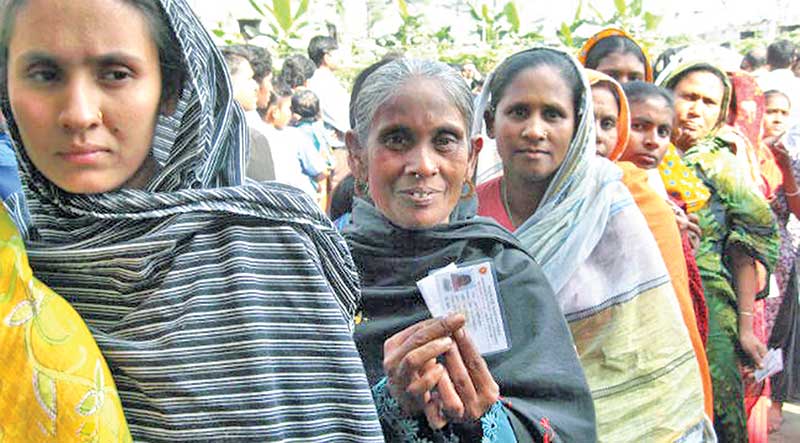
Liberal democratic model of governance -- as a theory and practice -- is being practiced in Bangladesh with a chequered record. The country's Constitution contains the two basic elements of liberal democracy couched through various Articles, such as individual liberty and equality. As liberalism is concerned with the protection of individual liberty, equality forms the basis of democracy. In democracy, political equality manifests through voting in free, fair and competitive elections. Holding elections often vitiated by occasional violence, repeated prolonged boycotts of the parliament by the opposition, 'winner takes all' mentality of the ruling party, the prevalence of Article-70 in the Bangladesh Constitution- all seem to have changed democracy in Bangladesh into 'illiberal democracy'. In recent times, the holding of the 5 January elections 2014 has shaken the above mentioned twin foundations of liberal democracy. At least half of the voters could not cast their votes in this election. The consequential governance emanating from this poses looming threats to the individual liberty. The adoption of National Broadcasting Policy passed by the Jatiya Sangsad (parliament) is a case in point. In Bangladesh, the sphere of liberty faces limits by the faith in religion Islam. The case of Latif Siddiqui's removal from the cabinet supports the point. On the other hand, unbridled economic liberty contradicts with the notion of political equality seen in Bangladesh as a section of the owners of the garments industry tends to discriminate the workers in the country by not giving their due wage. Against this backdrop, I have argued in this paper that never in history, liberalism and democracy has been able to correspond with each other resulting in a coherent political ideology and form of governance in Bangladesh.
Liberal democracy in Bangladesh: Search for its genesis
The history of liberal democracy in Bangladesh goes back to the British Colonial period. At that time, Bengal formed one of the important provinces of British-India. Liberal democracy in Bengal was the direct copy of Westminster democracy from England. Representative government, institutional form of liberal democratic government, had been gradually taking root in British India through India Acts 1861, 1892 and 1909. The then British Colonial government introduced some rudimentary form of parliamentary government in the Indian sub-continent through the Constitutional Reforms in 1919. It was enlarged and extended under the Government of India Act 1935, although it was not a full-fledged form of parliamentary government (Choudhury 1063:2). By this Act, introducing election as a method of selecting the members of the legislative assembly came into existence. The notion of political equality or the extension of voting rights gradually developed. Until 1919, only 3 per cent of the total population was having the voting rights while it went up to 14 per cent in the year 1935. The number of legislative assembly was even raised from 139 to 250 (Cited in Rashid 1993: 380).
Under 1935 Act, the elections were held in Bengal in 1937 and 1946. Following these two elections, representative governments were formed at the provincial level. Thus these elections showed glimmer of hope for the conjoined journey of liberalism and democracy. The Bengal Legislative Assembly played some proactive role against the unjust British colonial rule inflicted on the Bengalis. A K Fazlul Huq criticized the inaction of the British government in times of the famine in 1943. As a result, he was forced to resign. In order to abolish Zamindari system Fazlul Huq placed the Bengal Tenancy (Amendment) Act Bill in September (Islam 1993: 310-11). Although the Assembly served the interests of the British in most cases, it became the forerunner of parliamentary democracy in the British India. The procedures that the present parliamentary government follows inherited from the traditions of Bengal Legislative Assembly (Islam 1993: 316).
However, the partition that took place in 1947 divided the Indian subcontinent into two independent states: India and Pakistan. At the partition, while Indian political leaders like Nehru decided to have parliamentary democracy as its form of government, Pakistan continued to stick to 1935 Act under which Governor General exercised huge powers. Jinnah, Pakistan's Governor General, wrapped in a mantle of charisma was the only 'prop' to national solidarity. He was still the president of the M.L.- the party in power- and was subsequently made the President of the Constituent Assembly and also the Federal Legislature of Pakistan (Harun 2001: 13). The ethos of parliamentary government had not been carried over into Pakistan by charismatic Jinnah. Jinnah was more influenced by the urgency of national integration of Pakistan, even though he was a liberal democrat. His famous speech in the Constituent Assembly of Pakistan shows his identity as liberal democrat, 'we are all citizens and equal citizens of one state (loud applause). We should keep that in front of us as our ideal that in the course of time Hindus will cease to be Hindus and Muslims will cease to be Muslims, not in the religious sense but in the political sense as citizens of the nation' (Cited in Harun 2001: 25). But during his life time he himself deviated from his commitment when the question of Bangla to be the state language came into the forefront of political conflict between the (West) Pakistan ruling elite and East Bengal.
It appears from the above analysis that parliamentary government has been form of government imported from a foreign land which was imposed from the above in the Indian subcontinent where many of the conditions for the successful operations of parliamentary democracy were not ready (Choudhury 1963: 1). But, the political leadership made a difference in the practice of liberal democracy as Nehru and Jinnah's cases stated above prove the point.
Liberalism and democracy:
Liberalism is a philosophical doctrine that seeks to protect individual freedom. Here individual freedom in political sense is nothing but the absence of impediments deliberately placed by some people in the way of other people's efforts to pursue their chosen goals (cited in Cunningham 2002: 36; Berlin 1969 [1958]: 122). This is called negative liberty. As opposed to the above notion of liberty, positive liberty connotes the free individual as a 'doer' and as 'self-determining'. It purports to autonomist conception of freedom (cited in Cunningham 2002:36).
On the contrary, Sartori identifies democracy with equality. This equality includes political equality. In his view, political equality promotes social and economic equality. Political equality refers to the equal rights to vote, run for, or form political parties. However, liberalism dominated over democracy in the nineteenth century, but democracy has prevailed over in the twentieth century (See Cunningham 2002: 30). In the words of Sartori, liberal democracy may have two futures: one, a democracy within liberalism; two, a democracy without liberalism (Cited in Cunningham 2002:30).
Liberal democratic government rests on the idea of limited government, in other words, by having the constitution it puts limits to the excess committed by the incumbent government. Besides the constitution, parliament and political parties feeds liberal democratic values into the political system.
On the contrary, in the opinion of Mill, democracy strengthens civil liberties by conferring legitimacy on liberal laws. Likewise, liberalism strengthens democracy. Mill argues for the protection of civil liberties such as freedom of speech, expression and association. This is vital for the sake of vibrant democracy (See Cunningham 2002: 31).
Resolving majority-minority conflict underpins liberal democracy. Majority may stifle the voice of the minority. In this case, democracy requires the majorities be 'anonymous'. Minorities have to be protected from the majority domination require procedural fairness in dispute resolution and the participation in democratic governance. In addition, the future of liberal democracy depends on capitalist economic development. Individual's economic liberty is equally important for the capitalist development. However, unrestrained liberty of the capitalists is likely to undermine political freedom of the individuals.
In the name of formal political equality, liberal-democratic state masks economic inequality between two classes: haves and have- nots. It thus creates a class-based society within the structure of capitalist economy. In such a context, state is not a 'neutral' agent; it exists primarily and fundamentally to secure the interests of one class and repress another (Schwarzmanterl 1994: 103).
Sustained liberal democracy requires internalization of the correspondence of liberalism and democracy which is mediated by political leaders who act as agents in this process. In addition, the bourgeoisie class- whose power lies in controlling the mode of production- wants the state to act as the protector of individual liberty. Bourgeoisie views their interests predominantly hampered by the authoritarian character of the state. I argue that political leaders as agents may act independently without being influenced by the bourgeoisie as the social class dominating the capitalist mode of production. In democratic transition, political leaders take the responsibility of internalizing liberal democratic values and procedure. For example, parliamentary democracy in India had been institutionalized by the role of political leaders like Nehru. He was deeply respectful of liberal institutions and traditions, such as the prerogatives of parliament and the press (Zakaria 2003: 107). Be that as it may, deepening liberal democracy requires interactions between agents and structures. As stated before, Jinnah preferred to be the Governor General of Pakistan defying the norms of parliamentary government while Lord Mountbatten being the Constitutional head of India let the office of the Prime Minister grow in stature in Inida (Harun 2001: 15). As opposition leaders, Suhrawardy and Bangabandhu Sheikh Mujibur Rahman struggled for parliamentary democracy in the then Pakistan. Democracy until 1971 only remained as the basis of the movement for self-rule to the Bengalis. In post independence Bangladesh, despite the institutional infrastructure in paper, leadership was not serious enough to establish the linkages between liberalism and democracy. On the contrary, lack of the growth of independent national bourgeoisie left the stability of liberal democracy in limbo.
Liberal democracy cannot take root without the practice of freedom of expression. The extent of the practice of freedom of expression has long been a debate in Bangladesh. This debate seems often circumscribed by restrictions of Islam. It holds some inherent limits to the absolute exercise of the freedom of expression. Absolute freedom is necessary for creative development, but freedom of expression needed to make compromise with the community's beliefs in certain areas.
The Pakistan period (1947-1971): 'State against the Nation'
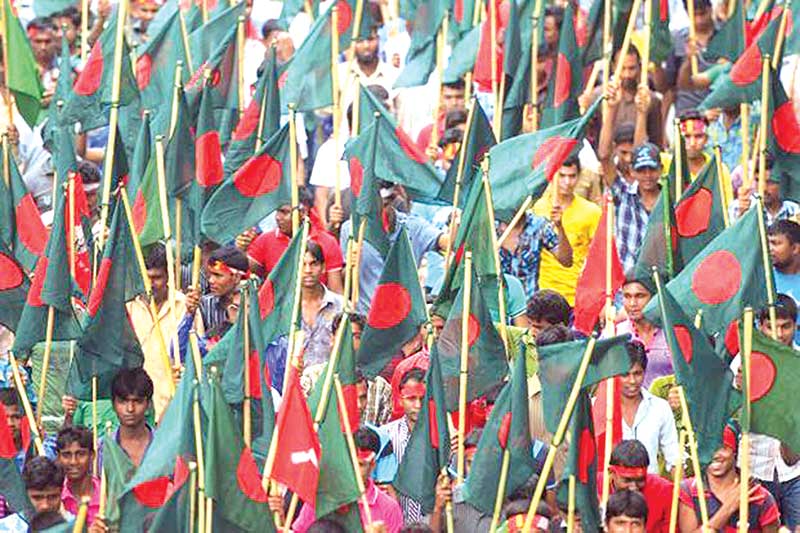
However, after the partition, the Muslim League that struggled for the independence of Pakistan could not live up to the expectations of representing the Bengalis' interests. In this context, the Bengali political leaders Maulana Bhashani, Sheikh Mujibur Rahman, AK Fazlul Huq and others founded East Pakistan Awami Muslim League on 23 June 1949 (Rahman 2012: 120-121). Thus EPAML became the first opposition party in the united Pakistan which primarily represented the majority Bengalis.
All Pakistan Awami Muslim League was later established with H.S. Suhrawardy as founder president (Harun 2001: 21). In 1955, the word 'Muslim' was dropped from the label of Awami Muslim League, allowing Awami League to be the inclusive party regardless of religious identity
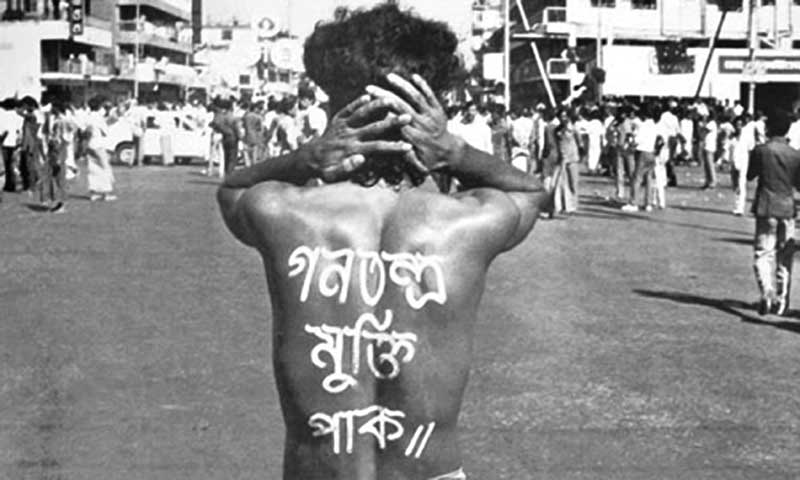
Inherent in the struggle of the Bengalis for liberation from (West) Pakistani rule can be explained as the struggle of the 'State against the Nation' (Kama! 2009). Since inception, the state had been administered by a coalition of the civil-military bureaucratic elites. Punjabi dominated civil-military bureaucratic elites from the beginning had been discriminating the Bengalis - who constituted the 56 percent of the total population- from their cultural and economic rights. The state went against the interests of the ordinary people in guaranteeing their rights to land, food and water. Aided by the civil bureaucracy, military dominated the politics of Pakistan beginning from the year 1958 to 1971 (till 16 December). In order to stymie politics, military rulers resorted policies like Elective Bodies (Disqualification) Order (EBDO), 1959, which disqualified politicians from politics. Under this order, leaders like Khan Abdul Ghaffar Khan and Maulana Bhashani had been automatically disqualified until December 31, 1966 from being a member or a candidate for membership of any elective body (Sayeed 1959: 402). Ayub Khan adopted 1962 Constitution which was only aimed to perpetuate his power. He introduced Basic Democracies which formed an electoral college entrusted with the responsibility to elect him as the President. The 1962 Constitution fused the powers of the executive and the legislature. Under this Constitution, the issue of Bengalis marginalization-both political and economic- remained unaddressed. Politically, by taking a position on parliamentary government, Bengali politicians made it 'an article of faith' (Chowdhury 1980: 339). Bengalis' calls for liberty and equality in political and economic spheres were included in 6-points announced in 1966.
In the economic sphere, Bengali's economic liberty was emasculated. Although the rise of capitalism in Bangladesh took place in the 1960s, in no way, it was the natural outcome of the development of private capital. To create the capitalist class was Ayub's political and administrative decision. To augment their interests this class became dependent upon political support and connections with bureaucracy. On the other hand, West Pakistan based industrialists or business groups in association with bureaucracy, military and the landlords -- during the Pakistan period -- drained resources from East Pakistan for the development of West Pakistan (Sobhan 2003: 67, 79 and 80). Just before independence, Bengali capitalist's share was 18 percent in the manufacturing sector, 18 percent in Bank capital, 10 percent in insurance business and 33 percent Bengali owners controlled jute trade (Sobhan 2003: 81).
Culturally the West Pakistanis were fearful of the domination of Hindu Culture over the Muslims of the East Bengal. The fear of Hindu domination encouraged the Pakistani rulers to ban Rabindra Sangit (Mamun 2007: 51).
Political marginalization of the Bengalis reached its apogee in 1970. Despite Awami League's winning the majority in the provincial and national assemblies, the Pakistani military junta did not transfer power to the majority party AL leader, Sheikh Mujibur Rahman. So the illiberal military elites of West Pakistan prevented Sheikh Mujibur Rahan from taking power, at the centre. On the other hand, in terms of the structural condition, Bengali bourgeoisie was unable to influence the political trajectory of (West) Pakistan as they had to rely on the state patronage for their survival.
The Bangladesh Period (1971-2014): Democracy without liberalism?
After independence, the adoption of 1972 Constitution declares Bangladesh is a liberal democracy as it incorporated articles on fundamental rights, right to universal franchise, etc. Democracy was enshrined in the Constitution as one of the state principles. Parliamentary government was installed and Sheikh Mujibur Rahman chose to become the Prime Minister although he was egged on to be the President. However, Bangabandhu made a bold decision in declining to be the President thus ensuring parliamentarism to flow in the right direction (Harun 2001:15). But the lifespan of parliamentary government was cut short when Sheikh Mujibur Rahman completely changed the system into a one party BAKSAL system, which has often been criticized as authoritarian governance. To give effect to these changes, he introduced a Constitution Amendment Bill called the Constitution (Fourth Amendment) Bill on 25 January 1975. The Bill was passed in the parliament without any discussion or debate. By this Amendment of the Constitution, the country entered into a new constitutional arrangement where none but only one party could exist with a President having supremacy over all executive, legislative and judicial organs of the state (Ahmed 1983: 278-9).
In June the government promulgated the Newspaper (Annulment of Declaration) Ordinance by which it allowed only 4 daily newspapers to continue publication and banned the rest. All these newspapers were to be owned and managed by the state bringing the news media completely under the control of the government (Ibid: 293). Mujib's renege on democracy may be pragmatically justified by political realism. He was perhaps influenced by the feuds within his party, bureaucracy, declining law and order situation and the abysmal level of corruption. So retreat from liberal democracy seems not to be Mujib's final seal on the faith in democracy. Instead it might have been his ad hoc response to the contextual challenges posed to his parliamentary governance.
After the killing of Mujib with his family members by a group of disgruntled army officers on 15 August 1975 followed by military interventions in the domestic politics of Bangladesh (1975-90) resulting in the decay of political institutions instead of institutionalization. By damaging political institutions, military rule has neither promoted liberalism nor helped establish institutions of democracy with genuine spirit. It is on record in the history when military came to power they have always dismissed western liberal democracy on the ground that it does not suit to the genius of the people. They, therefore, have harbored suspicion against politicians. Whenever the military seized power, they targeted civil politicians to expel from normal politics as we have witnessed it during the Ayub regime.
As opposed to the authoritarian state, civil society is a sphere, consists of organizations/institutions placed between the state and the private sector and family. A critical debate exists as to which organizations form the civil society in Bangladesh. For being mired in partisan politics, the role of civil society in Bangladesh to promote individual's liberty and equality has been called into question. Truly speaking, state's growing authoritarian character further relegates the role of civil society to the periphery. Nevertheless, civil society - though weak it is - has a dim voice, often going unheard of. Sujan- a civil society organization- has been persistently working for political corrections of the prevailing political process in Bangladesh. Similarly, TI(B) has been advocating for combating corruption taking place in different sectors of the country. It has been successful to sensitize the issue. However, it fails to challenge the structural causes of corruption. In case of state's capacity failure to deliver services to the needy, NGOs- known as civil society by donors complements state's role. Though civil society attempts to inculcate the value of self-management into the social psyche, it remains largely ineffective because of two visible lapses. One, civil society does not promote the local tradition of self-management; Second, state's aggressive intervention through the patron- client network reduces individual liberty to come to terms with the value of self management.
Electoral politics has been a site of contradiction in liberalism. Although elections have always been held in Bangladesh in festive mood with 'a long tradition of high political participation' (cited in Ali Riaz 2012: 20; Peter Bertocci 1982: 993), the flip side attests to the facts that violence, intimidation and vote buying often influenced the electoral culture in the country. More alarming sign is that after elections, minorities' lives and properties became targets by winning and losing parties in election. In 2001 elections, minority girls were even raped indiscriminately violating human rights.
The present 'one man, one vote' has been the hallmark of Bangladesh's election system. Though practiced in the country over the years, its recent turns towards the two-thirds has led to the rise of democratic authoritarianism tarnishing the image of Bangladesh as a democratic country. As a result, the weak parliament left unchecked by the absence of strong opposition. In 2001, 2008 and 2014 elections, the parties achieved two-third majority by which the ruling party became far more authoritarian. Since 1973, parliaments with a 'supermajority' held under civilian regimes have resorted to constitutional manipulation as the military did (Riaz 2015: 129).
Having a constitution by a country establishes the constitutional government, which forms the core of liberal democracy. Since inception, 16 amendments have been brought about in the constitution. Three factors undermine the role of constitution in strengthening liberal democracy in the country. First, some articles in the constitution are still hurdles remaining in the path of democratization in the country; second, politicians do lack moral commitment to uphold the constitution as a form of social contract; third; its amendment procedure has become more flexible by deleting the provision of referendum. Although the 1972 constitution was claimed to be democratic, certain intended lapses were deliberately kept in it. For example, the powers of the prime minister in 1972 remained in place like the powers of president.
With exceptions, these amendments to the Constitution seem to have contributed to developing Bangladesh as an overdevelop state. The 15lh and 16th amendments, to say the least, have made the state stronger than ever before. These amendments contradict with the concept of limited state. Over the years, the reproduction of the 'tyranny of the majority' has further compounded the growth of the overdeveloped state.
After independence, the Bengali bourgeoisie found their growth impeded by the policy of nationalization (Sobhan 2003:81). But this policy was later replaced by the policy of privatization since Bangladesh pursued capitalist development model during 1980s. Currently Bangladesh has become part of global capitalist development. Its scramble for market for labor, commodities and investment has become entangled with global capitalism. Naturally bourgeoisie will continue to insist on policy conducive to their economic liberty. But letting the bourgeoisie loose makes them crazy for profit. For example, like some other garments factory owners, owner of Tuba garments owner deprived the workers of wages. The struggle for wages of Tuba garments aptly demonstrates the case as explained above.
Significantly, bourgeoisie in Bangladesh never put emphasis on the establishment of good governance, because it was bomb in a chaotic social, economic and political environment. Primitive accumulation of capital and its growth was possible in such environment. In the absence of rule-based milieu, primitive bourgeoisie development was too quick through plunder and state patronage (Khan 2014: 191). For example, BEXIMCO - due to its connection with politics- gets the privileges of loan defaulting along with tax evasion and other beneficial benefits.
For insignificant progress in institutional differentiation, separation of powers between and among the legislature, executive and judiciary remains a pipe dream. As the executive dominance continues, the role of legislature becomes dormant. The 16th amendment to the constitution seems to threaten the independent functioning of the judiciary as it transfers the power of impeachment of the judges from the Supreme Judicial Council to the parliament.
Parliament is weak in terms of performance. It can neither check the government nor can protect the life, liberty and property of individuals. Article-70 of the Bangladesh Constitution makes the ruling party more powerful to control its MPs as it puts bar on the MP's floor-crossing.
After the 5 January elections in 2014, Jatiya Party (JP) joined the government with its role as the main opposition. As per Article-70, JP therefore will not be entitled to vote against the government's decision. Vote against the government will then be termed as constitutionally illegal.
JP's role in the parliament as the opposition has not been able to make significant dent on the performance of the government. It is simply following the footsteps as the ruling AL takes. In recent times, despite serving notice for discussion on National Broadcasting Policy in the parliament, finally JP changed its position, casting votes on exactly what the government wanted. As a matter of fact, JP's current position in the parliament has allowed the government to be authoritarian to the greater extent. Not only the JP's role in the parliament enfeebles its status, since 1991 both the mainstream parties (AL and BNP) as the main oppositions have had prolonged boycotts from the parliament making it dysfunctional, demonstrating their parochial attitudes towards the interests of the common people.
Political parties in Bangladesh are neither liberal nor democratic in Bangladesh. Leadership in political parties tends to be centralized and dynastic in all the political parties (Jahan 2015: 186). Jahan succinctly sums up the conditions of Bangladeshi political parties, 'Leadership at different strata is more likely to be selected rather than elected through secret ballot in party council meetings. Grassroots committees retain limited control over nomination of candidates. Ideological and policy issues are rarely debated within party fora. Key policy discussions are generally taken by the party chief. Sources of campaign and party funding remain non-transparent' (Jahan2015:104). Political parties have become dependent on a nouveau riche class (Ibid: 194).
The correspondence between liberalism and democracy has taken on a U-turn through the 5th January Elections 2014. At least half of the voters did not cast their votes in this election. Out of 300 MPs, 154 MPs have been elected without any sort of contest. This was largely orchestrated by the Awami League in association with Jatiya Party (JP). Thus the 5th January Elections has produced a parliament unrepresentative of the highest order. After election, JP became a managed opposition as well as a partner in the government. The largest virtual opposition Bangladesh Nationalist Party (BNP) did not participate in elections. Though the ruling AL claimed to hold the election a constitutional continuity, the BNP termed the election completely illegitimate both constitutionally and politically.
As many observers supported the elections on the ground of constitutional continuity, many of them even doubt of its constitutional validity as it is contrary to the Article-7 of the Bangladesh Constitution.
The main fault of the largest opposition BNP was, not to participate in elections on 5 January Elections 2014. As the largest opposition, staying outside the parliament has held back the progress of liberal democracy in the country. In the absence of check exercised by the opposition on the government makes the AL regime illiberal.
An effective local government with the devolution of power is one of the inevitable components of liberal democratic governance. Local government is thought to put limits on the excess of the powers wielded by the central government, thereby limiting the state powers. In Bangladesh, local government with the above-mentioned qualities has still remained a far cry. It has been lost in the lip services rendered by the parties in power. As a result, with some gloss of elections at the local level, bureaucratic control dominates the local government.
Liberal democracy denotes a form of 'disciplinary power' as Michel Foucault coined it while explaining the nature of capitalism in the West. He saw how the development of human sciences shaped the development of capitalism. Through this development, he identified the pattern of domination within capitalism. Force is not the means to this domination. It is the specific type of knowledge which resulted in a form of domination by which the individuals were made docile, subservient to capitalism. Similarly, liberal democracy meant a form of bourgeoisie power or domination which developed in the context of the West or Europe. Bourgeoisie had been successful to establish the liberal democracy as their preferred form of state. They had established the state which played a significant role in disciplining or normalizing the citizens in favour of the bourgeoisie interests. For example, the Bourgeoisie of England conceded to the workers' demands for welfare provisions. This is how sources of instability and tensions were removed from liberal democracy.
Bourgeoisie wants to bring all the strata of the population under one form of human governance. Founded on this human form of governance, all the institutions were developed with a view to safeguarding individual liberty.
Later on the introduction of universal franchise brought significant changes empowering the subaltern class in Europe and elsewhere. By dint of voting, they became stakeholders of state power. Their claim was on the basis of equality in power sharing. Individual's class and social identity became a matter of concern.
The institutional design of liberal democracy that developed in European context did not find its smooth inroad into the colonial societies. The Indian subcontinent is no exception to this case. There had been no bourgeoisie class since inception. In Bengal, only a handful of leaders with their background rooted in the Agrarian social structure came in contact with Western liberal democracies. In this case, Western education was instrumental in disciplining the leaders. We may cite the example of Suhrawardy here who received education from the Oxford University, though he came from a feudal family background. In all-India context, leaders like Nehru and Jinnah- however- were imbibed with liberal democratic values, though drifted apart after the 1947 partition. Jinnah seemed to have had influenced by the quest for national integration to be attained by exercising his authoritarian leadership. Nehru was rather more democratic in handling the internal crises of national integration. In Pakistan, therefore, the first generation leadership failed to create a second generation leaders committed to liberal democracy. Suhrawardy and Bangabandhu Sheikh Mujibur Rahman were the exceptions. The role of these two personalities held up the flicker of hope for liberal democracy in the then Pakistan. Since 1958, Pakistan had been under the prolonged military rule till the independence of Bangladesh in 1971. So disciplining and normalizing the political leadership in light of the ethos of liberal democracy was failing to take root. It is only the Bengalis struggle for self-rule under the leadership of Bangabandhu, the spirit of liberal democracy was kept alive.
During the Ayub regime, the miniscule Bengali Bourgeoisie had little or no role in fostering liberal democratic values. This pattern continues to dominate the political landscape of Bangladesh after the independence in 1971.
After 1971, Bangabandhu Sheikh Mujibur Rahman laid the institutional foundation of liberal democratic governance by including the parliamentary form of government in 1972 Bangladesh Constitution. Beginning with 1975 the country fell under the military rule lasting for 15-years. This huge wastage of time has been a notable jam to the growth of liberal democracy. Since 1991, although leaders have repeatedly committed to deepening liberal democracy, they have reneged on their commitments once they assumed the state power. As a spin-off, authoritarian and illiberal democracy has prevailed over the intentions of liberal democracy in Bangladesh. Since the beginning of electoral democracy, political leaders have become only largely familiar with its cultures and rules ignoring the substantial aspects of democracy. Therefore, political leaders in Bangladesh suffered inter-generational familiarity with the cultural traits of liberal democracy.
Just as in the past, so is at the present the growth of Bourgeoisie class is still tied to the state patronage. Moreover, bourgeoisie at present is extremely divided along the party- line. Naturally, their efforts for upholding liberal democratic values make no impact.
Religious values are often at odds with secular values in the public sphere which overshadows the prospects of liberal democracy. Like many other Muslim countries, Islamic creeds are kept blasphemous in Bangladesh. For example, the former Minister Latif Siddiqui was sacked from the ministry and party because of his remarks on the Muslim religious beliefs on Hajj. In 1994, Bangladeshi female writer Taslima Nasrin had to go on exile because her writings were blasphemous as she insulted Islam, the Quran and the Prophet (pbh) through her writings (Riaz 2009:1; Ansari 2009: 104-5).
In Foucault's words power has two dimensions: productive and repressive. Liberal democracy not only became an academic discourse in the region but it had offered the path of freedom to the oppressed people of South Asia by the colonial forces. As an academic discipline, the department of political science was introduced in the University of Dhaka in 1938 with a view producing a generation included with the knowledge of liberal democracy.
As I said, Awami League became the effective opposition in the then united Pakistan, it accepted liberal democracy as its political ideology. To show its liberal identity, in 1955, AL dropped the word 'Muslim' from the name of the party, making the party plural. In the united Pakistan, Bengalis, the majority of the population justified their struggle for self-rule based on liberal democracy. Parliamentary democracy therefore was one of the points of 6-points in 1966 autonomy movement. It was also one of the 11-points demands raised by the students in 1968. In 1970 elections, parliamentary democracy was included in AL's election manifesto.
The above review brings some points to the forefront. Bridging between liberalism and democracy has not been significantly visible throughout the history of Bangladesh. It appears that Bangladesh has only experienced electoral democracy which forms a partial view of liberal democracy. In the absence of bridging, political institutions in Bangladesh have not developed in light of liberal democratic values. The more the failure of bridging between liberalism and democracy shall continue, the less liberal democracy takes root.
Remarks:
It emerges from the above discussion that liberalism and democracy has never been able to establish sustained correspondence in Bangladesh. Liberalism therefore could hardly mingle with democracy. Political leadership appeared to have failed to inculcate the practice of liberal democracy amongst the successive generations of leaders that created the gap for inter-generational familiarity with liberal democracy. The prolonged military rule has exhausted time for taking root of liberal democracy. In addition, the absence of nationalist bourgeoisie adds further problems of mingling liberalism with democracy. The dismal scenario that stems from these limitations is that political institutions have become the breeding ground for authoritarianism in the guise of democracy.
In Bangladesh, the future of liberal democracy is linked with two more factors, such as the conflict between secular and Islamic values will continue to affect the values of liberal democracy; second; the growing surge for capitalist development will result in the disruption of man-nature nexus coupled with Bangladesh's ever-increasing need for integration into global capitalism for sustainable development. Consequently, in the future correspondence between liberalism and democracy even may be overlooked.
Dr Sabbir Ahmed is Associate Professor, Department of Political Science, University of Dhaka
Email: ahmed.sabbir24@yshoo.com
References:
Ahmed, Moudud (1983), The Era of Sheikh Mujibur Rahman, Dhaka: The University Press Limited.
Choudhury, G.W. (1963). 'Democracy on Trial in Pakistan', Middle East Journal, Vol. 17, No. 1/2 (Winter-Spring), pp. 1-13
Cunningham, Frank (2002), Theories of Democracy- A Critical Introduction, London and New York: Routledge
Chowdhury, Najma (1980),77/e Legislative Process in Bangladesh: Politics and Functioning of the East Bengal Legislative Assembly 1947-58, Dacca: The University of Dacca
Danaher, Geoff, Schirato, Tony & Webb, Jen (eds.), (2000), Understanding Foucault, London, California and India: Sage Publications
Dobb, Maurice (2007), Studies in the Development of Capitalism, London and Henley: Routledge & Kegan Paul (India reprint)
Harun, Shamsul Hilda (2001), The Making of the Prime Minister H.S.Suhrawardy in Anagram Polity 1947- 58, Dhaka: The Institute of Liberation Bangabandhu and Bangladesh Studies, National University
Jahan, Rounaq (2015), Political Parties in Bangladesh-Challenges of Democratization, Dhaka: Prothoma Prokashan
Islam, Nurul (2003), Making of a Nation-An Economist's Tale, Dhaka: The University Press Limited.
Islam, Syed Serajul (1993), Bongiya Ain Shabha o Shashantantrik Bikash (Bengal Legislative Assembly and Constitutional Development), pp.296-323, in Islam, Serajul (ed.), Banglaclesher Rajnaitik Itihas ('Political History of Bangladesh'), First Volume, Dhaka: Asiatic Society of Bangladesh
Jahan, Rounaq (2015), Political Parties in Bangladesh-Challenges of Democratization, Dhaka: Prothoma Prokashan,
Kamal, Ahmed (2009), State against the Nation-The Decline of the Muslim League in Pre- independent Bangladesh, Dhaka: The University Press Limited.
Khan, Bazlur Rahman (1987), Politics in Bengal 1927-1936, Dhaka: Asiatic Society of Bangladesh
Khan, Iqbal A. (2009), Free Speech-Hate Speech: The Taslima Nasrin Case, pp. 99-107, in Riaz, Ali (2009) (ed.), (Re) Reading Taslima Nasrin: Contexts, Contents and Constructions, Dhaka: Shrabon Prokashani
Khan, Bardrul Alam (2015), Songhatmoy Bangladesh: Otit Theke Bortoman, Dhaka: Prothoma Prokashan
Mamun, Muntassir (2007), Bangladesh: Bengali Psyche, Stateformation and Modernity (in Bangla), Calcutta: Krishti Rahman, Sheikh Mujibur Rahman (2012), Ausamapta Atmajiboni (Unfinished Memoirs), Dhaka: The University Press Limited
Rashid, Harun-or (1993), 'Bongiya Montrishabha, 1937-1947' ('Bengal Ministry, 1937-1947'), pp. 380-407, in Islam, Serajul (ed.), Bangladesher Rajnaitik Itihas ('Political History of Bangladesh'), First Volume, Dhaka: Asiatic Society of Bangladesh
Riaz, Ali (2015), How did we arrive here?, Dhaka: Prothoma Prokashan.
Riaz, Ali (2009) (ed.), (Re) Reading Taslima Nasrin: Contexts, Contents and Constructions, Dhaka: Shrabon Prokashani
(2012) Inconvenient Truths About Bangladeshi Politics, Dhaka: Prothoma Prokashan
Sayeed, Khalid Bin (1999). 'Collapse of Parliamentary Democracy in Pakistan', Middle East Journal, Vol. 13, No.4 (Autumn), pp.389-406.
Schwarzmantel, John (1994) 'The State in Contemporary Society- an introduction', New York, London, Toronto, Sydney, Tokyo and Singapore: Harvester and Wheatsheaf
Sobhan, Rehman (2003), Burjoa Rashtrabebosthar Samkat, Dhaka: Jatiya Sahitta Prokashan
Zakaria, Fareed (2003), The Future of Freedom-Illiberal Democracy at home and abroad. Penguin Books: New Delhi, New York.