When the International Criminal Tribunal for the Former Yugoslavia (ICTY) was established by the Security Council resolution pursuant to Article 41 of the United Charter, it was highly debated whether international criminal justice can be the means to achieve peace. This position was positively upheld by ICTY notably in Tadic� case and by the establishment of subsequent similar institutions. Even the Rome Statute of the International Criminal Court (Rome Statute) also recognizes peace as an aim of the enforcement of international justice (Preamble, para 3). Now, the international criminal courts and tribunals have been considered as an integral part of transitional justice. Since the establishment of Nuremberg Tribunal to International Criminal Court (ICC), several institutions had worked or have been working to establish global peace in their respective jurisdictions.
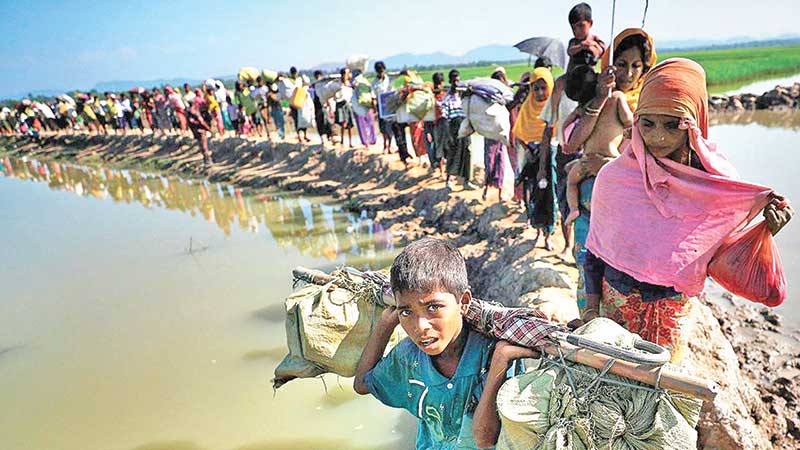
The commission of one or several categories of international crimes including genocide or crimes against humanity has been suspected of being committed against the Rohingyas. In the word of international criminal justice, there leaves little doubt about the existence of the threat to peace. The real challenge lies in establishing peace through international criminal law. There has been vibrant demand in different forums to refer the situation in ICC which appears to be the sole forum of justice. My position is that the Rohingya situation is not at the cul-de-sac rather at the crossroad of international criminal justice consisting of many possible directions to follow.
Para 61 of Arrest Warrant case (Democratic Republic of Congo V Belgium) of International Court of Justice (ICJ) has provided a draft sketch of the crossroad for the trial of any person accused of committing international crimes. These are (1) domestic criminal courts of the country where the crime is committed, (2) foreign courts and tribunals competent to exercise jurisdiction over international crimes and (3) international criminal justice institutions like ICC.
In fact, the international criminal justice system is in itself consists of several probable directions. The ICJ has mentioned ICTY and ICC as some of such institutions. As of 2018, there have been many hybrid and regional criminal justice institutions to add the list. Placing the Rohingya situation at the crossroad of justice, the following directions may be suggested to establish peace.
As of present, Myanmar has no legislation for the punishment of international crimes and therefore the crimes can only be tried as general crimes as defined in Penal Code (of Myanmar), 1860. These crimes can also be tried in foreign courts having jurisdictions over international crimes outside their territories popularly known as universal jurisdiction.
Trial International, a Swiss NGO, has reported that 126 persons are facing trials in 14 countries in 2017. One such case has already been filed in Australia against Aung San Suu Kyi. In the United States, Alien Tort Statute of 1789 once offered a viable option for the establishment of reparations for international crimes, especially following Fl�rtiga v. Pe�a-Irala. But Kiobel v. Royal Dutch Petroleum restricted the jurisdiction to the situations linked with the United States and we need to wait for further development.
Though ICC has ratio temporis over crimes committed after 2002, there have been institutions like the tribunal for the Central Africa Republic and Special Tribunal for Lebanon for the trial of post-2002 situations. This leaves an option to establish such specialized institutions. Following the instance of Extraordinary African Chamber, a regional arrangement can be made with ASEAN of which Myanmar is a member. To facilitate the future prosecutions with evidence, a General Assembly mandated body like Independent, Impartial and International Mechanisms on
Syria may be established.
It has been echoed from many quarters of the international community that ICC is the best forum for justice for Rohingya people. But, the jurisdictional issues of the ICC are very problematic. The jurisdiction of the ICC as established by Rome Statute is not automatic rather it is attributable to the States by its ratification (Article 12(1)), declaration of a non-party State (Article 12(3)) and referral by the Security Council (Article 13(b)).
Myanmar is neither a party nor has made any such declaration. Thus, there is no option for self-referral of the situation to the ICC. As the jurisdiction of the ICC is based on territoriality and nationality, no other State parties including Bangladesh can make a referral. Though Bangladesh is affected by the Rohingya situation, it cannot plead the jurisdiction based on 'effect doctrine' which is neither recognized in Article 12 and the travaux préparatoires of the Statute and nor in consonance with its object and purpose. Unlikely, the Prosecutor cannot exercise her jurisdiction propriomotu because Myanmar is not within the jurisdiction of the court (Article 15(1)). In this context, the only means to empower the ICC with Rohingya situation is the Security Council referral in accordance with Chapter VII of the UN Charter. Evidently, the possibility of admissibility of the Rohingya situation is more political than legal.
Apart from the individual criminal responsibilities, the determination of the state responsibilities of Myanmar for committing international crimes is another venture to ensure justice. Articles on Responsibilities of States for Internationally Wrongfully Acts (2001) enumerated restitution, compensation, and satisfaction as the forms of reparation for internationally wrongful acts which include international crimes attributable to states. Moreover, Article IX of the Genocide Convention has provided the possibility of resorting to the International Court of Justice for the determination of state responsibilities for genocides. But this option demands further examinations.
The importance of international criminal justice institutions in establishing peace cannot be overlooked. The trauma of Rohingyas for international crimes inflicted upon them can only be pacified by adequate and meaningful justice with its deterrent and protective effects. Without peace through justice, any kind of repatriation, if any, will also be counterproductive and suicidal. Thus, the international community should come forward with their political wills and legal solutions.
Quazi Omar Foysal is an LLM Candidate at the Geneva Academy of International Humanitarian Law and Human Rights, Geneva, Switzerland